

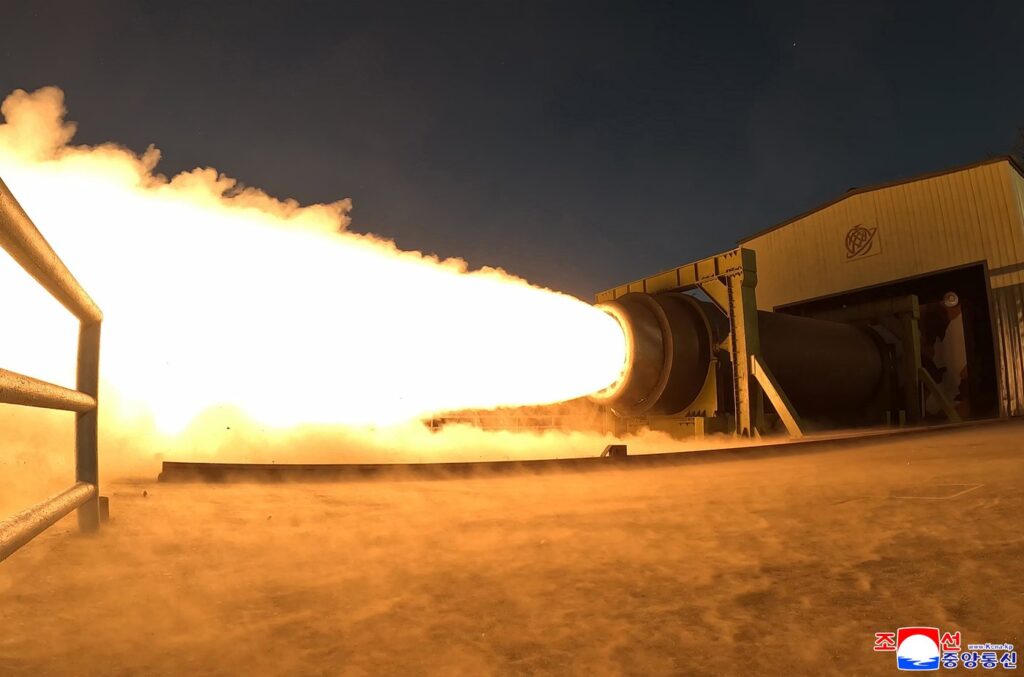
SEOUL, South Korea (AP) – North Korean leader Kim Jong Un has observed a significant test of a high-thrust solid-fuel engine for military purposes, which he praised as a developmental step aimed at enhancing the country's strategic military capabilities, according to state media reports from Sunday. This recent test signals Kim's ambitions to expand and modernize North Korea's arsenal of missiles that can potentially reach the U.S. mainland.
The Korean Central News Agency (KCNA) issued this report shortly after Kim delivered a speech at North Korea's Parliament, where he vowed to irrevocably solidify the nation’s status as a nuclear power. In his address, Kim leveled accusations against the United States, describing it as a perpetrator of global "state terrorism and aggression." This rhetoric appears to link to the ongoing conflict in the Middle East.
During the engine test, which involved a ground jet mechanism, Kim noted that the engine incorporated a newly upgraded design utilizing composite carbon fiber material. KCNA reported that the upgraded engine achieved a maximum thrust of 2,500 kilotons. This represents an increase from the approximately 1,971 kilotons reported in a similar solid-fuel engine test conducted in September. This push to enhance engine power is likely associated with efforts to develop missiles capable of deploying multiple warheads, thereby increasing the chances of overcoming U.S. defenses, according to veteran observers of military strategies.
The specific time and location of the test have not been disclosed by KCNA. However, this test is part of North Korea's broader five-year military escalation program. The objectives of this plan include upgrading "strategic strike means," which are generally interpreted as intercontinental ballistic missiles (ICBMs) armed with nuclear capabilities and aimed at the U.S. mainland.
In his statements regarding the engine test, Kim emphasized its "great significance" in elevating the nation's strategic military prowess to unparalleled heights. Over recent years, North Korea has been active in test-firing a variety of ICBMs that demonstrate a potential reach to the U.S. mainland. This includes missiles utilizing solid propellants, which provide the advantage of stealth by making detection prior to launch more difficult. In contrast, older liquid-fuel missiles require fueling before takeoff and have limitations in terms of operational readiness.
While some foreign experts maintain that North Korea still faces significant technological challenges in entering the realm of effective ICBM capabilities—such as ensuring that its warheads can successfully survive the rigors of atmospheric reentry—others contend that given the extensive time and resources the country has dedicated to its nuclear and missile programs, it may already be further advanced than initially assessed.
Since the collapse of high-stakes diplomatic negotiations with then-U.S. President Donald Trump in 2019, North Korea has intensified its efforts to expand its nuclear arsenal. In a Workers' Party congress held in February, Kim left open the possibility for dialogue with the U.S. leader but insisted that Washington should abandon its demands for North Korea’s nuclear disarmament as a precondition for continued discussions.








