

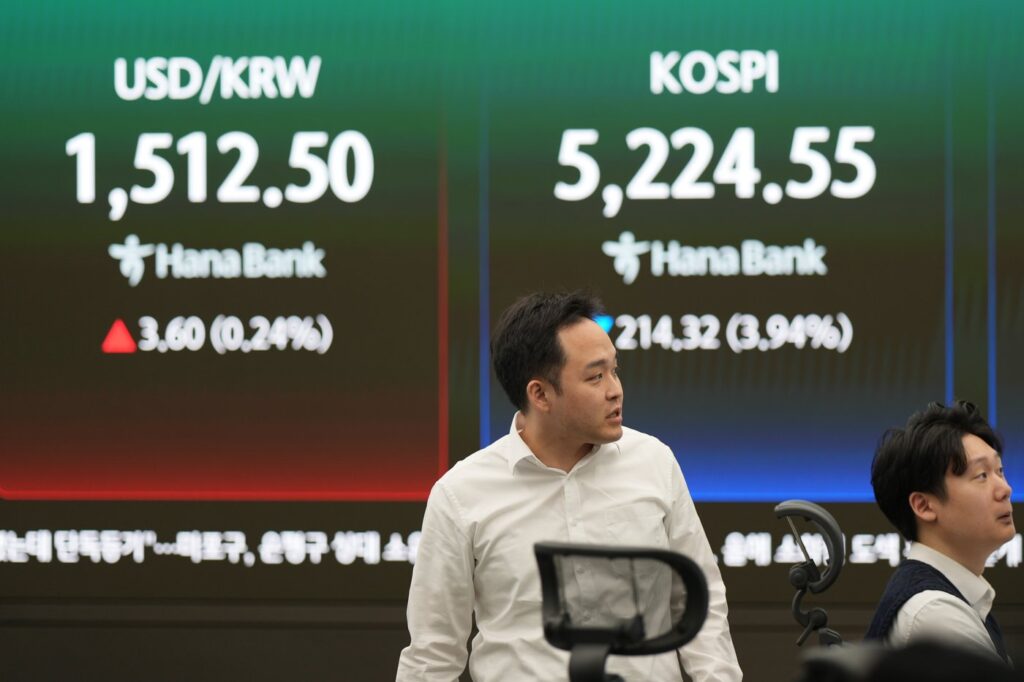
TOKYO (AP) — Asian shares experienced a downturn in Monday morning trading due to ongoing concerns regarding surging oil prices and the likelihood of further escalation in the U.S. war with Iran. The declines in Asia follow significant losses on Wall Street last Friday, marking a fifth consecutive week of losses, the longest such streak in nearly four years.
Japan's benchmark Nikkei 225 index dropped 4.5%, closing at 50,979.54 points. Additionally, Australia's S&P/ASX 200 index fell by 1.2% to 8,417.00, and South Korea's Kospi index plunged 3.2%, settling at 5,264.32. Hong Kong's Hang Seng Index decreased by 1.7% to 24,519.63, while the Shanghai Composite Index lost 0.7%, reaching a total of 3,884.57.
Concerns are mounting in Japan and Asia as a whole regarding restricted access to the Strait of Hormuz due to the conflict in Iran. This strategic waterway is vital for oil shipments, and disruptions could significantly impact the region's economy.
In energy markets, benchmark U.S. crude oil prices surged by $2.28, bringing the price per barrel to $101.92. Similarly, Brent crude—the international benchmark—rose by $2.88, hitting $115.45 per barrel. This stark increase is notable, especially considering that prior to the war, Brent crude prices were approximately $70 per barrel.
Investors are preparing for a prolonged conflict, which could lead to global market inflation and hinder economic growth in Asia. "Although we do not expect the conflict to be protracted, we anticipate heightened volatility in the near term," stated Xavier Lee, a senior equity analyst at Morningstar Research.
Oil prices are once again on the rise after briefly easing when President Donald Trump postponed a self-imposed deadline to "obliterate" Iran's power plants to April 6. The ramifications have been felt on Wall Street where the S&P 500 index declined by 1.7%, resulting in its worst week since the beginning of the war with Iran. The Dow Jones Industrial Average dropped 793 points, equivalent to a 1.7% decrease, and has now fallen over 10% from its peak earlier in the month. The Nasdaq composite index fell by 2.1% as well.
The S&P 500 is currently 8.7% below its all-time high set in January. Major technology stocks such as Amazon and Nvidia significantly weighed down the market averages. The S&P 500 index closed down 108.31 points at 6,368.85, while the Dow ended at 45,166.64, down 793.47, and the Nasdaq composite at 20,948.36, down 459.72.
In the bond market, the yield for the 10-year Treasury note peaked at 4.48% before retracing to finish last week at 4.43%. This reflects an increase from 4.42% late Thursday and a sharp rise from just 3.97% before the onset of the hostilities.
In currency trading, the U.S. dollar showed a slight decline against the Japanese yen, dropping to 159.97 yen from 160.32 yen. The euro traded at $1.1505, down marginally from $1.1510.
Yuri Kageyama is on Threads: https://www.threads.com/@yurikageyama








