

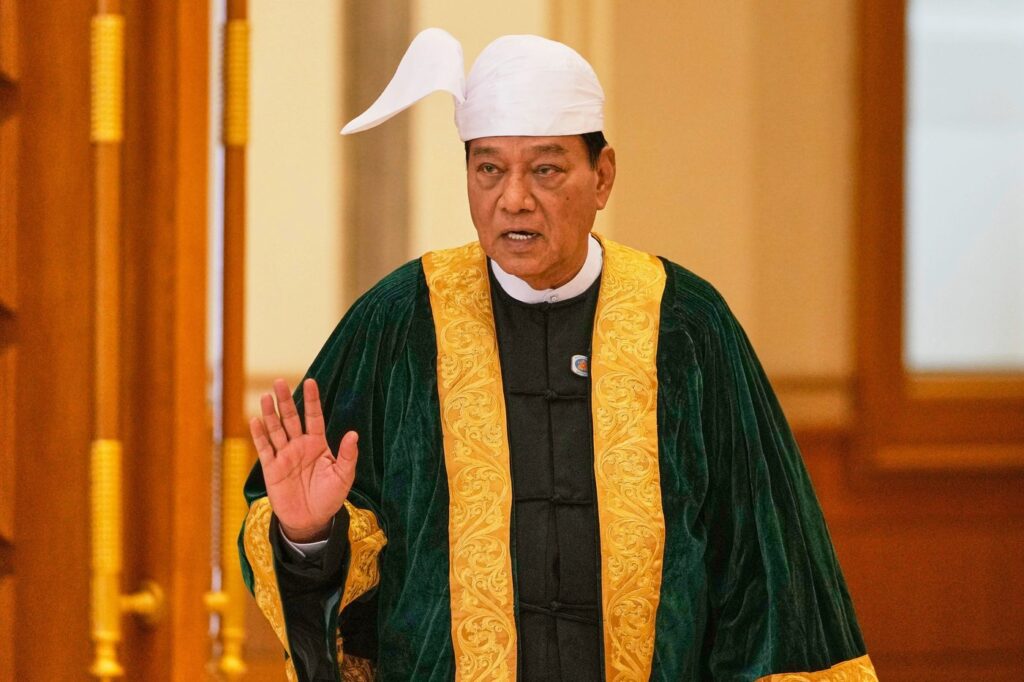
BANGKOK (AP) — On Monday, Myanmar's Parliament initiated the election process for the country's next president, marking a nominal return to an elected government after five years of military rule. However, this development is largely viewed as an attempt to maintain military power in the country.
The parliamentary procedures commenced on the same day that Senior Gen. Min Aung Hlaing, the leader of the military-led government, announced his resignation as the commander-in-chief of the armed forces. This move is essential, as the Constitution prohibits an individual from holding both the presidency and the highest military position concurrently.
Min Aung Hlaing is expected to be one of the three nominees for the presidency, with strong indications that he will secure the position. Military-backed parties and appointed members from the military collectively hold a significant majority in Parliament, ensuring a favorable outcome for Hlaing.
A decision on the new president could be made by the end of the week. The election process involves nominations from the Lower House, the Upper House, and a military bloc that holds a quarter of the legislature's seats. Min Aung Hlaing was nominated by the Lower House, while the Upper House presented two lesser-known candidates. The military has not yet revealed its nominees.
Once each group finalizes a nominee and their credentials undergo verification by a review committee, the 586-member Parliament will cast their votes. The candidate who receives the most votes will be declared president, while the remaining two nominees will serve as vice presidents. The exact date of the vote is not specified, but it could occur as soon as Thursday.
The history of military rule in Myanmar is long-standing. The members of Parliament were elected during three phases of voting held in December and January. Critics of military rule argue that these elections were conducted unfairly, intended to legitimize military governance that began with the ousting of Aung San Suu Kyi's democratically elected government in February 2021.
Myanmar experienced military dominance from 1962 until 2016 when Suu Kyi's National League for Democracy (NLD) came into power following a significant victory in the 2015 elections. The NLD achieved an even greater mandate in the 2020 general elections, but the army seized control before the new Parliament could convene.
Following the coup, peaceful protests against military rule were met with brutal force, leading pro-democracy activists to arm themselves and collaborate with ethnic minority groups advocating for greater autonomy. Today, much of the country is engulfed in a severe civil war, resulting in security concerns that limited recent voting activities to only 263 of the nation's 330 townships.
Min Aung Hlaing, who has been at the helm of Myanmar's military since 2011, has exercised significant political influence under the 2008 military-drafted Constitution. His international profile grew during a 2017 campaign of repression against the Rohingya Muslim minority, which caused a mass exodus into Bangladesh amid allegations of human rights violations.
In a ceremony conducted in Naypyitaw, the capital, state-run MRTV reported that Min Aung Hlaing passed command of the military to Gen. Ye Win Oo, a close associate. Gen. Ye Win Oo, 60, previously held the position of secretary of the ruling State Administration Council, which was formed following the military takeover.
There exists minimal opposition in Parliament, as leading opposition parties, including Suu Kyi's former ruling NLD, were either barred from participating in the recent elections or chose not to compete under what they perceived as unfair conditions. Aung San Suu Kyi, the former leader of Myanmar at 80 years old, is currently serving a 27-year prison sentence on charges widely regarded as unjust and politically motivated. Her party was compelled to dissolve in 2023 after rejecting registration under newly imposed military regulations.








