

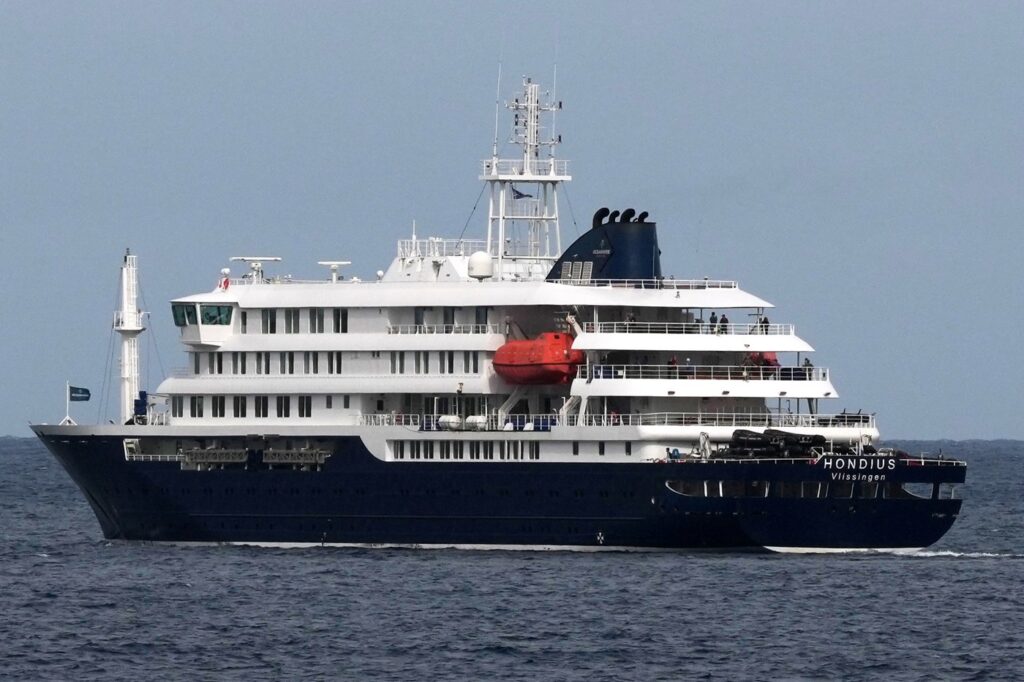
MADRID (AP) — Spanish authorities are preparing to receive more than 140 individuals—including passengers and crew members—aboard the MV Hondius, a cruise ship affected by a hantavirus outbreak. The vessel is headed for the Canary Islands, specifically the Spanish island of Tenerife, and is expected to arrive on Saturday or Sunday. Virginia Barcones, Spain's head of emergency services, indicated that the passengers will be directed to an isolated, cordoned-off area upon arrival.
Officials from the Netherlands, where the MV Hondius is registered, have been in close contact with the ship's owner and health authorities from countries whose citizens are onboard. Among these are the United States and the United Kingdom, both of whom have arranged for repatriation flights. The U.S. has agreed to send a plane to evacuate its 17 citizens, while the British government will charter a flight to bring back nearly two dozen British citizens who are also aboard.
Tragically, at least three passengers have died due to the hantavirus, and several others have fallen ill. The World Health Organization (WHO) has assessed the risk posed to the broader public as low, further noting that a flight attendant who briefly interacted with an infected passenger tested negative for the virus. This was particularly significant as her possible exposure raised concerns about the potential transmissibility of hantavirus between individuals.
Hantavirus is primarily transmitted through the inhalation of contaminated rodent droppings and is not easily spread between humans. Symptoms typically manifest between one and eight weeks after exposure. Currently, no remaining passengers or crew on the ship are exhibiting symptoms, according to the Netherlands-based cruise line, Oceanwide Expeditions.
Amidst these developments, health authorities from various countries are focusing their efforts on tracing and monitoring passengers who disembarked the ship prior to the outbreak being identified. There are ongoing efforts to connect with individuals who may have encountered these passengers since their departure.
On April 24, nearly two weeks post the death of the first passenger, over two dozen individuals from at least 12 different countries left the ship without any measures for contact tracing. It was only on May 2 that health officials confirmed the presence of hantavirus in a passenger onboard the vessel. Furthermore, a KLM flight attendant who tested negative for hantavirus had worked on a flight from Johannesburg to Amsterdam on April 25 and subsequently fell ill, leading to her isolation at an Amsterdam hospital.
Notably, the cruise passenger who was on the aforementioned flight— a Dutch woman whose husband also died on the ship—was too ill to continue on the international flight to Europe and subsequently passed away in Johannesburg. The Dutch public health service is diligently conducting contact tracing on passengers who interacted with the ill woman prior to her departure from the aircraft.
UK health authorities have recently reported that a third British national is suspected of contracting the hantavirus. This suspected case is currently in Tristan da Cunha, a remote British overseas territory located in the South Atlantic, where the cruise ship made a stop in April. However, details on the individual's condition remain unreported. Consequently, two other British passengers from the ship have been confirmed to have the virus, with one currently hospitalized in the Netherlands and the other in South Africa.
In South Africa, health authorities are also working to trace contacts of passengers who previously disembarked the vessel, focusing specifically on an April 25 flight from the remote island of St. Helena in the South Atlantic to Johannesburg, just a day after some passengers had disembarked on St. Helena.








