

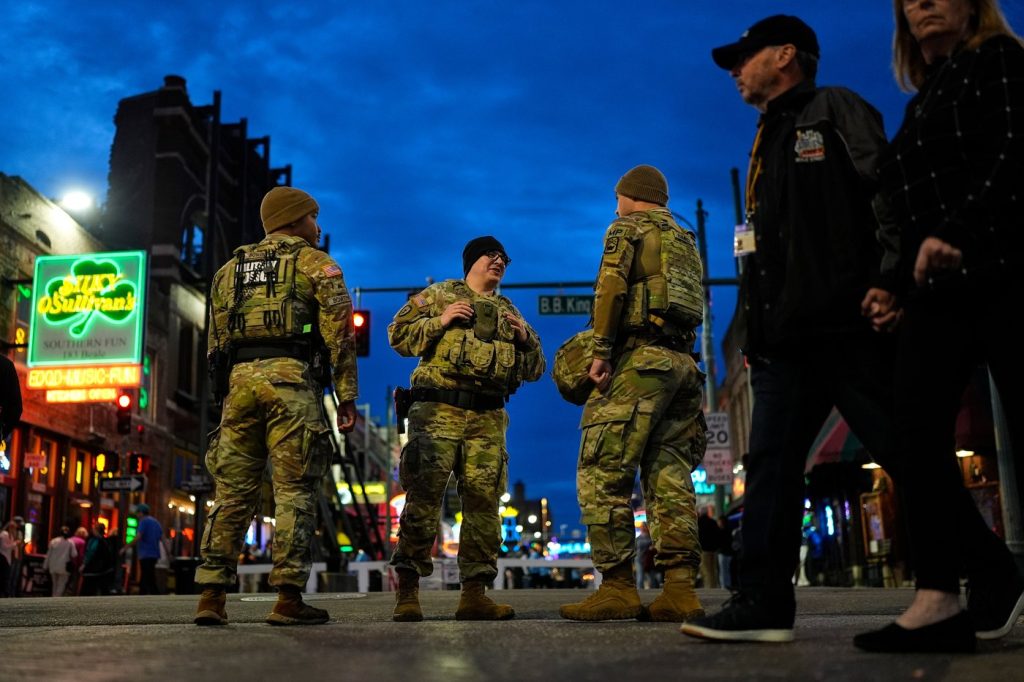
MEMPHIS, Tenn. (AP) – A Tennessee judge has temporarily blocked the deployment of the National Guard in Memphis, stemming from a crime-fighting initiative spearheaded by former President Donald Trump. The ruling was delivered on Monday by Davidson County Chancellor Patricia Head Moskal, who sided with Democratic state and local officials that filed a lawsuit, asserting that Republican Governor Bill Lee lacks the authority to mobilize the Tennessee National Guard for civil unrest without specific legislative action.
The lawsuit argues that under Tennessee law, the governor can only deploy the National Guard in instances of rebellion or invasion, and even then, approval from state lawmakers is required. Additionally, the plaintiffs contended that local governments must request the Guard's assistance in scenarios such as a "breakdown of law and order." Chancellor Moskal agreed with these claims, indicating that the plaintiffs demonstrated a likelihood of success and could face irreparable harm if the injunction was not granted.
Despite granting the injunction, Moskal put her order on hold for five days to allow the government to appeal the decision. The judge noted that the governor's authority as commander-in-chief of the National Guard is not without limits. The state has claimed that Tennessee law provides the governor broad authority to dispatch the Guard as seen fit, without necessitating a legislative order.
In the aftermath of the ruling, Shelby County Mayor Lee Harris expressed optimism, stating on the social media platform X that the decision is a beneficial step toward upholding the rule of law in Tennessee. Skye Perryman, president and CEO of Democracy Forward—representing the plaintiffs—voiced that the ruling serves as a powerful affirmation that no individual, including a president or governor, is above the law.
Since their deployment began on October 10, National Guard members have been patrolling various neighborhoods and commercial districts in Memphis, donning military police attire and carrying firearms in holsters. Despite their visible presence, officials clarified that Guard members are not authorized to make arrests. This deployment is part of a broader task force established by Trump, which also includes federal law enforcement officers who have been active in the city for several weeks.
The task force, dubbed the Memphis Safe Task Force, has reportedly conducted over 2,500 arrests, addressing a range of issues, from drug and weapon offenses to homicides. Governor Lee asserted that the National Guard's role is integral in supporting local law enforcement efforts to combat crime, which Memphis has long struggled with, including issues of violent crime such as assaults and carjackings. Although recent statistics indicate some improvements in certain crime categories, violence remains a significant concern for the city.
Memphis Mayor Paul Young, who has not been involved in the lawsuit, previously stated that he never requested the Guard's presence in the city. Following Trump's announcement and Lee's agreement to deploy the National Guard, Young emphasized the need for the task force to specifically target violent offenders.
It was acknowledged by both the plaintiffs and the state that the governor did not issue a formal order to trigger the deployment, but instead communicated his intentions via a statement. Governor Lee articulated that his authority as commander-in-chief justified the National Guard's strategic mission in Memphis, framing it as an essential effort to enhance public safety and foster a sense of security among residents in the city.
In summary, the ongoing legal dispute highlights tensions regarding state governance and the deployment of military resources within domestic civil matters, with potential implications for the management of law enforcement and public safety in Memphis.








