

CALGARY – Alberta Premier Danielle Smith is placing the blame for Calgary's recent water problems squarely on her political opponent, NDP Leader Naheed Nenshi, accusing him of neglect during his tenure as the city's mayor. According to Smith, the city's failure to adequately monitor the condition of the Bearspaw South Feeder Main, which has ruptured again this week for the second time in under two years, has led to the current issues.
During an unrelated news conference on Friday, Smith expressed her frustrations, stating, “Frustration doesn’t begin to describe what we’re seeing with what happened in Calgary,” highlighting that the city has experienced a higher rate of leakage from its water system for years. She asserted that these problems should have been identified early on, thereby preventing subsequent mayors from dealing with the fallout of such failures.
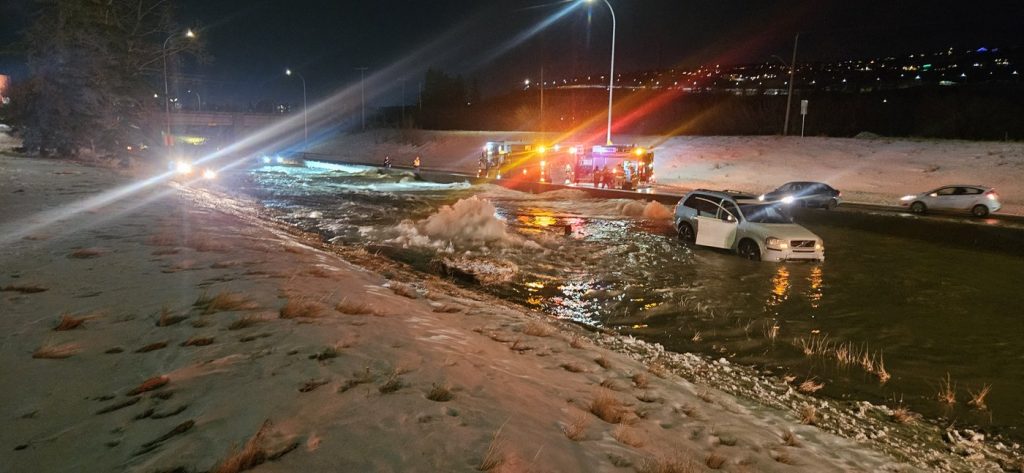
The Bearspaw South Feeder Main ruptured late on Tuesday night, flooding the roads adjacent to Canada Olympic Park and supplying 60 percent of the treated water to Calgary, which has a population of approximately 1.6 million. As a result of the rupture, Calgary's drinking water manager announced that residents need to reduce their daily water consumption to less than 485 million liters for the upcoming weeks. Residents are being urged to take shorter showers, limit toilet use, and run fewer laundry and dish cycles.
Currently, some neighborhoods are under boil-water advisories due to the situation. In response to the city's appeal for reduced water usage, officials noted on Friday that consumption had dropped to about 473 million liters per day by noon. Calgary Emergency Management Agency Chief Susan Henry thanked residents for their cooperation but cautioned that increased demand could occur with the return of people to offices and schools on Monday.
Nenshi, who served as mayor from 2010 to 2021 and is now the Leader of the Opposition, countered Smith's accusations, stating that “of course the inspections were always done,” and emphasized that no major water main breaks occurred in Calgary during the 20 years leading up to the 2024 failure. He dismissed Smith's claims as “total garbage,” criticizing the government for attempting to assign blame rather than addressing the issues constructively during the emergency.
Following the water main rupture, city officials have deployed acoustical equipment to listen for signs of cable snapping that reinforce the concrete of the main. However, they have stated that no such snaps were detected in the two months preceding the latest failure. In response to the ongoing situation, Mayor Jeromy Farkas has ordered a technical report on the matter, which was initially scheduled for release later this year, to be made available to city councilors sooner. Farkas indicated the report should be ready in a matter of days.
In light of the incidents, Premier Smith has expressed her intention to investigate whether increased oversight for municipal water systems is necessary. She pointed out that provincial oversight is already applied to other utilities like electricity and gas. Nenshi responded by highlighting the commonality of the type of pre-stressed concrete used in the main, indicating that while it was engineered to last up to 100 years, it is often failing within 50 to 60 years. He challenged Smith, saying, "If the premier has some sort of way of predicting these wires snapping, I think she should share it with everyone because no one in the world has figured out how to do this kind of inspection."
This ongoing dispute and the state of Calgary's water infrastructure have raised significant concerns among residents and have prompted calls for immediate solutions to avert future crises.








