

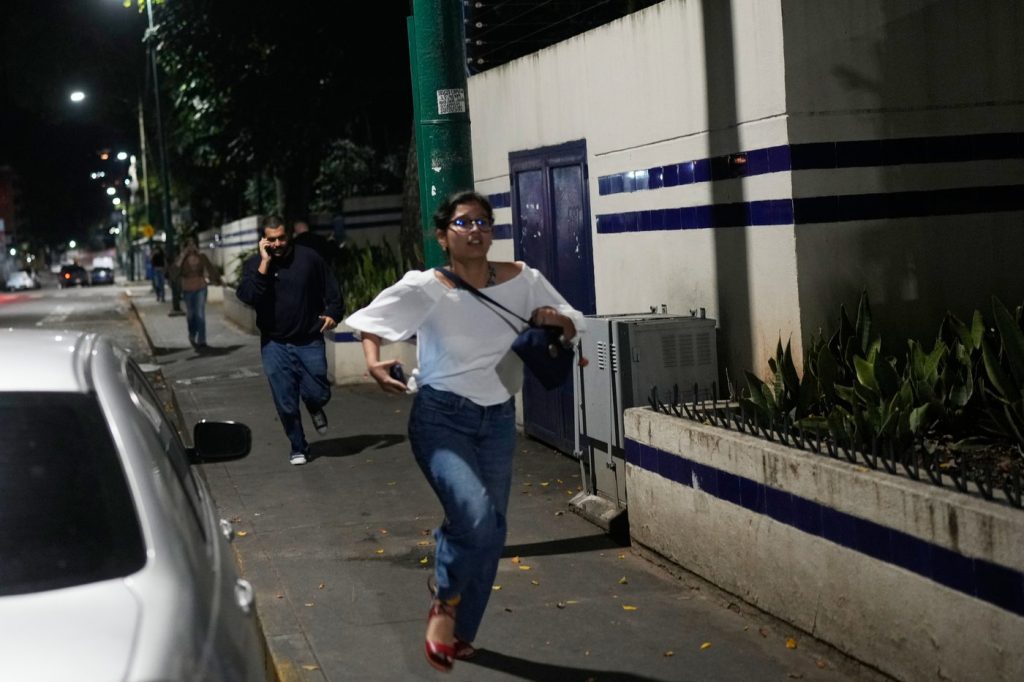
CARACAS, Venezuela (AP) — The United States carried out a "large-scale strike" early Saturday morning, leading to the reported capture of Venezuelan President Nicolás Maduro. This operation was announced by President Donald Trump via social media shortly after the attack, which occurred on January 3, 2026, in the capital city of Caracas.
Witnesses reported multiple explosions and the sight of low-flying aircraft throughout the city. In response, Maduro's government accused the United States of launching an "imperialist attack" targeting both civilian and military installations, calling for citizens to demonstrate in the streets.
Details surrounding the situation remained murky as Maduro’s location was unknown. Trump claimed on Truth Social that Maduro and his wife had been captured and transported out of Venezuela, promising further details at an upcoming news conference. The barrage of blasts lasted less than 30 minutes, with the U.S. Federal Aviation Administration (FAA) issuing a ban on American commercial flights in Venezuelan airspace due to "ongoing military activity."
The strike was part of a broader campaign by the Trump administration aimed at increasing pressure on Maduro, who faces narco-terrorism charges in the United States. A recent CIA drone strike at a Venezuelan docking area linked to drug cartels marked a significant escalation, being the first known operation on Venezuelan soil since an uptick in U.S. military actions began in September 2025.
Trump had previously threatened military strikes on Venezuelan territory, with highlighted actions primarily aimed at vessels accused of drug trafficking. Maduro has denounced these military operations as efforts by the U.S. to forcibly remove him from power.
Following the early morning attacks, armed individuals and pro-government militia members mobilized in areas considered strongholds for Maduro's ruling party. However, several parts of Caracas remained deserted hours after the explosions, as some neighborhoods experienced power outages. Residents shared videos showcasing smoke and tracers from military activity, while others expressed frantic reactions to the events as they unfolded.
At the time of the strikes, Trump was at his private club in Palm Beach, Florida. Reports indicated he was scheduled to receive an intelligence briefing just hours prior to the attacks. The Venezuelan government responded with a call to the public to take to the streets and condemned the U.S. military actions as an imperialist aggression, urging the activation of national defense plans and declaring a state of external disturbance.
The U.S. Embassy, which has been closed since 2019, issued a warning for American citizens in Venezuela, advising them to shelter in place amid the instability. Attempts to gain official comments from the Pentagon and U.S. Southern Command since the attack went unanswered. Additionally, lawmakers in Congress expressed constitutional concerns regarding the attacks, reflecting a bipartisan skepticism over the lack of declared war or specific authorizations for such military actions in the region.
The military engagements have notably escalated, with U.S. forces targeting boats in Caribbean waters since early September. The reported number of boat strikes has reached 35, resulting in at least 115 fatalities. The Trump administration justified these actions as necessary measures against drug trafficking and asserted an ongoing "armed conflict" with drug cartels.
In a forthcoming twist, Venezuela expressed a willingness to negotiate an agreement with the U.S. to combat drug trafficking. However, Maduro has accused the U.S. of seeking regime change for access to the nation’s vast oil reserves through continued pressure. Meanwhile, international reactions have begun to surface, with countries like Cuba and Iran condemning the U.S. strikes, further complicating the geopolitical landscape.








