

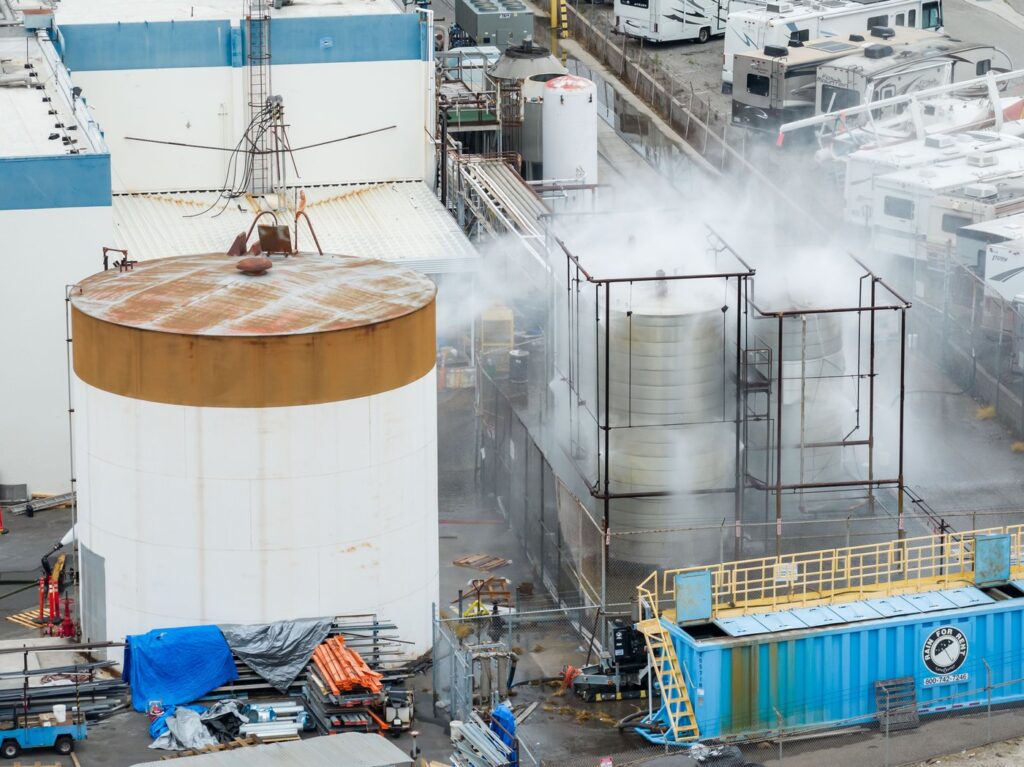
A damaged chemical tank in Southern California caused significant concerns over the weekend after it cracked, resulting in the evacuation of approximately 50,000 residents. The incident occurred at a facility in Garden Grove, a city with a population of about 170,000, located roughly 40 miles south of downtown Los Angeles. The tank began venting vapors due to overheating, prompting local and state officials to engage in urgent measures to prevent a catastrophic explosion. Fortunately, no injuries have been reported.
Firefighters have been consistently spraying the tank with water to lower the temperature of its contents. Reports indicate that the interior temperature reached 100 degrees Fahrenheit (approximately 37.7 degrees Celsius) on Sunday, which represents a 10-degree increase since Saturday, as noted by Democratic state Senator Tom Umberg. As officials assessed the situation, they discovered a crack in the tank, which appeared to reduce the risk of a devastating explosion and indicated that the highly volatile chemicals inside might not have leaked, according to Orange County Fire Authority Captain Wayhowe Huang.
Despite the crack, Captain Huang emphasized that the threat of an explosion still looms. In response to the crisis, California Governor Gavin Newsom declared a state of emergency on Saturday, appealing to President Trump for federal support to enhance local and state relief efforts.
The tank at GKN Aerospace Transparency Systems, which manufactures components for both commercial and military aircraft, contains between 6,000 and 7,000 gallons (22,700 to 26,500 liters) of methyl methacrylate—a chemical used to produce plastic parts. Monitoring efforts around the evacuation zone identified that air pollution levels remained within normal limits. Equipped with specialized instruments, state and federal environmental officials ensured that no gas was being released during the incident.
The primary goal for firefighters remains cooling the chemicals in the tank to avert leaks or explosions. Drones are deployed to monitor temperature changes every ten minutes, with containment barriers established to prevent any release into storm drains or nearby water bodies. According to Purdue University engineering professor Andrew Whelton, the rising temperature causes methyl methacrylate to transition from liquid to gas, escalating pressure inside the tank. The crack may facilitate escaping pressure, thus lowering explosion risks. Whelton compared this situation to a soda can left in a hot car—it can explode unless a hole is made to relieve pressure, preventing a more dangerous explosion.
Firefighters are cautious about creating a hole in the tank due to the danger of igniting the volatile gas. Such an explosion could disperse chemicals across a wide area, potentially leading to disastrous shrapnel injuries.
The evacuation has left many locals displaced, with aerial images showing empty streets in Garden Grove. Several evacuation shelters were opened, including a high school in neighboring La Palma where individuals sought refuge on matts or even in their cars. Nearby Disneyland attractions remain operational and are monitoring the situation, as they were not included in evacuation orders.
Health officials highlighted that exposure to methyl methacrylate poses serious health risks, including respiratory and neurological issues, as well as skin, eye, and throat irritation. Whelton stressed the importance of conducting thorough air monitoring for the specific chemical should an explosion occur, contrasting this with previous incidents where generic tests were used.
Amid the crisis, some residents have initiated a class-action lawsuit against GKN Aerospace, asserting that their property values are likely to be diminished regardless of the outcome of the situation. While GKN Aerospace has not commented on the lawsuit, they have conveyed their apologies to the affected residents and businesses, indicating that they are working diligently to mitigate the risks of a potential leak. In a previous agreement in 2025, GKN Aerospace settled with state regulators for over $900,000 pertaining to violations related to recordkeeping and emissions.








