

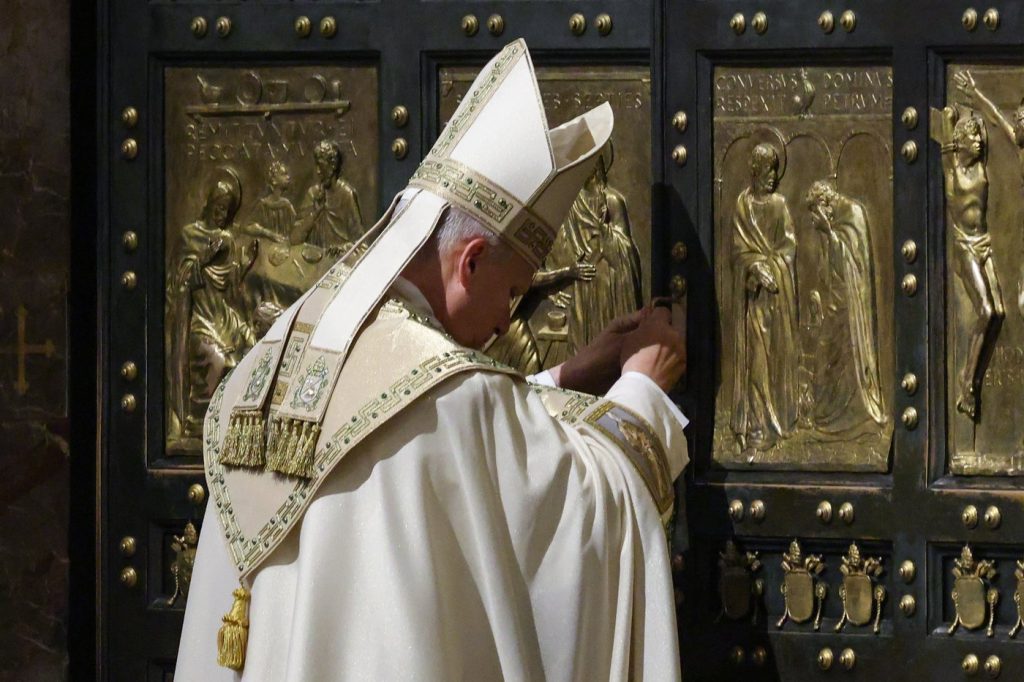
VATICAN CITY (AP) – Pope Leo XIV concluded the Vatican's 2025 Holy Year on Tuesday, delivering a poignant message that criticized contemporary consumerism and prevailing anti-foreigner sentiments. This Jubilee year witnessed an impressive influx of approximately 33 million pilgrims visiting Rome, marking a historic transition between two American popes, Francis and Leo.
During the closing ceremony, held on the feast of Epiphany, Pope Leo XIV kneeled in prayer at the Holy Door of St. Peter's Basilica before symbolically closing the doors, signifying the end of a rare Jubilee that began under the frail Pope Francis in December 2024 and continued through his funeral and the subsequent papal conclave. Notably, this was only the second occasion in history that a Holy Year was inaugurated by one pope and concluded by another, the first instance occurring in 1700.
In many respects, the ceremony marked an important juncture in Pope Leo's papacy, as he prepares to address the governing of the Catholic Church with a global cardinal summit commencing on Wednesday. The meetings will focus on liturgical issues, specifically the ongoing divisions within the Church regarding the celebration of the traditional Latin Mass, indicating Pope Leo's decisive approach to these challenges.
In his homily, Pope Leo XIV rallied Christians to reflect on Biblical principles urging the welcome of strangers and the need to resist the allurements of power dynamics. He remarked on a "distorted economy" that seeks profit at the expense of humanity, questioning whether the Jubilee experience has equipped individuals to recognize the dignity of pilgrims, seekers, and foreign neighbors. His remarks urged a deeper comprehension of human relationships in light of faith and community.
The Vatican reported that the 2025 Holy Year attracted a staggering 33,475,369 pilgrims, although the organizer, Archbishop Rino Fisichella, conceded that this figure is an approximate estimate, which might include instances of double counting. Furthermore, no detailed comparison was provided between Holy Year pilgrims and the total tourist figures visiting Rome during this period.
The tradition of Holy Years in Rome dates back to 1300, when Pope Boniface VIII initiated the first Jubilee, establishing Rome as the epicenter of Christianity. The influx of pilgrims for such events has historically led to significant public works projects aimed at rejuvenating the city. The Vatican has utilized the occasion to secure funding for extensive renovations, with public investment for the latest Jubilee amounting to roughly 4 billion euros (about $4.3 billion).
Previous substantial undertakings associated with Holy Years include the Sistine Chapel, commissioned for the 1475 Jubilee, and a large Vatican garage built for the Jubilee in 2000. The most controversial projects included the extensive construction of Via della Conciliazione, resulting in the demolition of an entire neighborhood in preparation for the 1950 Jubilee. The forthcoming public works for the 2025 Jubilee feature an extension of this boulevard, creating a pedestrian piazza along the Tiber, which will connect Via della Conciliazione to Castel St. Angelo via an underground tunnel.
Pope Leo XIV has announced that the next Jubilee is scheduled for 2033, commemorating the death and resurrection of Christ, a significant event in Christian belief. The conclusion of the 2025 Holy Year was marked not just by reflection on the past year’s events, but as a poignant moment for the future of the Catholic Church under Leo's leadership.








