

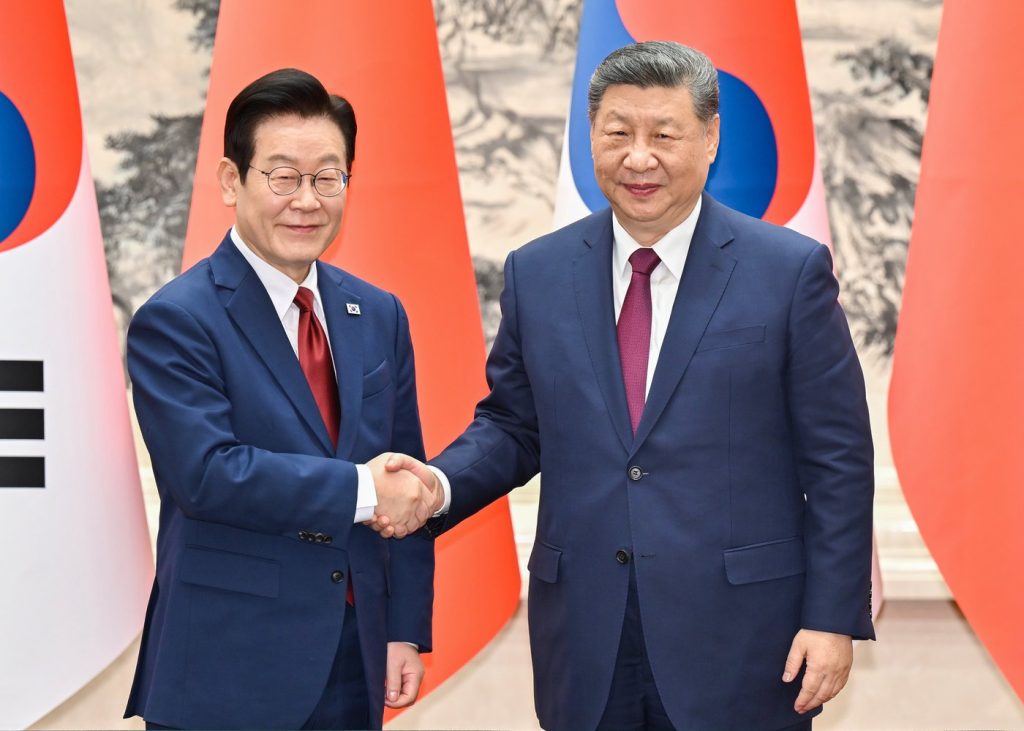
SEOUL, South Korea (AP) — South Korean President Lee Jae Myung stated on Wednesday that he had requested Chinese President Xi Jinping to act as a mediator in addressing the ongoing North Korean nuclear crisis and to help reduce tensions between North and South Korea. This request was made during their summit earlier this week.
In comments shared with reporters during the Shanghai leg of his trip to China, Lee referenced Xi's response, which emphasized the necessity of patience regarding matters related to North Korea. “We’re making efforts but all our channels (with North Korea) are completely blocked so we can’t communicate at all. I told him it would be good for China to play the role of a mediator for peace,” Lee remarked in televised statements. He further noted that President Xi acknowledged their efforts and reiterated the need for patience.
As North Korea's primary trading partner and a significant diplomatic ally, China holds a pivotal position concerning North Korean affairs. Both South Korea and the United States have frequently urged China to leverage its influence to motivate North Korea to resume stalled diplomatic discussions or engage in denuclearization efforts. In response, China has often called for all parties involved in North Korean issues to exercise restraint and has, in recent years, halted efforts from the U.S. and other nations to impose stricter sanctions on North Korea, despite its ongoing missile tests that violate U.N. resolutions.
Meanwhile, North Korea has consistently shunned dialogue with both South Korea and the United States, opting instead to expand its nuclear capabilities following the breakdown of high-profile nuclear negotiations involving Kim Jong Un and then-President Donald Trump in 2019.
Since assuming the presidency in June 2022, Lee’s liberal administration has vigorously sought to reinitiate discussions with North Korea, yet their advances have largely been disregarded by Pyongyang. In July, Kim Yo Jong, Kim Jong Un's sister and a senior official, criticized the Lee administration for its “blind trust” in the alliance with the U.S. and its perceived hostility towards North Korea, suggesting that it was no different from previous conservative administrations.
During his visit, Lee also reported a separate meeting with Chinese Premier Li Qiang, who echoed the sentiment about the need for patience concerning North Korean issues. “Roles of neighbors are necessary. We requested China to play such a role, and China said it will anyway make such efforts,” Lee stated, highlighting the collaborative nature of their discussions.
During his meetings with Chinese officials, Lee shared his administration's approach to advocate for a phased and gradual process of denuclearization from North Korea, proposing that this approach could include offering corresponding benefits. Lee underscored the importance of freezing North Korea's nuclear and missile developments to prevent an increase in its arsenal and the potential for nuclear proliferation. He expressed that China aligns with this perspective.
“Leaving the current status would be a loss for Northeast Asia and the entire world because (North Korea’s) nuclear weapons are being produced continuously,” Lee warned, emphasizing the urgency of addressing North Korea's nuclear advancements.
Despite South Korea's calls for dialogue, North Korea has made it clear that it will not entertain the prospect of denuclearization in negotiations again. Concerns persist among international experts that providing North Korea with incentives for limited denuclearization could enable it to withdraw from diplomatic engagements while maintaining significant elements of its nuclear program in exchange for much-needed relief from sanctions.








