

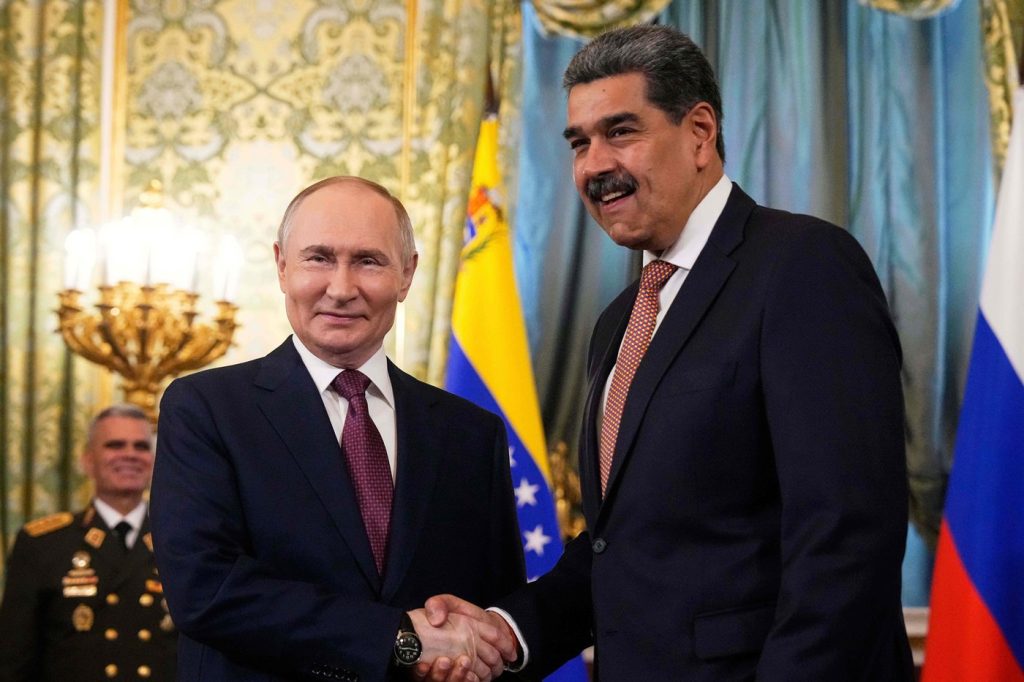
The recent U.S. operation to capture Venezuelan leader Nicolas Maduro has emerged as a complex issue for Russian President Vladimir Putin. This development follows a series of setbacks for Russia, including its unsuccessful efforts to capture Kyiv and oust Ukraine's leadership at the beginning of its invasion nearly four years ago. The ousting of Maduro signifies yet another instance where the Kremlin has failed to effectively support an ally, coming on the heels of the downfall of Syria’s former President Bashar Assad in 2024 and recent U.S. and Israeli strikes on Iran.
The U.S. is clearly focused on consolidating its influence in Venezuela, which threatens to erode Russia’s strategic foothold in the Western Hemisphere alongside the substantial financial investments it has made in the Venezuelan oil sector. Yet, the actions taken by former President Donald Trump in Venezuela have also raised concerns among Western nations, offering the Kremlin fresh rhetoric to justify its actions in Ukraine.
Additionally, Trump’s interest in controlling Greenland from NATO ally Denmark further risks destabilizing the alliance, especially at a time when the U.S.-led efforts to negotiate peace in Ukraine are entering a pivotal stage. This situation may distract NATO members from providing sufficient support and security guarantees to Ukraine. While Putin has not directly commented on the U.S. actions in Venezuela, Russian diplomats denounce them as blatant aggression. Dmitry Medvedev, Russia’s former president and current deputy on the presidential Security Council, criticized Washington for violating international law while simultaneously acknowledging Trump's consistency in supporting American national interests.
On Wednesday, the U.S. announced it had seized two sanctioned oil tankers linked to Venezuela, including one flagged to Russia in the North Atlantic, symbolizing its aggressive stance in the region.
Since the 2014 annexation of Crimea, Putin has sought to frame his actions as necessary to protect a Russian sphere of influence. He argues that just as the U.S. would oppose foreign military presence in its vicinity, Russia views NATO's expansion as a grave security threat. This justification was a key factor behind his rationale for the invasion of Ukraine, where he expressed unequivocal opposition to NATO's further eastward expansion.
In earlier negotiations, Russia had hinted at a potential deal in which it would refrain from intruding in Latin America in exchange for U.S. acknowledgment of its interests in Europe. Fiona Hill, who previously oversaw Russia and Europe on Trump’s National Security Council, noted that Russian officials signaled a willingness to cede influence in Venezuela. However, the Trump administration reportedly dismissed these overtures, indicating a lack of interest in such arrangements.
Interestingly, before Maduro’s capture, Russia had begun evacuating families of diplomats from Venezuela, raising questions about possible pre-emptive communication with the U.S. regarding the unfolding situation. Sam Greene, a Russia expert, speculated that Moscow might have reconsidered its stance on Venezuela, possibly in anticipation of a U.S.-Russia tacit agreement over their respective spheres of influence.
In the context of Russian history with Cuba and Venezuela, past threats by senior Russian officials to deploy troops to these areas were often dismissed as mere bluster. However, Russia has historically invested in Venezuela’s oil industry and extended generous loans for military assets, emphasizing its strategic interest in the region.
The recent U.S. actions in Venezuela have been characterized as a reaffirmation of the "might-makes-right" doctrine, which aligns with Russia’s narratives about protecting its vital interests in Ukraine. According to Medvedev, this gives Russia the ability to challenge U.S. actions in Venezuela, while Hill remarked that the capture of Maduro complicates the West's capacity to universally condemn Russia's actions in Ukraine. The fallout of this operation raises questions about how the international community can hold nations accountable for such aggressive actions when similar conduct goes unchallenged.
Overall, this situation paints a complex picture of international relations, with significant implications not only for Russian-American interactions but for the geopolitical landscape in both Latin America and Europe.








