

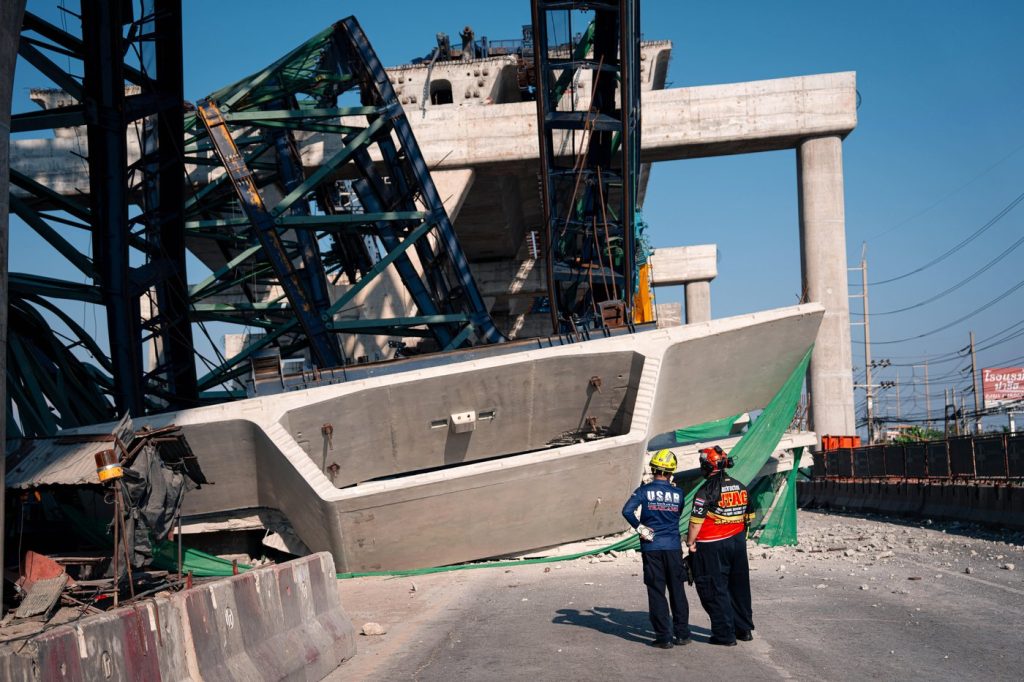
BANGKOK (AP) - Thailand's construction industry is facing severe scrutiny following a string of high-profile accidents that have resulted in fatalities. Recently, a crane collapsed onto a moving passenger train, leading to the deaths of 32 individuals, and a year prior, the collapse of an office tower killed nearly 100 workers. As accidents continue to occur, public concern in Bangkok has reached a boiling point, particularly regarding major road projects plagued by safety issues. In yet another incident, a construction crane fell on Thursday, claiming the lives of two more individuals, just a day after the tragic train accident.
The spotlight of public outrage has fallen on Italian-Thai Development, also known as Italthai, the contractor involved in both of last week’s incidents. This company, a prominent participant in many government projects, was also the joint lead contractor for the State Audit Office building that collapsed in March, resulting in approximately 100 fatalities. Notably, this building was the only significant structure in Thailand to collapse due to an earthquake that originated over 1,300 kilometers away in Myanmar.
In the wake of these tragedies, the Thai government has taken decisive action. Prime Minister Anutin Charnvirakul has ordered the Transport Ministry to terminate contracts with the companies involved, implement blacklisting measures, and pursue legal action against them. Additionally, the government announced that unfinished projects would continue through seized performance bonds and bank guarantees, reserving the right to seek further compensation for costs incurred. A “scorecard” system will also be enacted to monitor contractors’ performance records by early February.
The investigations into these construction disasters frequently pinpoint technical causes like human error or equipment failure. However, critics argue that systemic issues are at the heart of the ongoing safety concerns. They cite lax regulatory practices, poor enforcement, and widespread corruption as critical failures in the construction safety framework. A comprehensive investigation revealed that the building's collapse in March was not solely a result of the earthquake but rather an outcome of flawed structural design and deliberate efforts to bypass safety regulations.
Experts like Panudech Chumyen, a civil engineering lecturer at Thammasat University, express that while Thailand possesses adequate engineering knowledge, there are significant gaps in the enforcement system that must be addressed. These challenges include inconsistencies in legal enforcement, bureaucratic red tape, and a disconnect in safety policies among various stakeholders in construction projects. A notable lack of independent assessors without conflicts of interest has led to performance evaluations that often do not reflect actual conditions.
Additionally, concerns regarding the involvement of Chinese companies in the construction sector have emerged in light of the recent accidents. The train crash occurred on a line associated with the Thai-Chinese high-speed railway project, part of China’s Belt and Road Initiative. This initiative has garnered significant controversy globally, particularly regarding corruption. The State Audit Office project featured China Railway No. 10 as a co-lead contractor alongside Italthai, which raised alarms when the Bangkok representative was charged with violating Thailand's Foreign Business Act.
The aftermath of the State Audit Office building collapse triggered widespread outrage among the Thai populace, with many venting their frustrations on social media platforms. Viral images of “tofu buildings,” a term used to describe structures built with substandard materials, have reignited fears and anger about construction safety in the country. This term was originally coined in relation to the destructive 2008 earthquake in Sichuan, China.
Responding to these growing concerns, China’s ambassador to Thailand, Zhang Jianwei, stated that Chinese companies are required to comply with local regulations when undertaking international projects, affirming Beijing's willingness to assist with Thai authorities' investigations into these incidents.








