

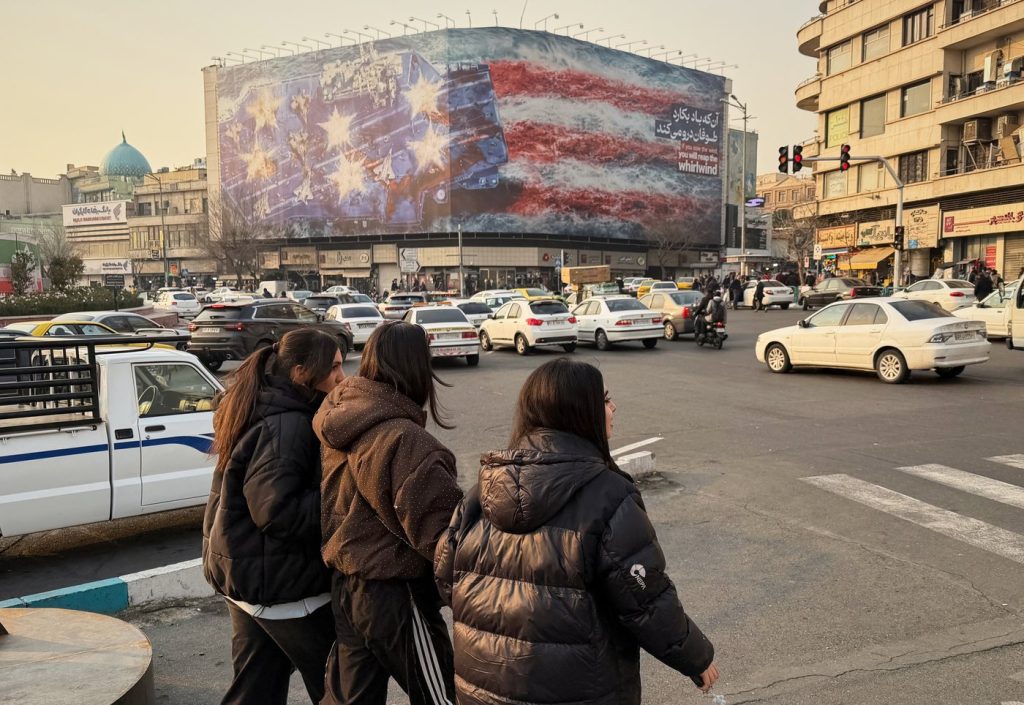
DUBAI, United Arab Emirates (AP) – A report from activists reveals that the violent crackdown on protests in Iran has resulted in the deaths of at least 6,126 individuals, with more still feared dead. This announcement comes as a U.S. aircraft carrier group, led by the USS Abraham Lincoln, arrives in the Middle East to prepare for any military response to the ongoing crisis.
The deployment of the USS Abraham Lincoln and its accompanying guided missile destroyers enhances the U.S. capacity to execute strikes against Iran. This move occurs amidst indications that Gulf Arab states prefer to avoid involvement in any attacks, despite hosting American military personnel in the region.
Two Iranian-backed militias have also expressed readiness to retaliate, likely in support of Iran, following U.S. President Donald Trump's warnings of military action in response to the killing of peaceful protesters or potential mass executions carried out by Tehran in the wake of the demonstrations.
Despite Iran’s threats to escalate the conflict across the Middle East, its military capabilities, including air defenses, are reportedly still recovering from damage inflicted during a June conflict initiated by Israel. Notably, the Houthis and Kataib Hezbollah refrained from engaging during Israel's recent 12-day conflict with Iran, which involved U.S. airstrikes targeting Iranian nuclear facilities. Their reluctance highlights the ongoing disruptions faced by Iran's so-called "Axis of Resistance" in the wake of Israeli assaults during its conflict with Hamas in the Gaza Strip.
The Human Rights Activists News Agency, based in the U.S., has been monitoring the protests and confirmed the death toll, which includes at least 5,777 protesters, 214 individuals affiliated with government forces, 86 children, and 49 civilians who were not involved in the demonstrations. Over 41,800 arrests have been reported. The Associated Press has been unable to independently verify these figures due to the Iranian government's internet restrictions and disruptions affecting communications within the country.
In contrast, Iranian authorities have reported a significantly lower death count of 3,117, which they claim includes 2,427 civilians and security personnel, labeling the remainder as "terrorists." Historically, the Iranian government has been criticized for understating or failing to disclose the death toll during times of civil unrest.
This current wave of protests began on December 28, triggered by the devaluation of the Iranian currency, the rial, and swiftly propagated throughout the nation. The government’s harsh response has led to one of the most complete internet blackouts in Iran’s history, lasting over two weeks.
Iran's ambassador to the U.N. vehemently criticized Trump's threats of military action during a recent Security Council meeting, claiming they are explicit and inciting violence supported by armed groups with ties to the U.S. and Israel, although he provided no evidence for these allegations.
In response to the ongoing turmoil, Iranian state media has sought to deflect blame onto foreign forces, while the government continues to struggle with a significantly weakened economy impacted by international sanctions, particularly those concerning its nuclear program.
Amidst these rising tensions, Iranian-backed militias have signaled their willingness to engage in combat. For instance, the Houthis have threatened to resume attacks on maritime shipping in the Red Sea. Ahmad "Abu Hussein" al-Hamidawi, the leader of Iraq’s Kataib Hezbollah militia, made ominous statements regarding potential conflict, warning that any war against Iran would result in severe repercussions for its adversaries.
Hezbollah, another key Iranian ally, is also preparing for possible aggression but remains ambiguous about its involvement in the event of a military conflict with Israel and the U.S. during a recent address, Hezbollah leader Sheikh Naim Kassem acknowledged the questions about the group's response but emphasized that decisions would be made in accordance with the prevailing circumstances of the conflict.








