

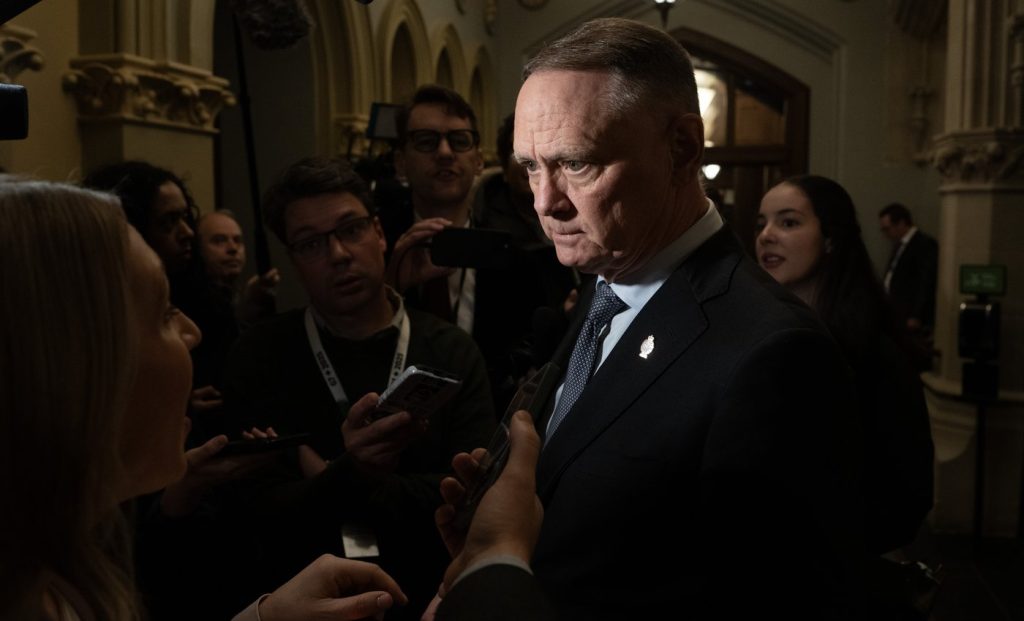
OTTAWA – Defence Minister David McGuinty has reaffirmed Canada’s longstanding stance against the acquisition of nuclear weapons. This statement comes in response to a recent suggestion made by former chief of the defence staff Wayne Eyre, who indicated that Canada should not completely dismiss the possibility of developing its own nuclear arsenal.
During a press briefing before entering a cabinet meeting, McGuinty emphasized Canada’s commitment to international treaties that explicitly prohibit the proliferation of nuclear arms. The minister clarified that Canada will continue to pursue building its military capabilities with a focus on conventional weaponry rather than exploring nuclear options.
Wayne Eyre, who led the Canadian Armed Forces until his retirement, made his remarks during an event in Ottawa on Monday. He highlighted the notion that Canada may struggle to attain true strategic independence without possessing its own nuclear deterrent. While Eyre acknowledged the potential strategic significance of nuclear weapons, he advocated for caution, stating that it is not the right time for Canada to pursue such capabilities.
The conversation around nuclear weapons acquisition has been reignited amid discussions of national defense and military preparedness. Eyre’s comments suggest a growing concern about Canada’s security landscape and the adequacy of its current capabilities in the face of evolving global threats.
The debate touches on Canada's historical position regarding nuclear arms—a policy largely driven by its commitment to international disarmament initiatives and non-proliferation treaties. These treaties underscore a global consensus on preventing the spread of nuclear weapons, with Canada playing a proactive role within this framework.
McGuinty’s reaffirmation of Canada’s position suggests that the government remains steadfast in its current approach to defense strategy, which prioritizes conventional military enhancements over the complexities and ethical dilemmas associated with nuclear arsenals. The minister underscored the need for a comprehensive military rebuild, focusing on advanced technologies and traditional defense measures that do not involve nuclear capabilities.
As discussions regarding national defense continue, the tension between the need for adequate protection and the ethical implications of nuclear armament comes to the forefront. Eyre's suggestion reflects a significant concern within military circles about the implications of not having a nuclear deterrent while other nations pursue such capabilities as a means of defense.
Ultimately, the dialogue surrounding Canada’s defensive posture is poised to evolve further, especially as geopolitical climates shift and new threats emerge. While the current government maintains its anti-nuclear stance, the complexity and dynamism of international relations may prompt ongoing discussions and assessments of Canada’s defense strategy in the years to come.








