

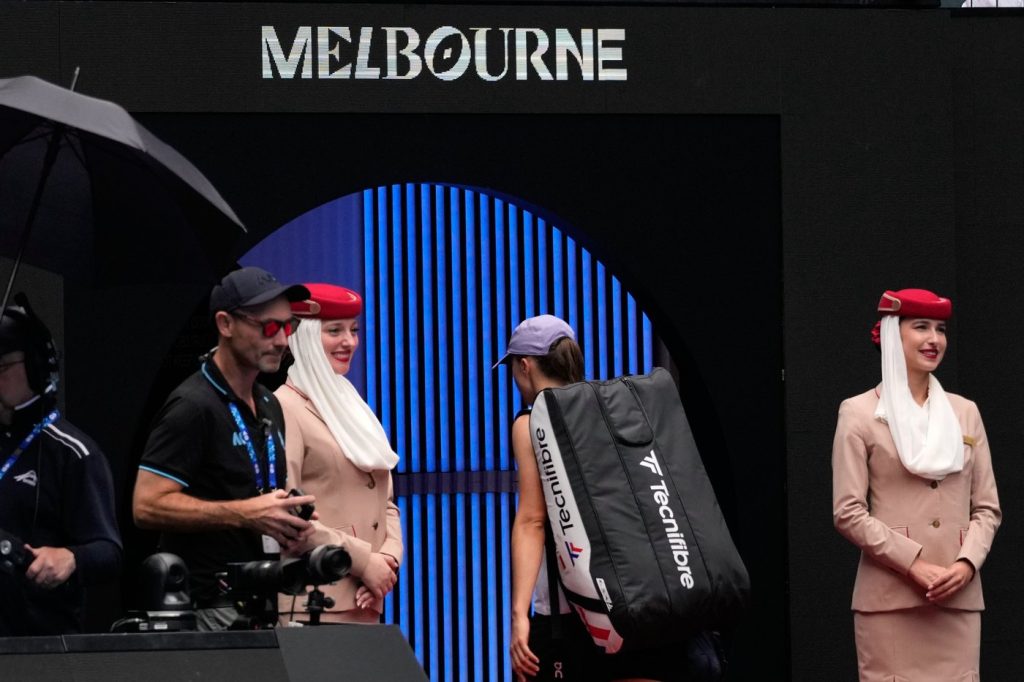
MELBOURNE, Australia (AP) - Iga Swiatek has echoed concerns raised by Coco Gauff regarding the pervasive presence of cameras that capture players not only on the court but also in areas that are typically private, such as locker rooms. Gauff recently highlighted the need for conversations about this constant surveillance after her emotional outburst involving racket smashing went viral during the Australian Open.
Following her quarterfinal defeat to fifth-seeded Elena Rybakina, Swiatek was asked about her views on the lack of private areas for players in the tournament. The 21-year-old Polish tennis star candidly questioned whether athletes are treated as professionals or merely as exhibits under constant scrutiny. "Yeah, the question is, are we tennis players, or are we, like, animals in the zoo where they are observed even when they poop?" she remarked, slightly apologizing for the hyperbole. "It would be nice to have some privacy," she added, emphasizing her desire for personal space to prepare mentally and physically before matches.
Both Swiatek and Gauff rank among the top three players in women's tennis, making them prime targets for media attention during major tournaments. An incident where Swiatek was momentarily halted by security for forgetting her credential became a meme, underscoring the blend of scrutiny and humor surrounding high-profile players' experiences. While security measures are a necessary part of tournament logistics, the players hope for more balance between fan engagement and personal privacy.
The excessive off-court camera surveillance is not unique to the Australian Open; it has become a trend at various other tournaments as organizers aim to engage fans through a continuous flow of content. Although the footage captured is not always broadcast, players understand that moments depicting their struggles or vulnerabilities could end up online, sometimes leading to unwanted attention.
Swiatek noted that there are aspects of her performance that she would prefer to practice immediately before entering the court, suggesting that a designated area away from prying eyes would be beneficial. "We're tennis players. We're meant to be watched on the court, you know, and in the press. That's our job," she stated. However, she pointed out that becoming an internet meme for trivial missteps, such as forgetting accreditation, detracts from their professionalism.
Coco Gauff, ranked third, also expressed her frustrations regarding the lack of privacy after her own emotional display following her quarterfinal loss to Elina Svitolina. During the match that lasted just 59 minutes, Gauff struggled notably with her serve and exhibited signs of distress as she exited the center court. In a moment of frustration, she smashed her racket multiple times in a secluded area, which she had hoped was out of sight from cameras. "I tried to go somewhere where I thought there wasn’t a camera because I don’t necessarily like breaking rackets," she explained, indicating her desire to maintain a level of composure even in private moments.
Gauff believes these emotional moments should not be publicized, citing a prior occurrence involving Aryna Sabalenka when they faced off at the U.S. Open. "I feel like they don’t need to broadcast," she implied, advocating for more discretion in how players' private struggles are shared with the public. "At this tournament, the only private place we have is the locker room," she concluded, mirroring Swiatek's sentiment that more private spaces would allow players to manage their emotions without the constant gaze of the cameras.








