

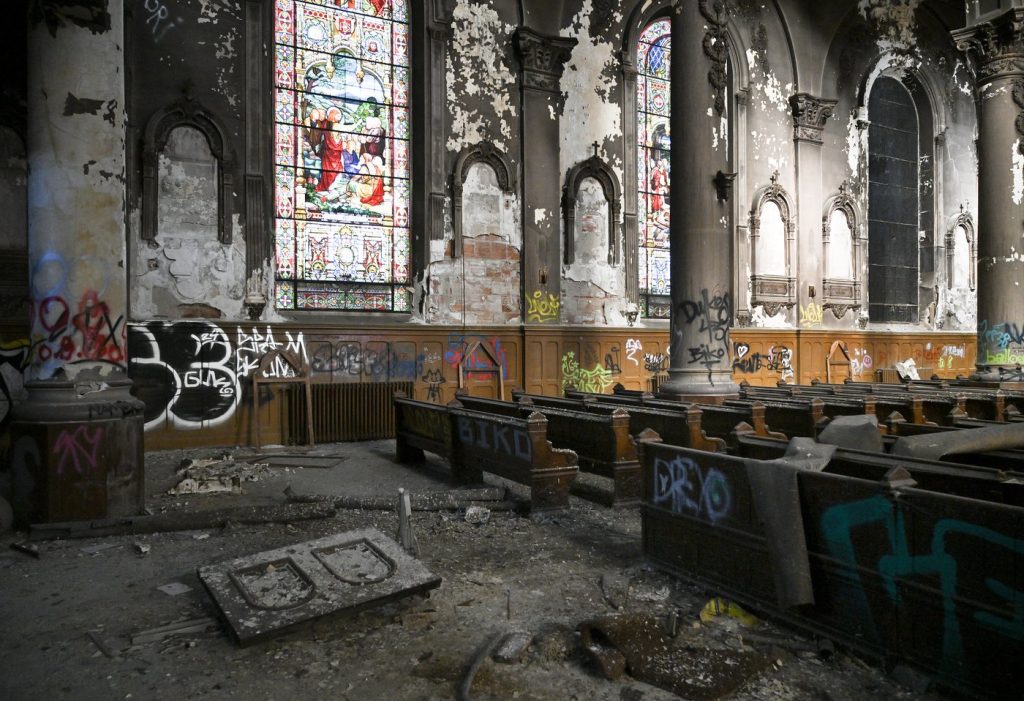
MONTREAL – The long-closed St-Eusèbe-de-Verceil church in Montreal has become a focal point of urban decay, drawing attention not only for its deteriorating condition but also for graffiti and poetry that reflect the community's sentiments. One poem, pinned next to statements like "Free Gaza," poignantly begins with "This church is no more," highlighting the struggles the church faces.
After years of neglect, a devastating fire, and numerous fines totaling hundreds of thousands of dollars, the church's management is now taking a standout step: they are suing the City of Montreal for demolition of the structure. As attendance continues to dwindle and government funding for the repair of religious buildings diminishes, underutilized churches across Quebec, including St-Eusèbe-de-Verceil, are struggling to find relevance in contemporary society.
Efforts to keep the church secure have been taxing for the parish fabrique, the overseeing legal entity, and for its 77-year-old priest, Roger Dufresne. He lamented the repeated break-ins, noting that intruders often use tools to shatter windows and doors, largely motivated by the allure of social media fame through TikTok. The church's interior now lies in ruin, littered with debris, bird droppings, and remnants of what was once a cherished organ, all damaged by vandals.
The sanctuary, once a gathering place for about 1,000 worshippers, has become a canvas for graffiti artists, with messages like "the devil was here" marring its walls, which have suffered paint loss due to a fire in 2019. The church’s condition has deteriorated to the point where both Dufresne and the Montreal Catholic archdiocese assert that nothing remains worth preserving. They are currently facing challenges in obtaining a demolition permit from the city, which has stalled their plans.
In a court application filed on January 7, the St-Eusèbe-de-Verceil parish is seeking permission to demolish the building for health and safety reasons, citing its structural integrity concerns. Since its main sanctuary ceased operation in 2009, officials have explored various partnerships to redevelop the site, but these efforts consistently fell through due to high costs and city-imposed restrictions.
The church has reportedly spent over $100,000 to secure the premises since 2017, including hiring security personnel, yet has accrued more than $219,000 in fines from the city. After a fire in 2019, an engineering firm estimated the cost to restore the church would exceed $50 million, recommending total demolition as the most viable and safe option.
Stefano Marrone, who oversees real estate for the Montreal Catholic archdiocese, emphasized that safety is paramount, particularly given the church's frequent intrusions by young people. The presence of uncertainties surrounding what needs conservation hinders potential development collaborations, complicating the future of the site. The archdiocese envisions a mixed-use project incorporating housing while potentially retaining parts of the church for community functions.
Scholars like Solange Lefebvre, a representative of cultural and religious diversity from Université de Montréal, argue that Quebec has historically excelled at repurposing churches. However, with skyrocketing renovation costs, the practicalities of restoration have become complicated, particularly for larger churches. There is a consensus that the overabundance of places of worship in Quebec necessitates the closure of some, allowing valuable land to be transformed into social or private housing.
Reflecting on the transformation, Dufresne expressed an understanding of the community's need for change, suggesting that a smaller chapel could accommodate current attendance levels more adequately. After years of serving as a priest, he has become realistic about the closure of churches, stating, "We can’t have ideas of grandeur."
This situation encapsulates an ongoing struggle in urban landscapes—balancing historical preservation with the urgent needs of contemporary communities. As the fate of St-Eusèbe-de-Verceil hangs in the balance, the dialogue continues around the future of religious sites in Quebec and their role in modern society.








