

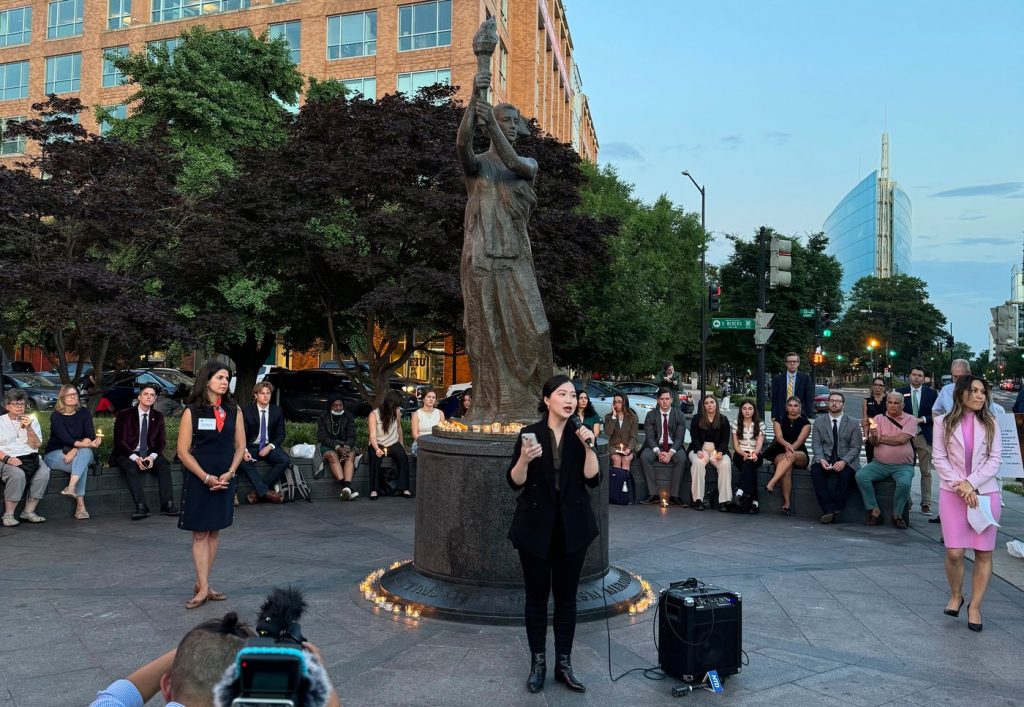
HONG KONG (AP) - In a landmark case under the national security law, Kwok Yin-sang, the father of U.S.-based activist Anna Kwok, was convicted on charges of attempting to deal with his daughter's financial assets. This ruling marks the first of its kind since the implementation of the controversial law designed to suppress dissent in Hong Kong. The conviction occurred on a Wednesday, less than a year after Hong Kong authorities placed a bounty on Anna, offering 1 million Hong Kong dollars (approximately $127,900) for information leading to her arrest.
Anna Kwok is the executive director of the Washington-based Hong Kong Democracy Council. She has faced accusations from Hong Kong authorities for allegedly soliciting foreign sanctions and engaging in hostile activities against China by meeting with foreign officials. This crackdown is seen as part of an ongoing effort by the authorities to silence opposition following significant anti-government protests in 2019.
Kwok Yin-sang, aged 69, was arrested in April 2025 under the national security law, locally referred to as Article 23 legislation, enacted the previous year. He was accused of trying to obtain money from an insurance policy that was taken out under his daughter's name when she was a child. During his trial, he maintained his innocence, pleading not guilty to the charges.
During the proceedings, acting principal magistrate Cheng Lim-chi determined that Kwok must have known of his daughter's status as an absconder and that he was attempting to handle her assets. The court heard that after Anna turned 18, she gained control over the insurance policy. In 2025, Kwok's intention was to cancel that policy to access the funds, drawing the attention of authorities.
Kwok’s attorney, Steven Kwan, argued for leniency in sentencing, noting that there was no evidence indicating that Kwok intended to use the funds to send back to Anna. He suggested a short prison term of 14 days. The maximum potential sentence for the charges against Kwok is seven years; however, since his case was held in magistrates' court, the typical maximum sentence is two years. A sentencing date has been set for February 26.
The condemnation of this case has been echoed by the Hong Kong Democratic Council, which stated that the verdict represents a troubling escalation in transnational repression. Critics, including U.S. and U.K. officials, have publicly denounced the targeting of overseas-based activists through police bounties, which they view as an infringement on human rights.
In 2025, the U.S. government sanctioned six Chinese and Hong Kong officials for transnational repression and actions that undermine the autonomy of Hong Kong. Washington claimed that Chinese and Hong Kong officials have wielded national security laws extraterritorially to intimidate and silence activists who fled abroad. Following these actions, Beijing retaliated, announcing sanctions on U.S. officials and others perceived as having performed poorly on Hong Kong issues.
Since the imposition of the national security law in 2020, many prominent activists have been arrested or have gone into exile, continuing their advocacy from abroad. Both the governments of China and Hong Kong argue that the security laws are essential for maintaining the stability of the city, which was handed over from British to Chinese rule in 1997. This legal action against Kwok Yin-sang underscores the ongoing tensions surrounding the enforcement of such laws and the wider implications for civil liberties in Hong Kong.








