

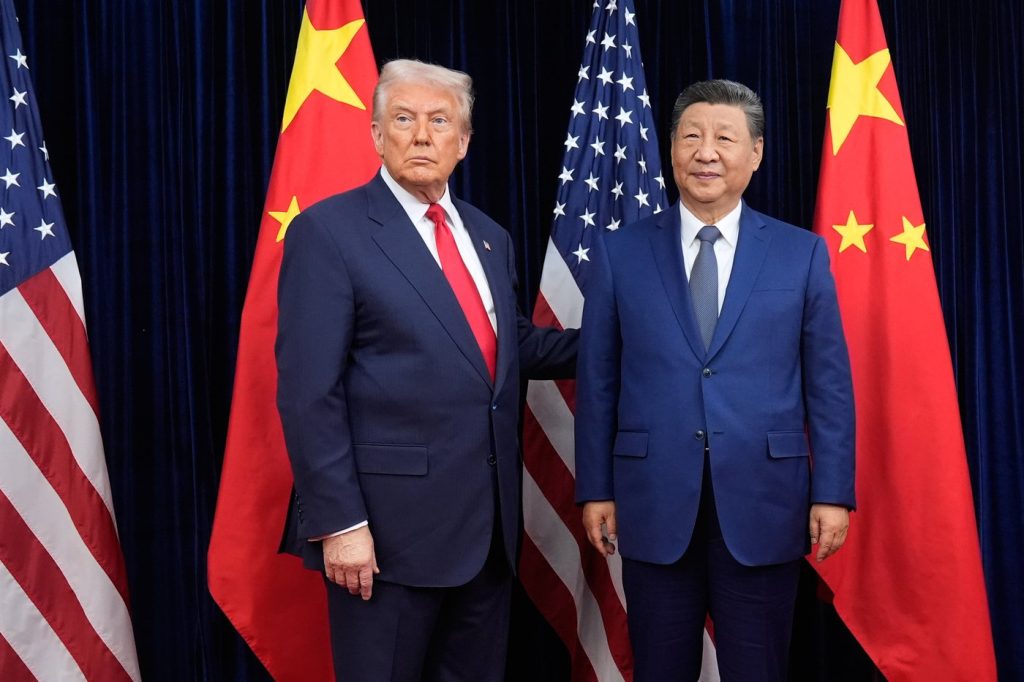
The recent Supreme Court decision invalidating President Donald Trump's extensive tariffs has added complexity to the already tense U.S.-China relations. Both nations are strategically maneuvering to prevent a full-blown trade war that could negatively impact the global economy while still competing for leverage in ongoing negotiations.
Analysts suggest that while the ruling may bolster China's negotiating position, Beijing is likely to exercise restraint in capitalizing on this advantage, recognizing that Trump retains other means to impose tariffs. Both countries aim to uphold a fragile trade truce and stabilize relations in anticipation of Trump's upcoming visit to Beijing from March 31 to April 2.
Sun Yun, director of the China program at the Stimson Center, noted that while the Supreme Court's decision represents a moral victory for China in negotiations, they are prepared for the likelihood that it may not lead to significant changes in practice. Meanwhile, Trump, incensed by the ruling, initially announced a temporary global tariff of 10% which he later raised to 15%, while exploring alternative routes for imposing import duties. He cited China as a major threat to U.S. economic, technological, and military dominance.
Chinese President Xi Jinping is expected to approach the negotiation thoughtfully, avoiding a heavy-handed demonstration of the Supreme Court ruling. Ali Wyne, a senior adviser at the International Crisis Group, posited that strengthening his relationship with Trump could enhance the odds of the trade truce taking root and lead to security concessions from the U.S. that would grant China more latitude in its regional actions.
In a response to the court ruling, Chinese Embassy spokesperson Liu Pengyu emphasized that trade wars are counterproductive for both countries, advocating for collaboration to foster stability and certainty in U.S.-China economic and trade relationships.
The ruling not only introduces uncertainty for China but also affects other U.S. trading partners in Asia and around the globe, particularly those who have previously secured deals meant to assuage the chaos following Trump's tariffs. Dan Kritenbrink, a partner at The Asia Group, anticipated a cautious approach from Asian partners, suggesting that current agreements would largely remain intact as they assess the implications of the recent developments.
Trump's administration has previously utilized emergency powers to impose tariffs, including a 20% levy on Chinese goods, after alleging China's negligence in addressing fentanyl production. Following negotiations and a temporary truce, both nations agreed to a baseline tariff of 10% but the situation remains fluid as tensions persist.
According to Wendy Cutler, vice president of the Asia Society Policy Institute, the Trump administration is likely to roll out an alternative strategy if issues with China's compliance arise. The Office of the U.S. Trade Representative is currently investigating China's adherence to past agreements, potentially enabling the U.S. to impose tariffs if violations are found.
Gabriel Wildau, a managing director focused on political risk in China, remarked that Trump's willingness to leverage legal avenues to introduce tariffs suggests that they could be reinstated or maintained, posing challenges for Beijing. However, there is a prevailing hope that China can persuade Trump to reduce tariffs in return for purchase guarantees or other concessions.
The situation continues to evolve, with both nations navigating a complex and sensitive landscape filled with economic and strategic implications.








