

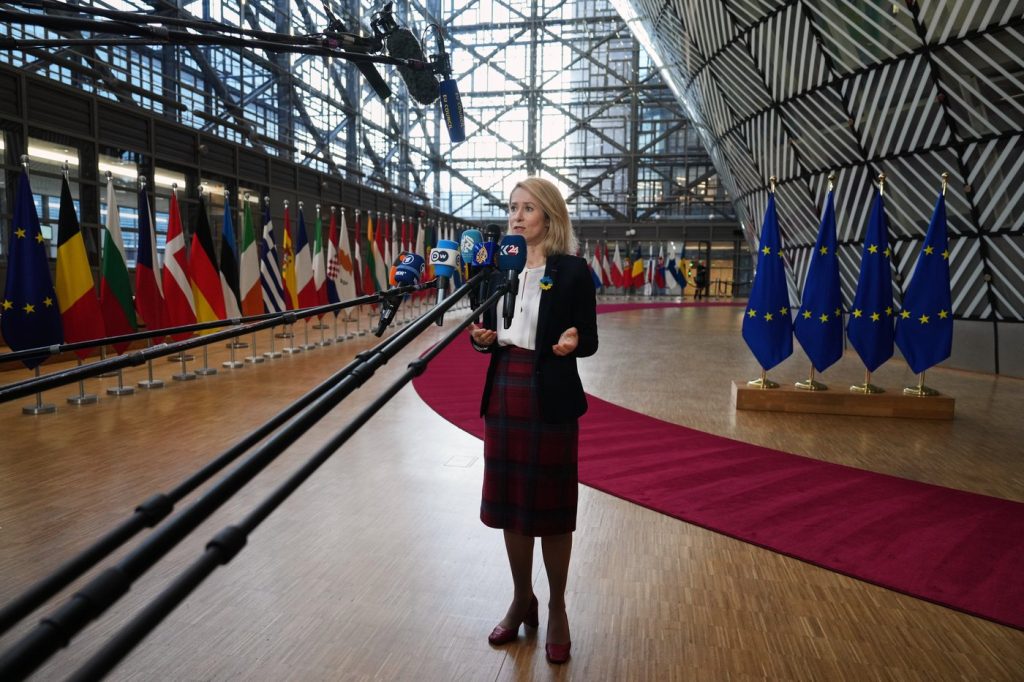
BRUSSELS (AP) — A recent sanctions package from the European Union aimed at targeting Russia's shadow fleet and energy revenues is being blocked by Hungary, as announced by the EU's top diplomat on Monday. This 20th sanctions package was intended to be approved just ahead of the fourth anniversary on Tuesday of Russia's full-scale invasion of Ukraine.
EU foreign policy chief Kaja Kallas stated, “I think there is not going to be progress regarding this today,” before the regular meeting of the EU's foreign ministers in Brussels, dedicated to discussing the sanctions package. Hungary recently threatened to obstruct the sanctions plans, additionally conditioning its participation on the resumption of Russian oil deliveries to Hungary.
Since January 27, Russian oil shipments to Hungary and Slovakia have been disrupted following Ukrainian officials' claims of Russian drone attacks that damaged the Druzhba pipeline, which transports Russian crude through Ukraine into Central Europe. This situation has incited increasing tensions between Budapest and Kyiv.
Hungarian Prime Minister Viktor Orbán reiterated on Monday his unsupported claim that Ukraine was intentionally limiting Russian oil shipments and accused Kyiv of attempting to destabilize his government. In a social media post, Orbán referred to the ongoing oil disruptions as a “Ukrainian oil blockade” orchestrated by President Volodymyr Zelenskyy, asserting, “We have given President Zelenskyy firm and proportionate responses. He, too, must understand: by attacking Hungary, he can only lose.”
To pass the sanctions package, a unanimous agreement is required among the 27 EU member states. Kallas indicated that efforts would continue on the same day to progress discussions related to the EU’s extensive 90 billion euro loan to Ukraine.
The looming election in Hungary casts a shadow over the EU negotiations. Orbán is facing a crucial election within two months and has initiated an aggressive anti-Ukraine campaign, alleging that the opposition Tisza party, which leads in polls, is conspiring with the EU and Ukraine to implement a “pro-Ukraine government aligned with Brussels and Kyiv.”
Poland’s Foreign Minister Radoslaw Sikorski commented on Hungary’s unexpected announcement, suggesting it might be more about Orbán's struggle to maintain power. He expressed disappointment over Hungary’s lack of solidarity with Ukraine, stating that the ruling party has cultivated an environment of hostility toward the victim of aggression while exploiting this sentiment for electoral gain.
As the conflict continues, nearly every European nation has significantly reduced or halted Russian energy imports since Russia launched its full-scale assault on Ukraine on February 24, 2022. However, Hungary and Slovakia, both EU and NATO members, have maintained their Russian oil and gas supplies, benefitting from a temporary exemption from an EU policy banning Russian oil imports.
European leaders are calling for solidarity with Ukraine. Latvian Foreign Minister Baiba Braze emphasized their commitment to the 20th sanctions package and reaffirmed their support for European values. German Foreign Minister Johann Wadephul expressed astonishment at Hungary’s position, suggesting that it undermines Hungary's own historical battle for freedom and European sovereignty. Wadephul affirmed that Germany would continue to engage with Hungary to reconsider their stance and reiterated the need for the EU to maintain pressure on Russia.
The situation is further complicated by the impending 90 billion euro ($106 billion) EU loan to Ukraine, deemed crucial for addressing the country’s military and economic requirements over the next two years. Estonia’s Foreign Minister Margus Tsahkna voiced the urgent need to finalize a consensus on this funding, emphasizing Ukraine's critical need for financial support.








