

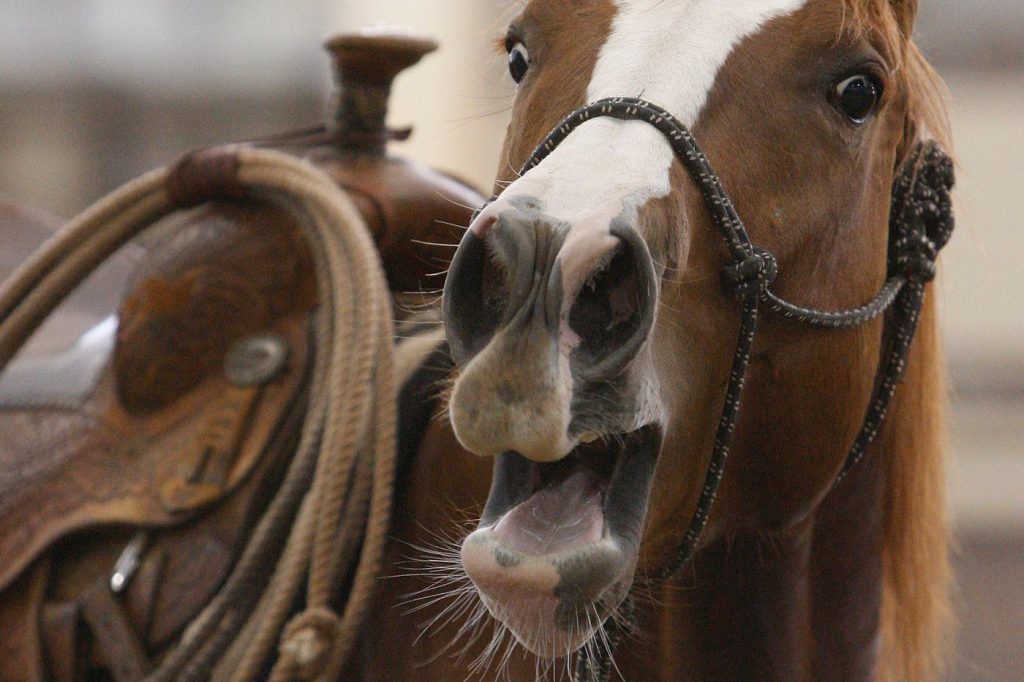
NEW YORK (AP) Horses whinny for various reasons, including to establish connections with new friends, greet familiar ones, and celebrate joyful moments such as feeding time. The exact manner in which these animals produce their distinctive whinny, also known as a neigh, has been a long-standing mystery for scientists.
Researchers have noted that the whinny is a unique blend of both high and low-pitched sounds, resembling a mix between a grunt and a squeal, emanating simultaneously. While the low-pitched sounds can be attributed to air passing over vibrating tissue in the horses' voice boxes, the origin of the high-pitched components has remained elusive. Typically, larger animals with larger vocal cords tend to produce lower-frequency sounds, raising questions about how horses manage to create higher pitches.
A recent study has unveiled that horses actually produce high-pitched sounds by whistling. In their investigation, researchers introduced a small camera into the horses' nostrils to capture internal video footage while the animals whinnied and produced a softer sound known as a nicker. The team also utilized detailed scans and conducted experiments that involved blowing air through the isolated voice boxes of deceased horses to study this phenomenon further.
The findings revealed that the high-pitched tones of the whinny are generated through a whistling mechanism that originates in the horse's voice box. As air vibrates the tissues within, a section just above the voice box tightens, creating a small opening that allows the whistling sound to emerge. This differs from how humans typically whistle, which is done using the mouth.
Jenifer Nadeau, an expert on horse behavior from the University of Connecticut who was not involved in the study, expressed her surprise at the idea of a whistling component in horse vocalizations, stating, "I’d never imagined that there was a whistling component. It’s really interesting, and I can hear that now."
Interestingly, while some small rodents like rats and mice exhibit similar whistling behaviors, horses are the first large mammals identified as possessing this capability. They are also unique in their ability to whistle through their voice boxes while simultaneously vocalizing.
Alisa Herbst from Rutgers University’s Equine Science Center remarked on the significance of the study, saying, “Knowing that a ‘whinny’ is not just a ‘whinny’ but that it is actually composed of two different fundamental frequencies created by two different mechanisms is exciting.”
A lingering question from this research is how horses developed this two-toned vocalization. Some wild horses, like Przewalski's horses, and other distant relatives such as elks, exhibit similar vocal characteristics. However, closer relatives like donkeys and zebras do not produce high-pitched sounds.
The dual tonal quality of horse whinnies may serve multiple purposes, allowing them to communicate various messages simultaneously. The distinct pitches could enable horses to express a wider array of emotions while interacting with one another, as highlighted by study author Elodie Mandel-Briefer from the University of Copenhagen, who stated, "They can express emotions in these two dimensions."
In conclusion, this recent study provides valuable insight into horse communication and suggests that the complexity of their vocalizations plays an essential role in their social interactions.








