

BANGKOK (AP) – On Tuesday, Asian shares exhibited mixed performance following a significant downturn in U.S. stocks, where heavy selling occurred for companies seen as potential losers in the ongoing artificial intelligence boom. Despite this, U.S. futures increased and oil prices showed gains. Tokyo's Nikkei 225 index experienced a notable rise of 0.9%, reaching 57,354.14, buoyed by advances in computer-chip related companies. Notably, chip-testing equipment manufacturer Advantest surged by 4.6%, while machinery maker Disco Corp. gained 2.2%.
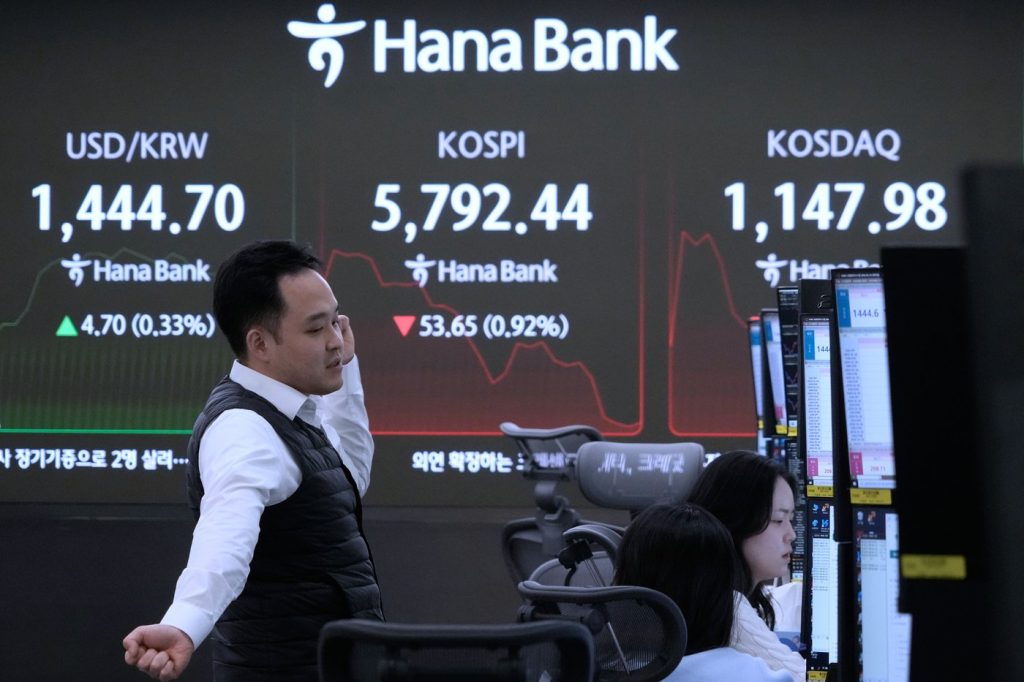
Markets in mainland China rebounded by more than 1% as they reopened after a weeklong holiday. The Shanghai Composite index rose by 1.2% to 4,129.78. Conversely, Hong Kong's Hang Seng fell by 1.9% to 26,564.01 as traders opted to lock in profits from previous gains. In South Korea, the Kospi index climbed 1.8% to 5,951.90, setting new records on the back of strong performance from Samsung Electronics, which saw a jump of 3.2%, and SK Hynix, another prominent chip maker, which rose by 4.8%. Australia’s S&P/ASX 200 edged down by 0.1% to 9,014.50, while Taiwan's Taiex achieved a gain of 2.4%. India's Sensex, however, experienced a decline of 0.3%.
On the U.S. front, stocks slumped on Monday following President Donald Trump’s announcement of new tariffs. The S&P 500 index fell by 1% to 6,837.75, amidst news that Trump would implement temporary 15% tariffs on various countries after a Supreme Court ruling that limited his authority to impose more sweeping “reciprocal” tariffs. The Dow Jones Industrial Average dropped 1.7% to 48,804.06, while the Nasdaq composite fell by 1.1% to 22,627.27.
Trump's swift move towards escalating tariffs highlights the ongoing uncertainty surrounding the global economy, despite the Supreme Court ruling. Investors appear to be bracing themselves for a protracted period of uncertainty regarding global trade dynamics, compounded by potential legal battles.
The AI sector's impact was palpable on Wall Street, as companies that may face competition from AI technology suffered significant losses. For instance, CrowdStrike's share price plummeted by 9.8%, marking a loss of 25.3% for the year thus far. This selling pressure was sparked by concerns over Anthropic’s new tool that identifies security vulnerabilities, which has been affecting stocks across the cybersecurity sector. Similarly, AppLovin experienced a decline of 9.1%, bringing its year-to-date losses to 43.5%.
The week ahead promises further volatility as investors await Nvidia's profit report scheduled for Wednesday. There are growing worries that major companies, including Alphabet and Amazon, may be over-investing in Nvidia's chips, facing the risk of not recouping their investments through increased productivity and future profits.
Aside from AI-related stocks, the airline sector also faced downward pressure as heavy snowfall and high winds resulted in the cancellation of thousands of flights across the Northeastern United States. United Airlines’ stock fell by 5.2%, American Airlines dropped by 4.9%, and Delta Air Lines sank by 3.7%. Furthermore, shares of Novo Nordisk plummeted by 16.4% after the Danish drugmaker reported disappointing results from a trial for its CagriSema drug, which showed less weight loss efficacy after 84 weeks compared to a similar drug from rival Eli Lilly, whose stock rose by 4.9%.
In comments made on Monday, Federal Reserve Governor Christopher Waller indicated that it was now uncertain whether the Fed would lower its key interest rate in March or maintain the current rate. This is a shift from earlier in January when he had voiced dissent against the Fed's decision to keep rates steady after the central bank implemented three rate cuts at the end of 2022. Lower rates could bolster the economy, though they might also exacerbate inflationary pressures.
Early Tuesday trade saw U.S. benchmark crude oil gaining 57 cents to $66.88 per barrel, while Brent crude, the international standard, rose by 59 cents to $71.70 per barrel. This uptick in crude prices follows worries over potential military action by President Trump against Iran. The U.S. dollar strengthened against the Japanese yen, rising to 155.16 from 154.66, while the euro declined slightly to $1.1775 from $1.1786. Bitcoin saw a decrease of 2.4%, trading at $63,330.








