

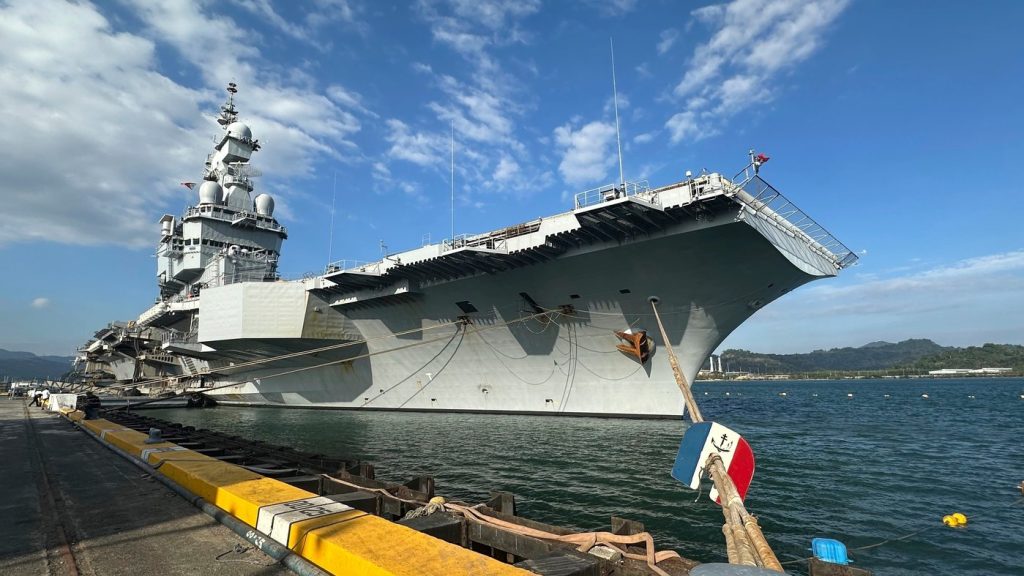
STOCKHOLM (AP) — The Swedish military has successfully intercepted a suspected Russian drone off the southern coast of Sweden, coinciding with the presence of the French aircraft carrier Charles de Gaulle docked in the port city of Malmö. Observations were made by a Swedish naval ship during a routine patrol in the Öresund, the strait separating Sweden from Denmark.
On Thursday, officials reported that Swedish armed forces took unspecified countermeasures to disrupt the drone, after which contact with the aircraft was lost. The Charles de Gaulle, a nuclear-powered aircraft carrier, is in Malmö this week as part of regular NATO exercises. This military collaboration aims to strengthen security measures amid growing tensions in the region.
French military spokesperson Guillaume Vernet informed The Associated Press that the drone was detected on Wednesday and was addressed by Swedish forces integrated into the security system surrounding the carrier. Vernet emphasized that the drone was located more than 10 kilometers (approximately 6 miles) away from the Charles de Gaulle at the time of the incident, asserting that the event did not affect the operations of the aircraft carrier battle group.
Swedish Defense Minister Pål Jonson spoke with public broadcaster SVT on Thursday evening, revealing that the suspected violation of Swedish airspace by the drone occurred simultaneously with a Russian military vessel being present in Swedish territorial waters. When asked about the origin of the drone, Jonson responded, “Probably Russia.” Following the incident, the Russian ship continued its course into the Baltic Sea, while Swedish authorities maintained close communication with their Danish counterparts to monitor the situation. Notably, the Swedish military reported that no additional drones were observed in the area following this encounter.
Western officials have alleged that Russia is orchestrating a comprehensive campaign of sabotage and disruption throughout Europe. An Associated Press database has recorded over 100 such incidents attributed to this strategy. However, not all occurrences are made public, and it can sometimes take officials months to establish a direct link to Moscow.
Since President Vladimir Putin's invasion of Ukraine in 2022, this campaign aims to undermine support for Kyiv while simultaneously attempting to identify vulnerabilities within Europe. Western intelligence agencies have expressed concerns that Russian actions are designed to strain law enforcement resources and create instability across the continent.








