

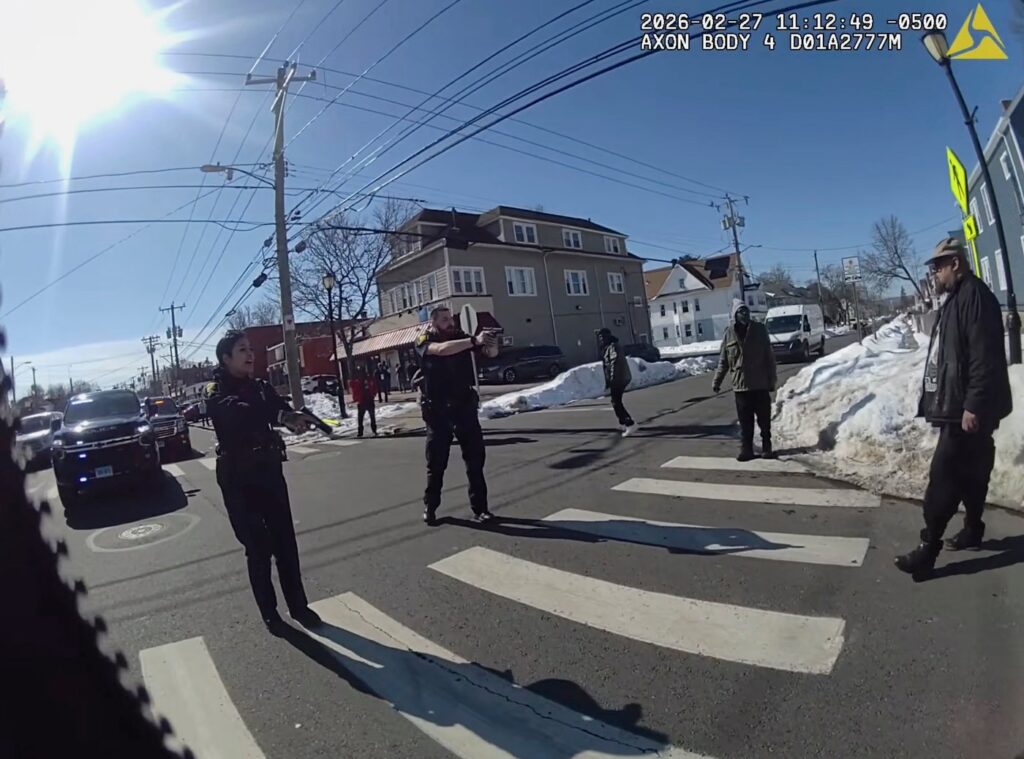
HARTFORD, Conn. (AP) — Joseph Magnano, a white police officer in Connecticut, made his first court appearance on a manslaughter charge related to the fatal shooting of a Black man, Steven Jones, during a mental health crisis. The incident took place on February 27, and the shooting led to significant public outrage regarding police responses to individuals experiencing mental distress.
During the brief hearing at Superior Court, Magnano remained silent and later received support from fellow officers, whom he embraced after the proceedings. Following the shooting, Magnano was terminated from his position by the Hartford mayor, amplifying the community's concerns over police conduct in similar scenarios.
Steven Jones, 55, had a documented history of mental illness and was seen holding a large knife on the street when police arrived. Body camera footage from the incident revealed three officers attempting to communicate with Jones for several minutes, urging him to drop the knife while assuring him that their intentions were to help. Officer James Prignano was recorded stating, “Steve, you’re OK. We’re going to make sure you’re OK. Just drop the knife. We’re going to go talk to somebody, OK?” However, Jones did not verbally respond during these interactions.
Approximately 12 minutes after the 911 call, Officer Magnano arrived on the scene, drew his pistol, and ordered Jones to drop the knife, stating, “You’re going to get shot.” Amid the escalating confrontation, a bystander could be heard pleading, “Don’t shoot him!” Despite colleagues signaling for Magnano to step back, he fired nine shots at Jones as the latter approached, resulting in Jones’ death four days later in a hospital.
Connecticut Inspector General Eliot Prescott conducted an investigation revealing that Magnano “failed to make reasonable attempts to use non-lethal force” and concluded that Jones did not pose an imminent threat at the time of the shooting. The incident report indicated that Magnano perceived a risk of serious physical injury to bystanders, but there was no effort made to relocate them away from what he perceived as danger.
In a defense of Magnano, James Rutkauski, president of the local police union, claimed that the officer was defending himself and the other officers present. He characterized the arrest of Magnano as a profound shake in the department, asserting that it should alarm citizens, saying, “This warrant is an absolute attack on the foundation of justice and the constitutional rights of every citizen.” Rutkauski expressed concern for Magnano's well-being, describing the 23-year-old as “a mess” following his arrest.
Civil rights attorney Ben Crump, representing Jones' family, articulated a starkly different perspective. He criticized the incident, emphasizing that “Stevie was in the middle of a mental health crisis, and instead of receiving the care he needed, he was shot nine times.” This sentiment underscores the demanding conversation surrounding police interactions with individuals experiencing mental health issues.
The court appearance attracted an audience of more than 60 police officers who came to show solidarity with Magnano, while several supporters of Jones, including members from the local NAACP, were also present. However, Jones' relatives opted not to attend the hearing. The events following the shooting and Magnano's subsequent legal struggles will leave a significant impact on the community and ongoing discussions regarding police strategy in managing mental health crises.








