

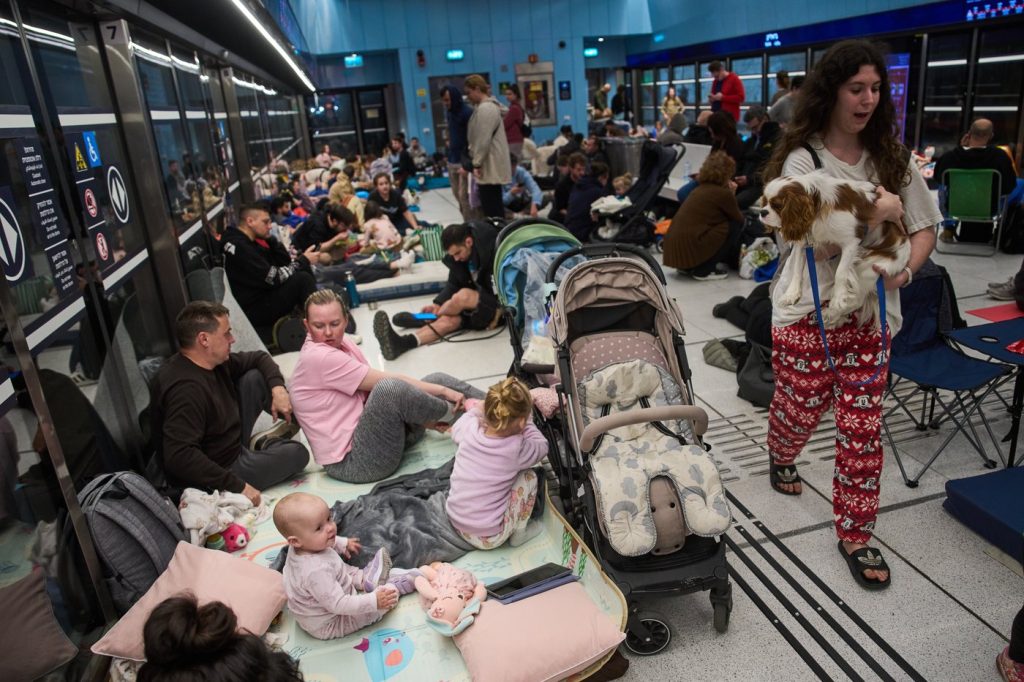
TEL AVIV, Israel (AP) — On Saturday, constant missile barrages from Iran forced residents in central Israel to seek refuge in shelters as tensions escalated following a major attack launched by the U.S. and Israel on Iran. The situation has created a significant strain on the civilian population, particularly in poorer neighborhoods where access to adequate shelters is limited.
In Jaffa, a mixed Arab-Jewish neighborhood of Tel Aviv, over 100 individuals, including Muslim families with young children and religious Jews from a nearby seminary, crowded into a public shelter located beneath a park. Some people brought mattresses and played cards, others exchanged snacks, and observant Muslims took part in fasting during the holy month of Ramadan. Many residents were glued to their phones, scrolling through updates as air raid sirens sounded repeatedly in the area. As twilight approached, Muslims were compelled to break their daily fast with iftar meals in the bomb shelters.
Idit Cohen, a local resident, expressed the community's resilience despite the dire circumstances. “Of course we expected it, even though we didn’t want it to happen,” she stated, noting the instances of community solidarity. Her son received an emergency military summons, and a stranger in the shelter offered to drive him to his military base, despite being a religious Jew who typically refrains from driving on the Sabbath.
Cohen voiced her frustration about the ongoing violence: “I want it to end as soon as possible, it’s a nightmare. People are more and more frustrated and tired.” She highlighted the plight of families with infants and the elderly who struggle to endure the continuous movement to shelters throughout the day. Many families have become accustomed to this reality, with Igor Libenson, a construction worker and father of two, sharing that his children had previously experienced similar situations during conflicts in June.
In another shelter in northern Tel Aviv, Maya Tutian, a resident, expressed a long-term perspective on the conflict: “We look at this in the long term. We suffer today but we do hope that it will resolve the problems of tomorrow.” She emphasized that the Iranian regime poses a global threat, transcending regional borders.
During last year’s conflict with Iran, many residents who lacked access to proper shelters resorted to seeking refuge in underground light rail stations and mall parking garages. While new buildings in Israel are mandated to include reinforced safe rooms designed to resist rocket attacks, the escalating strength of Iranian ballistic missiles has rendered these shelters less effective. Additionally, there remains a critical shortage of shelter access in economically disadvantaged neighborhoods and rural areas of the country.
According to the Negev Coexistence Forum, a local advocacy group, over two-thirds of Israel’s Bedouin minority lack access to shelters. Last summer, many families from the Bedouin community resorted to constructing makeshift shelters from available materials, including buried steel containers and repurposed construction debris to protect themselves from missile attacks.
Following the early Saturday attack by Israel and the U.S., which initiated the wave of Iranian missile strikes, the Israeli army reported that dozens of missiles had been launched at Israel by nightfall. Israeli police and emergency services reported several minor injuries due to the strikes, while the military successfully intercepted many of the incoming missiles.
In response to the escalating situation, Israel issued a nationwide warning, placing the entire country on high alert and canceling schools and most public gatherings. The community, despite the tensions and trauma, has shown a remarkable capacity to come together in times of crisis, demonstrating resilience amid uncertainty.








