

BANGKOK (AP) — Asian stock markets experienced a significant downturn Wednesday, most notably South Korea's benchmark index, which plummeted by as much as 11%. This decline coincided with a rise in oil prices, driven by escalating concerns over the conflict with Iran. Investors are increasingly worried about how rising oil prices may contribute to worsening inflation, potentially hampering the global economy and impacting corporate profits.
The South Korean Kospi index led regional losses, dropping 9.6% to 5,235.72 points by midday. Major technology companies like Samsung Electronics and SK Hynix, which had previously benefited from advancements in artificial intelligence, saw their shares drop sharply—more than 10% for Samsung and 8% for SK Hynix. In response to these drastic declines, the Korea Exchange temporarily suspended trading in the Kospi index, and a circuit breaker was triggered for the tech-focused Kosdaq index after it fell over 8%.
This downturn appears stark given that South Korea's stock market had been one of the best performers globally earlier in the year, primarily due to the semiconductor sector thriving amid a worldwide AI boom. However, the ongoing war in the Middle East has raised significant fears regarding energy security, particularly as Iran threatens to shut down the Strait of Hormuz, which is crucial for global oil transportation, accounting for about 20% of all traded oil.
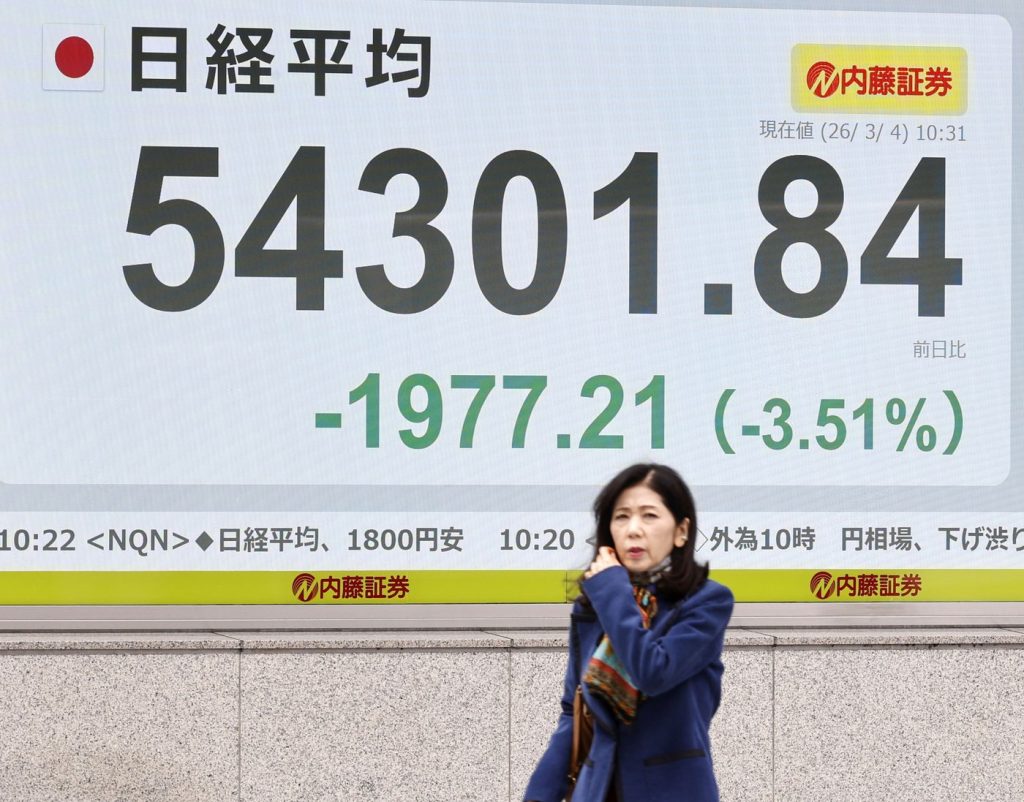
In Tokyo, the Nikkei 225 index fell 3.9% to 54,090.11. Similar to South Korea and Taiwan, Japan heavily relies on imports of oil and natural gas from the Middle East, now trapped in the Persian Gulf. Other markets across Asia were also negatively impacted, with Hong Kong's Hang Seng index declining 2.8% to 25,037.92 and the Shanghai Composite index losing 1.3% to 4,069.09. In Australia, the S&P/ASX 200 dipped by 2% to 8,896.50. Taiwan's Taiex index posted a loss of 3.4%, while shares in Jakarta decreased by 3.7%.
In the United States, the S&P 500 closed down 0.9% at 6,816.63, having dropped as much as 2.5% earlier in the day due to concerns about the war's economic impact. The Dow Jones Industrial Average also saw a reduction, finishing off 0.8% at 48,501.27, while the Nasdaq composite fell 1% to close at 22,516.69.
The bond market reacted similarly, with Treasury yields rising in the morning due to inflation fears. The yield on the 10-year Treasury note briefly surpassed 4.10% before settling just below 4.06%. Comparatively, it was at 4.05% late Monday and was lower at 3.97% on Friday. Increased yields can significantly raise borrowing costs for U.S. households and businesses, with implications for everything from mortgages to bond issuances. Additionally, they may exert downward pressure on stock prices and other types of investments.
While some analysts believe the current situation does not indicate the beginning of a prolonged market downtrend, they do recognize the situation's uncertainty, which was vividly illustrated by Tuesday’s market fluctuations. Meanwhile, the average price of gasoline in the U.S. increased by 11 cents overnight, reaching $3.11 per gallon, as drivers in various regions experienced long lines at gas stations. Global market trends influence U.S. gasoline prices, even though the country remains a net oil exporter.
In this context, the escalating war and consequent inflation risks could hinder the Federal Reserve's ability to lower interest rates moving forward. The Fed had previously indicated a string of rate cuts for 2026 to invigorate the economy and job market, but lowering rates can also exacerbate inflation concerns. Currently, U.S. benchmark crude oil prices rose 1.2% to $75.46 per barrel, while Brent crude increased by 1.5% to $82.61 per barrel. The dollar remained relatively stable at 157.55 Japanese yen, with the euro slipping marginally to $1.1599 from $1.1600.








