

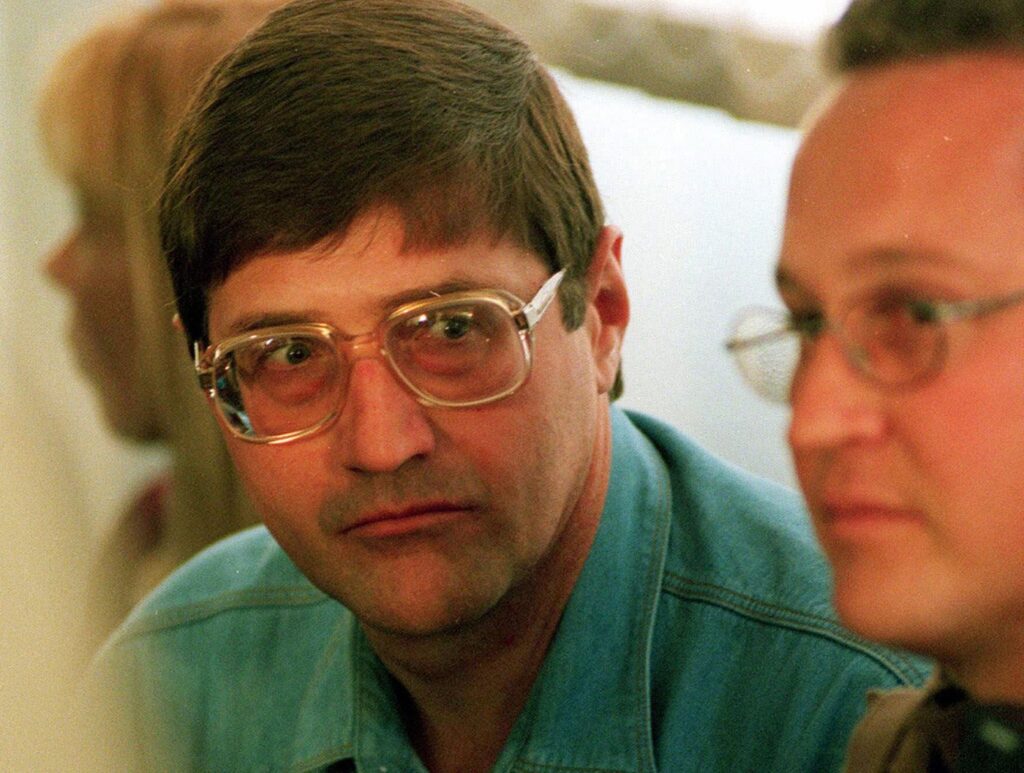
JOHANNESBURG (AP) — One of South Africa's most notorious apartheid police commanders, Eugene de Kock, known as "Prime Evil," testified on Monday at a renewed inquiry into the 1985 killings of four anti-apartheid activists, collectively known as the Cradock Four. This inquiry reflects South Africa's ongoing efforts to address atrocities committed by security forces during the decades of racial segregation that occurred under apartheid, a time when many crimes went unpunished.
De Kock, who was the commander of a special counterinsurgency unit during apartheid, denied any involvement in the case of the Cradock Four. He claimed that police at the time maintained a list of approximately 6,000 anti-apartheid activists whom they labeled as "known terrorists." He emphasized that the Cradock Four were not on that list. The activists Matthew Goniwe, Fort Calata, Sicelo Mhlauli, and Sparrow Mkonto, three of whom were teachers, were abducted at a police roadblock. Their bodies were later found burned in what is considered one of the most shocking cases of the apartheid era.
During his testimony, de Kock revealed that one of the implicated police officers had approached him for assistance in covering up the crime. He noted that this officer asked if he could procure another firearm and if there was a way to "interfere with the ballistics" related to the case.
In 1996, de Kock was sentenced to two life terms along with an additional 212 years in prison for his role in the kidnappings, torture, and killings of anti-apartheid activists. He was released on parole in 2015. At the age of 77, he was provided with police protection during his court appearance in Gqeberha, the city where the Cradock Four were killed. His image was blurred during the official video broadcasts after a judge ruled that he should not be identified, as indicated by the Foundation for Human Rights, which represents the families of the victims.
Two previous inquiries into the Cradock Four case, conducted during the apartheid regime, are widely considered to have been cover-ups. The first inquiry, initiated in 1987, concluded that the men were killed by unspecified individuals, while another inquiry begun in 1993 determined that unnamed police officers were responsible for the killings. Despite being identified, none of the six former policemen implicated in the case have been prosecuted, and they have all since passed away. The latest inquiry was initiated last year due to mounting pressure from the victims' families.
In recent years, South African authorities have reopened several investigations into apartheid-era atrocities. Notable cases include the 1967 death of Nobel Peace Prize winner Albert Luthuli, the 1981 killing of attorney Griffiths Mxenge, and the police custody death of prominent anti-apartheid figure Steve Biko in 1977.
In a further step towards addressing apartheid-era violence, South African President Cyril Ramaphosa ordered a separate inquiry last year. This inquiry aims to establish whether post-apartheid governments led by his party intentionally obstructed investigations and prosecutions concerning crimes committed during the apartheid era. The efforts highlight a renewed commitment to acknowledging and confronting the human rights violations that took place during one of South Africa’s darkest chapters.








