

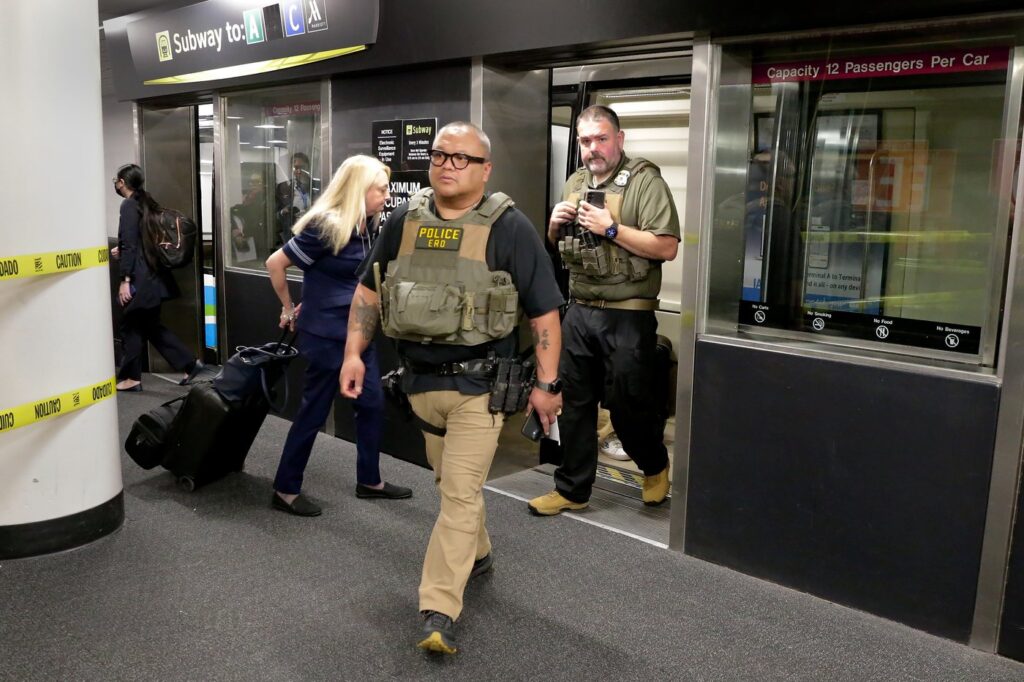
Federal immigration officers have been deployed to U.S. airports in response to a partial government shutdown, which has led to substantial delays and long lines at Transportation Security Administration (TSA) checkpoints nationwide. This move comes as part of President Donald Trump’s commitment to bolster airport security during this period of disruption, effectively assisting the TSA, which has faced staffing shortages due to the government closure.
The deployment of federal immigration agents is aimed at alleviating congestion at major airports, where travelers have experienced increasing wait times. These challenges have become particularly acute at key facilities such as George Bush Intercontinental Airport in Houston, Newark Liberty International Airport in New Jersey, John F. Kennedy International Airport (JFK) in New York City, and Hartsfield-Jackson Atlanta International Airport. The situation highlights the significant impact that governmental administrative issues can have on public infrastructure and service delivery.
On March 23, 2026, various airport locations reported extensive lines. For example, at George Bush Intercontinental Airport, federal agents were seen preparing to transfer between terminals to facilitate quicker passage through security. Similarly, at Newark Liberty International Airport and JFK, immigration agents observed and assisted travelers navigating overwhelming queues that stretched across terminal areas. Reports from each airport indicate that passengers were often left waiting in lines for prolonged periods, particularly as several TSA screening lines remained closed.
Inside JFK, federal agents were actively monitoring security protocols while addressing the needs of travelers moving through the airport. Additionally, visual documentation from the events showcased the growing presence of immigration officials within terminal spaces, signaling a heightened security environment designed to maintain order amid the chaos. The Hartsfield-Jackson Atlanta International Airport similarly exhibited long TSA lines, further emphasizing a pattern of extended wait times experienced by flyers across the country.
Louis Armstrong International Airport in Kenner, Louisiana, near New Orleans, also reported significant lines, with multiple screening areas closed, which contributed to the frustration among the passengers. The overall atmosphere across airports reflected the strain placed on the TSA due to the government shutdown, underlining the necessity for an immediate response to ensure passenger safety and reduce the likelihood of missed flights due to lengthy security checks.
This gallery of images, associated with the mentioned events, captures a moment in time where federal immigration agents were visibly engaged in assisting travelers, with varying degrees of success. As the government shutdown continued to affect airport operations, the implications of such deployments brought a mixed response from the public regarding effectiveness and necessity during peak travel times.
In summary, the presence of federal immigration agents across U.S. airports, particularly during a time of government shutdown, has raised questions about how such measures can impact traveler experience and airport security protocols. The extended wait times reported at numerous major airports underscore the complexities of managing public services amid administrative challenges, highlighting a critical intersection between policy implementation and everyday traveler realities.








