

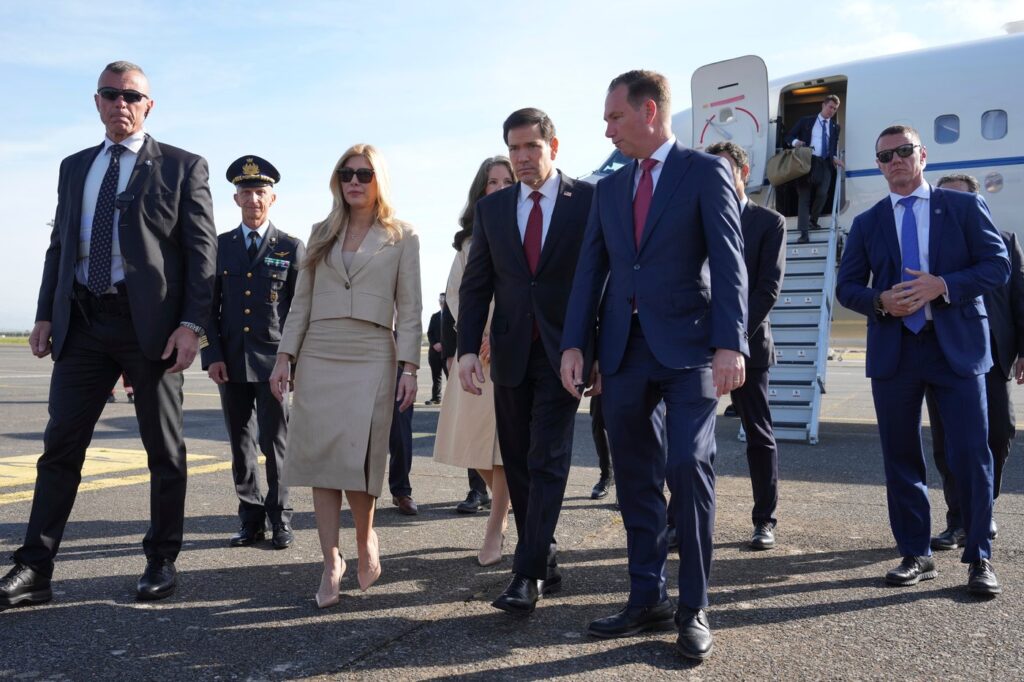
VATICAN CITY (AP) — U.S. Secretary of State Marco Rubio embarked on a diplomatic visit to the Vatican on Thursday, aiming to repair strained relations following President Donald Trump’s antagonistic remarks about Pope Leo XIV and the ongoing U.S.-Israeli conflict in Iran. The tensions have led to a series of public disagreements between Trump and the Vatican, prompting Rubio to take steps to mend ties.
Rubio, a practicing Catholic, was scheduled to meet with Pope Leo XIV, but his audience was complicated by Trump’s latest criticisms directed at the pope. Leo has openly refuted Trump’s characterizations of his stance on Iran and nuclear weapons, insisting that his message is one of peace, grounded in biblical teachings.
The Secretary of State was also set to engage with Vatican Secretary of State Cardinal Pietro Parolin. Prior to Rubio’s visit, Parolin defended the pope and hinted at the appropriateness of maintaining dialogue with the United States despite the challenges posed by Trump’s administration. He emphasized the Holy See’s ongoing partnership with Washington, indicating that, regardless of recent tensions, the U.S. remains a vital ally for the Vatican.
On Friday, Rubio’s itinerary included meetings with Italian Premier Giorgia Meloni and Foreign Minister Antonio Tajani. Both politicians have been vocal critics of Trump's approach, defending the pope against his attacks and contesting the legality of the U.S. and Israeli military actions in Iran. Rubio acknowledged that his visit had been planned for some time, but implied that current events necessitated a more pressing diplomatic mission.
The feud between Trump and Leo erupted last month when Trump condemned the pope on social media for being perceived as lenient on crime and terrorism, particularly in relation to immigration policies and the military conflict in Iran. In response, Leo stated that divine attention would not be granted to those who pursue war. Tensions escalated when Trump compared himself to Jesus Christ in a now-deleted social media post, a move that drew significant backlash.
Rubio defended Trump’s position by claiming that the president’s criticisms stem from genuine concerns about Iran’s potential nuclear capabilities, which, according to Rubio, could threaten Christians, including Catholics. However, Leo has never advocated for Iran to obtain nuclear weapons, maintaining that the Catholic Church has consistently opposed all nuclear arms and has instead focused on promoting peace and dialogue over aggression.
Furthermore, experts such as Giampiero Gramaglia have expressed skepticism about the visit’s impact on Italian and Vatican relations, positing that Rubio may be more interested in advancing his political career ahead of upcoming elections rather than genuinely serving as a mediator between Trump and the pope. The Vatican’s acknowledgment of Leo's global influence further underscores the importance of dialogue between the church and the U.S. administration.
In addition to discussing the Iran war, Rubio’s agenda included topics such as Cuba. The Vatican has shown particular concern over Trump's threats of potential military action in Cuba following Venezuela's political upheaval. Rubio, the son of Cuban immigrants, highlighted the humanitarian aid provided by the U.S. to Cuba, underscoring the complexities of U.S.-Cuban relations during this sensitive period.
As the diplomatic discourse unfolds, the outcomes of Rubio's visit remain pivotal for future relations between the Vatican and the U.S. administration, especially amidst the backdrop of heightened political tensions and critical global issues.








