

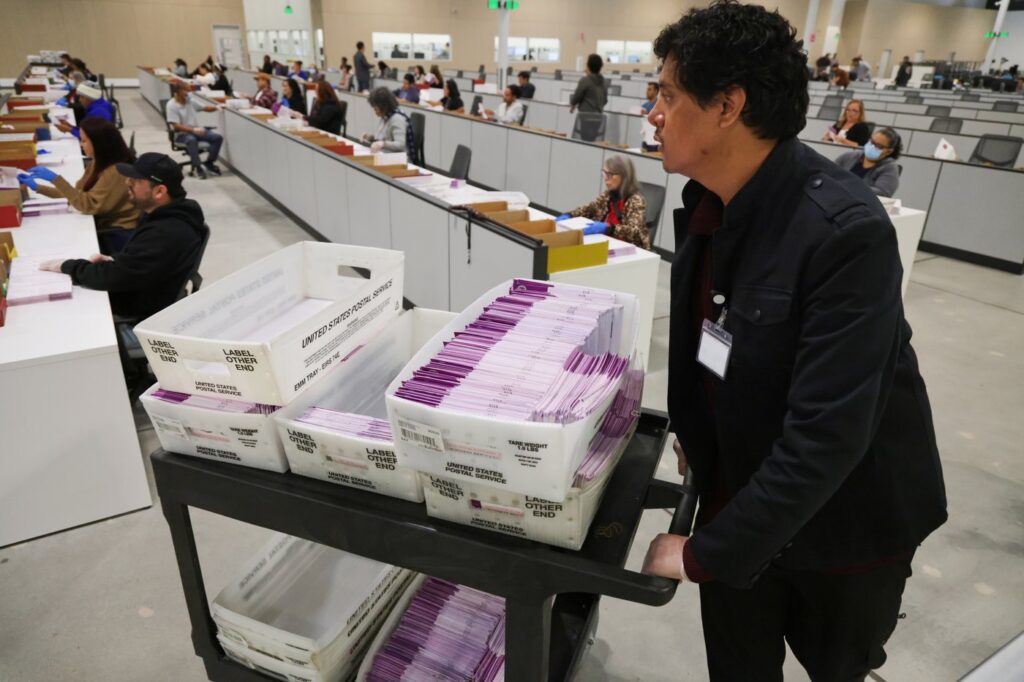
As the U.S. Supreme Court deliberated on whether mail ballots, which arrive postmarked by Election Day, should be counted if they arrive later, state election officials across the country were on alert. Nevada Secretary of State Cisco Aguilar, in response to the arguments presented, texted his staff to begin preparations for the November midterm elections in case the court's decision altered existing rules.
Aguilar emphasized the urgency of educating voters about any changes to the electoral process, stating, "The challenge is educating voters shortly before the election how the election is going to work. That doesn’t happen overnight. The election planning happens long before." This concern echoes the sentiments of election officials in Nevada and thirteen other states that permit grace periods for mail ballots, which have garnered scrutiny from conservative justices during Monday's hearings.
The debate largely centers on Alabama's law permitting the counting of late-arriving mail ballots, specifically those that are mailed by Election Day but can arrive up to five days later. This critical case has implications for the management of voting procedures as it touches upon issues raised by the Republican National Committee and the Libertarian Party regarding the perceived integrity of mail-in voting.
Justice Brett Kavanaugh raised concerns during the almost two-hour discussion about whether a ruling made in June could disrupt the upcoming elections. RNC attorney Paul Clement argued that such timing would provide election administrators ample opportunity to adapt to any changes. However, election experts like Tammy Patrick, a former Arizona election official, pointed out that most jurisdictions would struggle to communicate these shifts to voters effectively.
Patrick indicated that election offices have already prepared a variety of materials—flyers, signs, and even ballot envelopes—according to the current regulations. Any last-minute changes could lead to substantial financial repercussions, as officials would have to produce new materials that were budgeted for well in advance.
Looking at the statistics, in Nevada, 98% of mail ballots typically arrive before Election Day, with 95% of the late arrivals coming the following day. In contrast, Illinois recently noted that out of 5.5 million ballots cast in 2024, just under 2% arrived within its 14-day grace period. This raises the question of how effectively states would manage a potential shift in deadlines, particularly in communicating these changes to voters. Matt Dietrich, spokesman for the Illinois State Board of Elections, stated that efforts would be made to inform local jurisdictions.
Alaska's geographic challenges, with remote communities often relying on air transport, underscore the importance of its ten-day grace period for mail ballots. Michelle Sparck from the organization Get Out the Native Vote expressed her concern over the impact of the Supreme Court’s decision on voting within these communities, emphasizing the potential for disenfranchisement among residents who rely heavily on mail for ballots.
Other states like Massachusetts are constrained by their election schedules as well; they cannot send out general election ballots before their primary on September 1. Spokesperson Debra O’Malley raised additional concerns about the tight timing in relation to the courts' preferences, indicating that election administration cannot be rapidly adapted to sudden legal changes.
Patrick noted that election administrators have increasingly faced challenges due to swift changes in voting laws, particularly following former President Donald Trump's claims about voting integrity. The increase in legislation related to elections has exacerbated the complications facing those tasked with conducting fair and transparent elections.
The Supreme Court has adopted what is known as the "Purcell principle," established from a case in Arizona, which urges that procedural alterations should not occur too close to an election to avoid electoral chaos. Patrick's previous experience during a similar situation emphasizes the necessity of established timelines for informing voters of such changes, mainly in rural areas where mail delivery can be significantly slower.
Aguilar remains hopeful that Nevada officials can adapt to any potential changes but is wary of the disruptive nature a ruling might impose. "To change the rules of the game in the middle of the competition does not do anyone any good," he remarked.








