

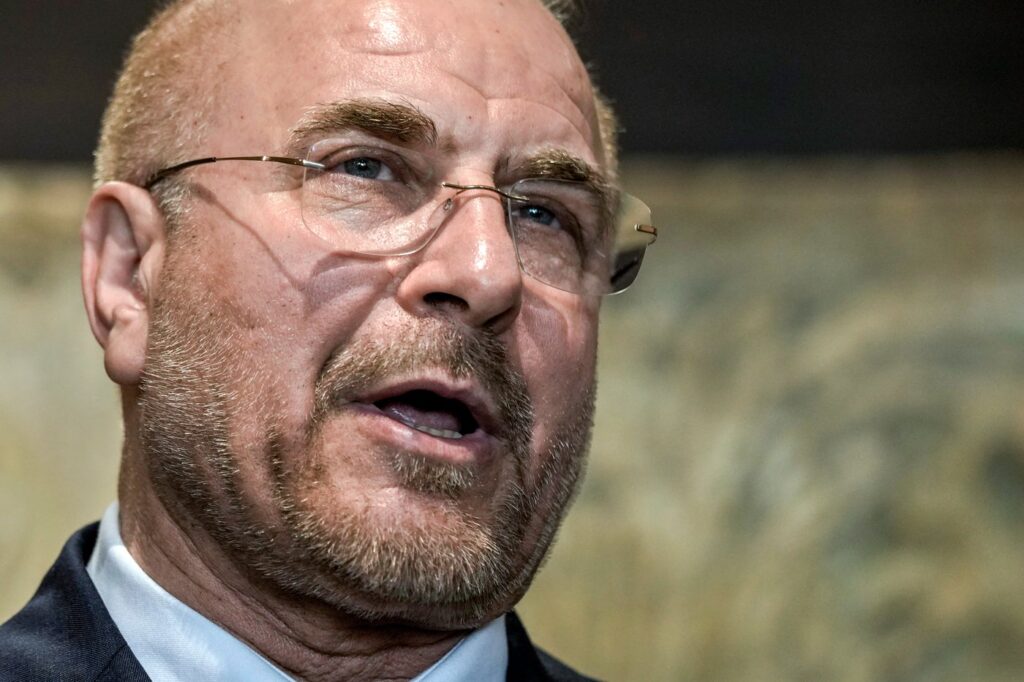
DUBAI, United Arab Emirates (AP) — Mohammad Bagher Qalibaf, Iran’s parliament speaker and a prominent hard-liner, has cultivated a reputation as a negotiator in diplomatic circles for nearly two decades, suggesting that the West could engage with him despite his radical views. In a 2008 interview with The Times of London, Qalibaf expressed a desire for the West to change its perception of Iran and emphasized the need for dialogue.
As the conflict involving the U.S. and Israel against Iran escalates, Qalibaf, now 64, has denied reports of him being considered as a potential negotiating partner for the U.S. amid ongoing tensions. His role and influence within the Iranian regime, particularly following the death of 86-year-old Supreme Leader Ayatollah Ali Khamenei due to an Israeli airstrike on February 28, remain uncertain. With Khamenei's son, Mojtaba, taking the helm as the new supreme leader, dynamics within Iran's theocracy are shifting, leading to power struggles among various factions.
Notably, Qalibaf has been linked to a crackdown on demonstrators advocating for governmental reforms and has faced accusations of corruption during his time in office. Despite mixed perceptions of him within Iran—where many citizens view him unfavorably—some diplomats regard him as a pragmatic figure. Analyst Michael Rubin pointed out that some see Qalibaf's pragmatic approach as merely opportunistic, suggesting he perceives the current U.S. administration as a potential ally to fulfill his ambitions for leadership.
The Iranian semiofficial news agency Tasnim criticized Western media portrayals of Qalibaf, labeling them as attempts to create discord within Iran’s leadership. Tasnim suggested that highlighting Qalibaf as a negotiator aimed to fracture the unity of Iranian leaders and incite conflict among competing political factions.
Qalibaf, born in Torqabeh in Razavi Khorasan province, emerged from a working-class background and rose through the ranks of the Revolutionary Guards during the Iran-Iraq War in the 1980s. He held various powerful positions, including commander of the Guards' air force and head of Iran's police, where he oversaw modernization efforts. His controversial past includes his involvement in suppressing protests and issuing orders for violence against demonstrators.
From 2005 to 2017, Qalibaf served as the mayor of Tehran, during which he faced several corruption allegations, including questionable financial practices involving his family. Despite the accusations, he represented Iran at the World Economic Forum and maintained a nuanced position that differentiated him from former President Mahmoud Ahmadinejad, who was known for his hardline stances.
Qalibaf has pursued presidential aspirations, running in elections in 2005, 2013, 2017, and 2024, yet he has not succeeded despite reported backing from Mojtaba Khamenei. Recently, media speculation suggested that he could serve as a contact for U.S. leaders in potential negotiations, though he firmly denied any ongoing discussions.
As pressure mounts on the Iranian government amid regional conflicts, Qalibaf’s positioning remains critical. Unlike many officials, he is not currently subjected to a U.S. bounty, which raises questions about how he is perceived by Israeli authorities. Following the Hamas attack on Israel on October 7, 2023, Qalibaf made inflammatory remarks asserting that the 'Zionist regime' would face annihilation, indicating a sharp rhetoric that aligns with Iran's longstanding opposition to Israel.
U.S. President Donald Trump has indicated caution regarding the identity of potential Iranian negotiators, expressing concerns over their safety amid the increasing volatility in the region. As the situation evolves, Qalibaf's role within Iran's leadership, especially in relation to foreign negotiations, will be closely monitored by international observers.








