

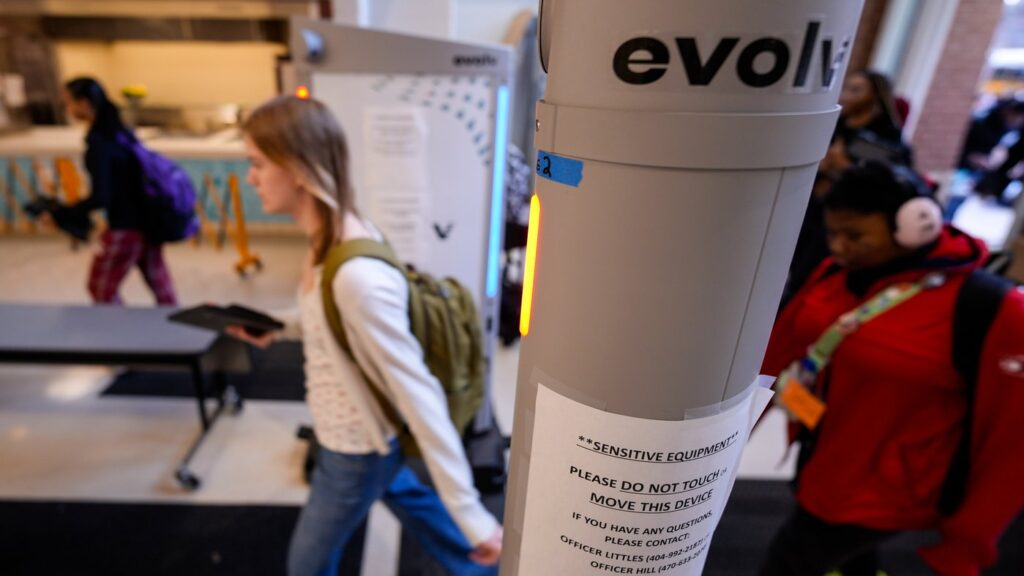
ATLANTA (AP) – Georgia is on the verge of becoming the first state to mandate daily weapons checks for every student entering public schools. A bill, gaining momentum in the legislature, aims to require weapons detection systems in a response to a 2024 school shooting at Apalachee High School in Winder, which resulted in four fatalities.
Daria Lezczynska, a junior at Apalachee High School, expressed her belief that had such systems been in place, the tragedy could have been averted. “That rifle would have never reached our hallways,” she stated, emphasizing that lives could have been saved, and the trauma experienced by students would have been lessened.
While some schools have implemented metal detectors or enforced clear backpack policies, technological advancements have introduced a new generation of weapons detection systems. These utilize computer analysis paired with cameras and electromagnetic fields to identify not just guns, but also knives. The deployment of such technology has become increasingly common in various venues including schools, stadiums, and hospitals.
Chuck Efstration, the bill's sponsor and Republican House Majority Leader, advocated for the importance of these systems for ensuring the safety of students and educators in Georgia. He noted that it is customary for courthouse visitors to pass through such detection systems, underlining that students deserve similar security measures in their schools.
Despite the proposed bill's support, some critics have raised concerns regarding its effectiveness and practicality. They point out the lack of rigorous research demonstrating that weapons detectors can prevent school shootings. Additionally, discussions have surfaced regarding the financial burden of installing these systems, with costs potentially exceeding $10,000 per unit. Furthermore, the effectiveness of these systems is sometimes compromised by false alarms, leading to challenges in maintaining vigilant security checks. Critics also argue about the necessity of such measures in elementary schools, which the current bill mandates.
This week, the Senate committee approved an amended version of Efstration's bill, bringing it closer to a final vote in both the Senate and House ahead of the close of Georgia’s 2026 legislative session. Ultimately, the bill will require the signature or veto from Republican Governor Brian Kemp.
Nationwide, the use of weapons detection systems varies significantly. A U.S. Department of Education survey covering the 2021-2022 school year revealed that only 6.2% of all schools and 14.2% of high schools enforced random metal detector checks; only 2.4% of all schools conducted daily checks. The survey indicated that such measures were more prevalent in urban areas, predominantly nonwhite student populations, and schools with a high percentage of economically disadvantaged students.
In Atlanta, school officials invested over $4 million to implement new detection systems in middle and high schools in 2021, aiming for a more streamlined process compared to traditional metal detectors. Atlanta District Police Chief Ronald Applin reported a significant drop in gun incidents at schools, from 32 the year prior to just four this year after the new system was initiated.
Students at Midtown High School, for instance, have adapted to the new process, often holding their laptops high as they pass through detection gates. School Resource Officer Meredith Littles remarked on the non-adversarial nature of the setup, alleviating concerns about a hostile environment during security checks.
However, the challenge of managing the sensitivity of these systems remains. Nikita Ermolaev, a research engineer specializing in security technology, emphasized the difficulty in calibrating detectors—too sensitive results in many false alarms, while too lenient risks allowing weapons to pass unnoticed. Maintaining attentiveness becomes increasingly hard as staff may become desensitized to recurring false alerts.
The financial implications of implementing these systems also pose a challenge for schools in Georgia. With a current allocation of $50,000 per public school for safety initiatives, many districts are already utilizing these funds for on-campus security personnel. Lawmakers have responded by proposing to borrow an additional $50 million for grants aimed at supporting school districts in acquiring these detection systems.
Opponents of the bill—including some Democrats—believe that the focus should shift towards regulating children's access to firearms instead of enhancing security measures like weapon detection. State Rep. Bryce Berry voiced concerns over the gun culture in Georgia, criticizing the acceptance of heightened security measures without addressing the underlying issue of gun accessibility.








