

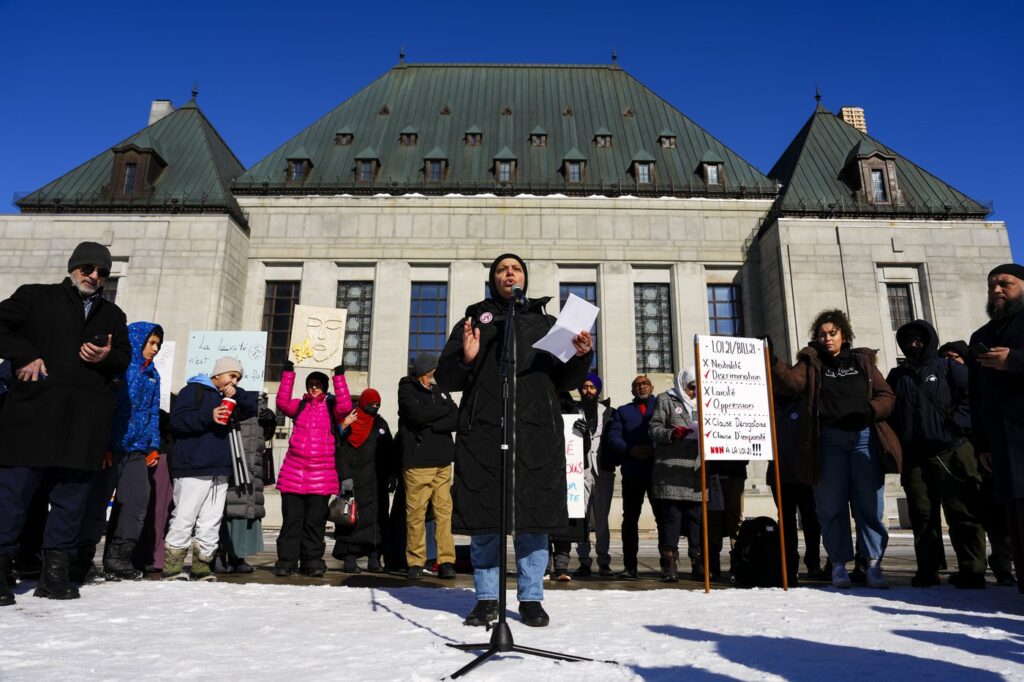
OTTAWA – In a significant legal proceeding, lawyers representing the Quebec government presented their case in the Supreme Court, defending the province's controversial secularism law, known as Bill 21. This law, enacted in 2019, imposes a ban on certain public sector employees from wearing religious symbols while performing their jobs.
The legislation has sparked considerable debate and contention, particularly due to its provision that allows it to override the Canadian Charter of Rights and Freedoms. Isabelle Brunet, a lawyer for the Quebec government, argued that the province is justified in invoking this override provision, referred to as the notwithstanding clause. Brunet asserted that Quebec is not required to provide justification for employing this legal mechanism, which serves to protect laws from being challenged in court.
Brunet emphasized that the notwithstanding clause serves to exempt laws from legal scrutiny, including the issuance of declaratory judgments. Such judgments occur when a court acknowledges that a Charter right has been infringed upon, but does not impose specific remedies or damages. This point of contention is central to the case, as it raises questions about the limits of the province's authority in relation to constitutional rights.
However, Justice Nicholas Kasirer of the Supreme Court raised concerns about this interpretation. He highlighted that there is no explicit constitutional language that precludes a judge from issuing a declaratory judgment on a law that invokes the notwithstanding clause. This exchange reflects the nuanced legal complexities at the heart of the debate surrounding Bill 21 and its implications for civil liberties in Canada.
The issue has drawn significant attention, with various groups opposing Bill 21 arguing that the law excessively infringes on Charter rights. On the preceding Monday, legal representatives for these challenging groups articulated their position to the court, asserting that the secularism law is unconstitutional and unduly restrictive.
As the legal arguments unfold, the implications of this case are profound, touching on themes of religious freedom, secularism, and the balance of power between provincial authorities and national constitutional rights. The outcome of the Supreme Court's deliberations could set a crucial precedent regarding the authority of provinces to enact laws that may sidestep established constitutional protections.
The hearings mark a critical moment in the ongoing discourse surrounding Bill 21, as both sides lay bare their legal reasoning and the stakes involved in this highly emblematic case. The Supreme Court's decision will ultimately determine the future of the law and its validity under the broader frameworks of Canadian law and constitutional protections.
The backdrop of this case includes ongoing societal debate about secularism and the role of religious symbols in public life, particularly in a diverse and multicultural society like Canada. As public interest in the proceedings remains high, the implications for public sector workers and their rights continue to be at the forefront of discussions around Bill 21.
This report reflects the latest developments from the Supreme Court proceedings, and the legal community and the general public are closely monitoring the unfolding situation as arguments are made and insights are shared in this landmark case for the Province of Quebec and beyond.








