

FORT COLLINS, Colo. (AP) – Junelle Lewis sought relief from soaring gas prices in the Seattle area, exacerbated by the Iran war. An app led her to the Tulalip Reservation, roughly 30 minutes from her home, where she found gas priced at $4.84 a gallon, a significant $0.75 cheaper than local stations. “Gas is ridiculous. But I have found, honestly, over the years, this gas station specifically is cheaper than a lot around here. Probably the cheapest,” she remarked while filling her Chevrolet Suburban.
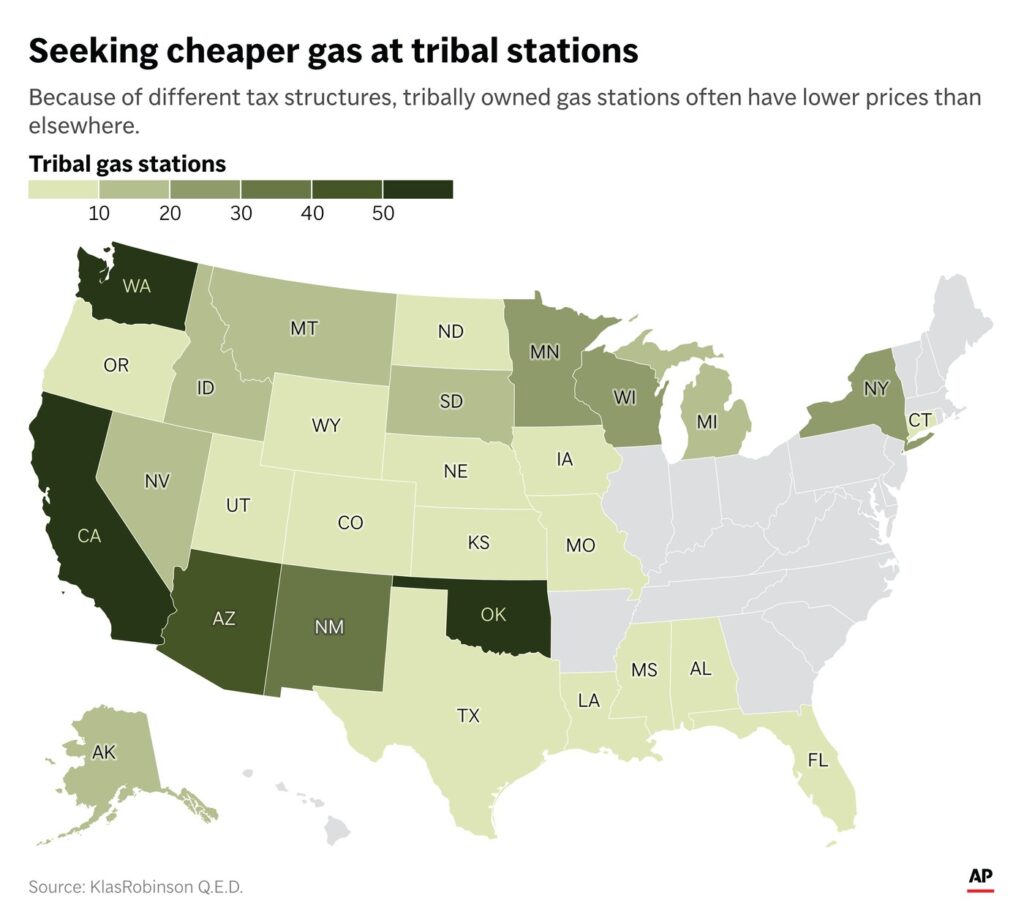
Lewis isn’t alone in discovering that some of the most affordable fuel is available at Native American reservations. States such as California, New Mexico, New York, Oklahoma, and Washington host numerous tribally owned gas stations. The tribes benefit from exemptions from state fuel taxes, allowing them to offer prices that are often much lower than neighboring stations.
Driven by rising gas prices, which reached an average of $4.15 per gallon nationwide since the Iran conflict commenced on February 28, many drivers are utilizing apps like Gas Buddy to identify the cheapest filling stations available. With prices peaking at over $5 during the summer of 2022, experts predict a continuing upward trend in gas prices, contributing to ongoing inflation as geopolitical tensions linger.
Across the U.S., nearly 500 tribally owned gas stations provide affordable fuel options. In California, 55 stations offer competitive prices, such as the Chukchansi Crossing Fuel Station between Fresno and Yosemite National Park, where gas was priced at $5.09—a $0.60 savings compared to nearby stations. Jamie Cross, a New Mexico resident, found fuel prices on the Mescalero Apache Reservation as low as $3.79. In eastern New York state, fuel prices at stations on the Cattaraugus Indian Territory were about $3.65, again significantly lower than local rates.
The reason behind these lower prices for tribes can be boiled down to tax exemptions. While tribes must pay federal fuel taxes, they are generally exempt from state fuel taxes on their lands due to longstanding legal precedents. U.S. courts have historically ruled that states lack the authority to impose taxes on tribes conducting business on their territories. This ruling, upheld by the Supreme Court, has remained a foundational principle in federal Indian law.
Fuel taxes vary widely across states, ranging from as little as $0.09 per gallon in Alaska to a staggering $0.71 in California. Complications arise due to the different taxation points and various agreements between states and tribes, as highlighted by two significant Supreme Court rulings. In 2005, the Court allowed Kansas to enforce taxes on tribal land fuel sales, but in 2019, another ruling reinforced treaty rights that prevented taxes on tribal lands in Washington state.
While gas sales are a notable revenue source, tribal convenience stores generate profit primarily through attracting customers to spend inside on snacks and other goods. Many of these gas stations also serve as vital access points for grocery supplies and household items in areas that would otherwise be food deserts. Matthew Klas, a consultant for tribal businesses, noted that these stores fulfill essential needs for local communities.
In addition to gas stations, tribally owned businesses diversify their revenue streams through various operations, including drive-through smoke shops, car washes, and truck stop amenities. Notably, 205 of these gas stations are located near or at tribal casinos, with some casinos including gas stations on their premises.
The economic impact of tribally owned businesses extends beyond profits; they provide essential services for their communities. As Tanya Burns, CEO of the Tulalip Tribes Federal Corporation, indicated, the revenue generated from rising gas sales is reinvested back into the community to cover crucial needs such as roads, healthcare, education, and housing.
Despite the current high gas prices, many customers like Todd Hall still prefer filling up at tribal stations. Hall noted he spent almost $90 to fill his tow truck at a Citizen Potawatomi Nation gas station, where diesel was priced at $4.57 per gallon—a savings compared to many local prices. Mark Foster, another customer, expressed loyalty to the tribe, appreciating the community partnership alongside relatively low prices.
At the Tulalip Market, drivers like Jared Blankenship were less concerned about the price and more frustrated about having to buy gas at all, especially after totaling his electric car. “So here we are,” he lamented, reflecting the challenges many are facing in an era of fluctuating fuel prices.








