

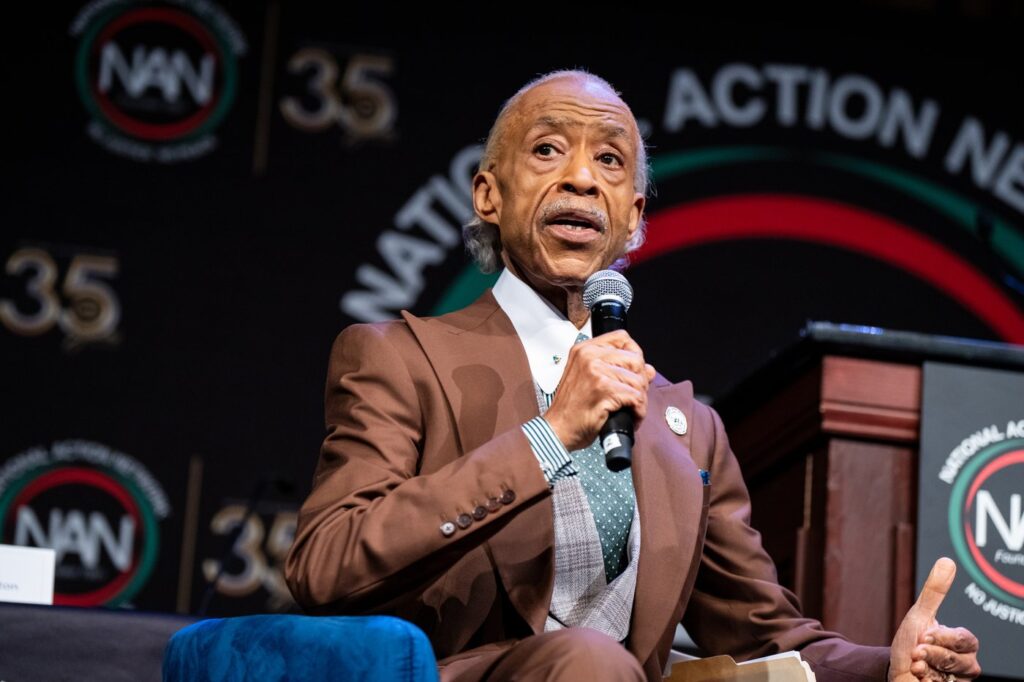
NEW YORK (AP) – The term "DEI," which stands for diversity, equity, and inclusion, has lost prominence in corporate discussions and Democratic rhetoric since President Donald Trump began his campaign against such initiatives last year. However, this narrative shifted at the recent National Action Network conference held in New York, where numerous Democratic politicians and prospective presidential candidates passionately defended DEI policies that have recently been sidelined.
During the event, House Minority Leader Hakeem Jeffries asserted the Democratic Party's commitment to DEI, describing Republicans as "extremists" engaged in an "all-out assault on civil rights, on voting rights," and particularly on diversity initiatives. Jeffries emphasized that contrary to Republican narratives, diversity and inclusion are intrinsic American values rather than foreign concepts. His comments echoed the broader sentiment expressed at the conference where DEI was reaffirmed as central to the party's platform.
Following the widespread adoption of DEI initiatives after the 2020 Black Lives Matter protests triggered by George Floyd's murder, Republican leaders have increasingly characterized these programs as divisive, claiming they discriminate against white individuals. Trump initiated this purge by signing executive orders to eliminate "illegal DEI" practices throughout the federal government and imposed compliance requirements on federal contractors aimed at enforcing his anti-DEI stance.
In February, Trump declared in his State of the Union address, “We ended DEI in America," illustrating the administration's commitment to dismantling these programs. Following these developments, Democratic responses have varied, with some members expressing concern that an excessive focus on diversity has alienated voters across different demographics.
Despite the mixed reactions, certain Democrats aiming for the White House are championing DEI policies. This rhetorical pivot is also seen as an effort to engage Black voters, who view attacks on DEI as attacks on civil rights and economic justice. Pennsylvania Governor Josh Shapiro affirmed his commitment to diversity, stating, “We believe diversity is our strength in the Commonwealth,” highlighting the continued existence of an Office of Diversity and Equity in Pennsylvania amidst widespread cutbacks in other states.
Maryland Governor Wes Moore, the nation’s only Black governor, showcased his state’s proactive response to the federal rollback of DEI policies, detailing initiatives aimed at supporting minority businesses and addressing racial inequality. Moore argued that Maryland serves as a model for equitable policymaking, signifying hope for the future in light of federal policies perceived as retrogressive.
Illinois Governor JB Pritzker shared similar sentiments, explaining that his administration has allocated resources to tackle long-standing inequities affecting the Black community. Kentucky Governor Andy Beshear, whose state Trump won decisively in the 2024 election, also plans to emphasize his support for diversity at the conference, having previously vetoed a divisive bill that sought to eliminate DEI programs from public universities.
Rev. Al Sharpton, who founded the National Action Network, expressed his expectation for 2028 presidential candidates to prioritize addressing racial disparities in their platforms. He highlighted the importance of specificity in how candidates approach these issues rather than resorting to broad generalizations.
Finally, Rep. James Clyburn of South Carolina emphasized the integral role of DEI in the pursuit of a more perfect union, warning that resistance to these principles could indicate opposition to core democratic values. He posed a compelling question: “Who, in search for a more perfect union, would shy away from diversity, equity, and inclusion?”








