

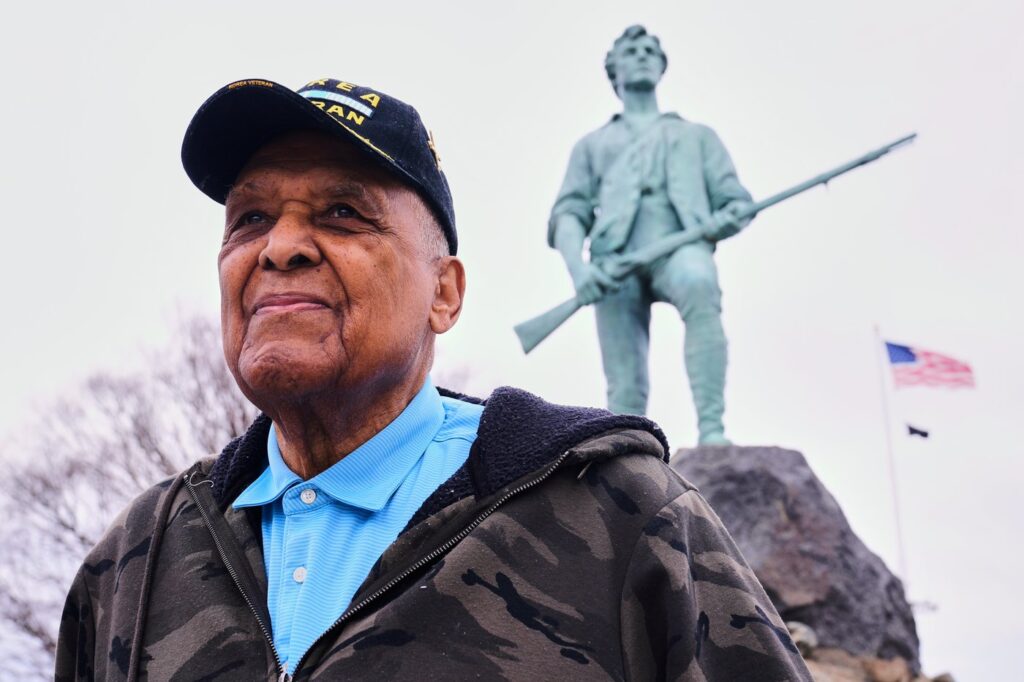
LEXINGTON, Mass. (AP) – Charlie Price, a 95-year-old Black Korean War veteran, reflects on his limited education about the American Revolution, where he only learned about key figures like George Washington and pivotal battles such as the Battle of Bunker Hill. His journey into history deepened when he joined the Lexington Minutemen, a group of Revolutionary War reenactors. Through this involvement, he discovered the rich and often overlooked contributions of individuals like Prince Estabrook, an enslaved man who fought alongside white patriots on April 19, 1775, during the Battle of Lexington.
Every year, the Lexington Minutemen commemorate the Battle of Lexington, honoring soldiers such as Estabrook—who was wounded in battle yet continued to serve throughout the war. Price, who portrayed Estabrook for half a century, expressed his surprise at the lack of knowledge surrounding Black soldiers in the Revolution, emphasizing the importance of recognizing such figures in American history.
As America approaches its 250th anniversary, efforts are being made to celebrate and document the diverse array of patriots of color who contributed to the nation’s founding. Programs across the country are focusing on telling a more comprehensive story of the Revolution, which has historically centered on white leaders like Benjamin Franklin and Paul Revere.
Christopher Brown, a historian at Columbia University, argues that the traditional portrayal of the Revolution offers a simple, moral narrative that idealizes American origins. However, recent years have seen a shift toward a more nuanced understanding that acknowledges the diverse groups that played vital roles. More than 5,500 patriots of color, including Black and Indigenous warriors, served on the colonial side during the war, underscore the need for greater curiosity and research into this forgotten history.
The legacy of slavery, which was legal in all 13 Colonies at the time, is intrinsically linked to the stories of Black patriots. Many were enslaved individuals fighting for their freedom, while Indigenous soldiers also participated in combat, motivated by survival and autonomy. Despite the rich tapestry of military diversity during this period, contemporary efforts to highlight these narratives face challenges, including censorship under the Trump administration regarding exhibits related to slavery and the Civil Rights Movement.
Roger Davidson, Jr., an associate professor of history at Bowie State University, warns that failing to acknowledge the contributions of marginalized groups can have lasting effects on communities of color, fostering biases and inequalities in the present day. “If you’re not seen as having contributed to society...then people can sort of overlook you,” Davidson stresses.
The MA250 initiative, which has distributed millions of dollars in grants for historical commemorations across Massachusetts, has played a crucial role in elevating the stories of Black patriots. This includes the Black Heritage Trail in Concord, which highlights the experiences of Black residents during the Revolutionary era. Museum exhibitions focusing on Black patriots have also benefitted from MA250 funding. Notable figures like Crispus Attucks and Salem Poor are gaining recognition, highlighting the broader contributions of people of color in the fight for American independence.
A non-profit history center in Boston, American Ancestors, is set to open its “Patriots of Color” exhibit, featuring the lives of 26 Black and Indigenous individuals who played pivotal roles in the Revolution. Among them are Prince Ames, a Black and Narragansett man forced to enlist in the Continental Army, and Paul Cuffe, a Black and Wampanoag businessman advocating for political rights.
Although historical records for Prince Estabrook are limited, it is believed he was born around 1740 in the Lexington area and was enslaved by landowner Benjamin Estabrook. After training as a soldier in the Lexington militia, Estabrook was wounded in the initial conflict of the Revolution. Subsequently, he dedicated eight years to military service and was granted freedom post-war. By 1790, he was listed as a non-white freeman working for Benjamin Estabrook. Price emphasizes the importance of preserving Estabrook's legacy, affirming that such figures must not be forgotten as part of America’s history.








