

California Democrats have successfully convinced voters to grant them the authority to redraw the state’s congressional map. This strategic move aims to potentially secure five additional seats in the U.S. House, primarily in response to aggressive redistricting efforts by the GOP in Texas. As California gears up for its primary elections, the outcomes will reveal the effectiveness of this initiative.
The state’s unique primary system allows the top two candidates, regardless of party affiliation, to advance to the general election. This raises concerns for Democrats in the San Diego suburbs. The district previously held by Republican Rep. Darrell Issa has been redrawn to have a slight Democratic advantage. However, with Issa’s retirement, Republican San Diego County supervisor Jim Desmond is entering the race alongside a crowded field of nine Democratic candidates. This multitude may lead to a split Democratic vote, potentially sidelining Democrats from advancing to the November general election.
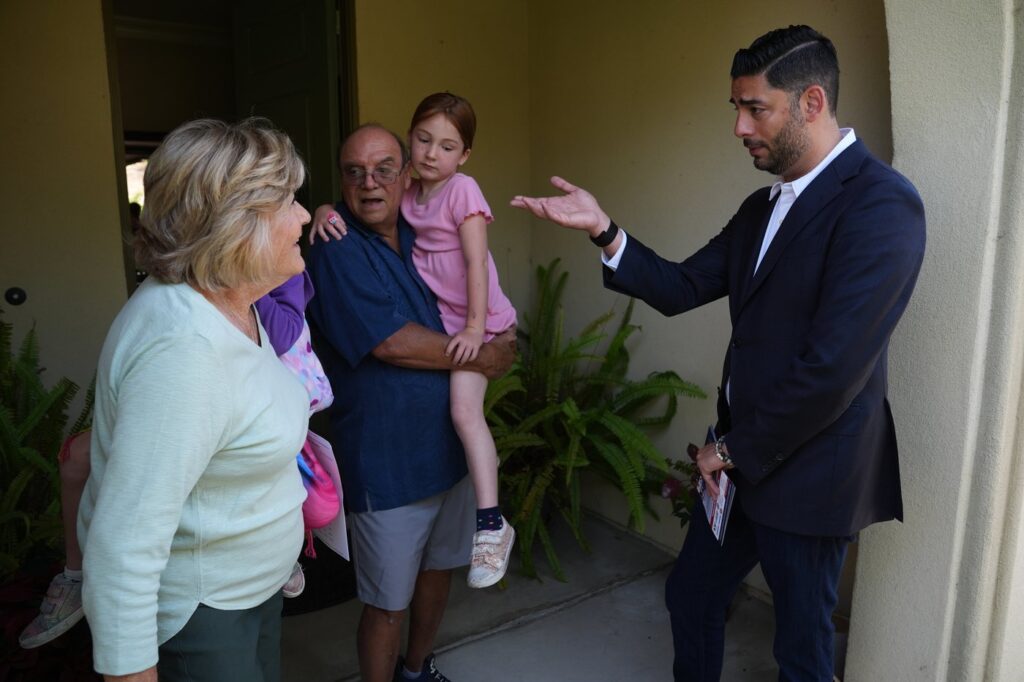
Ammar Campa-Najjar, a former Obama administration official and one of the Democratic candidates, expressed the severity of this situation, stating that being shut out of the election would be catastrophic after investing millions into the redistricting process aimed at countering Texas.
California represents a significant opportunity for Democrats amid a broader redistricting conflict that began under former President Donald Trump, who sought to bolster Republican control of the House. Following competitive redistricting in Texas designed to enhance Republican seat prospects, California voters opted to suspend their independent redistricting commission to create a favorable new map.
While the California strategy seems promising, similar efforts in Virginia faced challenges, including obstructions from their state Supreme Court. Additionally, the U.S. Supreme Court has weakened critical provisions of the Voting Rights Act, facilitating Republicans in the South to dissolve some majority-Black congressional districts.
Among the leading Democrats in the race for Issa's vacant seat are Ammar Campa-Najjar, San Diego City Councilwoman Marni von Wilpert, and investor Brandon Riker, who is financing his own campaign. Many within the party harbor optimism that their voters will unify behind a single candidate to run against Desmond in the fall.
Meanwhile, the Central Valley presents another battleground. The district currently held by Republican Rep. David Valadao has been redistricted to become more Democratic, setting the stage for a tough contest. Valadao, noted for surviving previous Democratic attempts to unseat him, is one of the few remaining Republican House members who voted to impeach Trump after the January 6, 2021, Capitol attack. The primary will determine whether he faces state Assemblywoman Jasmeet Bains, aligned with the Democratic establishment, or Randy Villegas, representing the party's progressive wing.
This year’s primaries are characterized by a notable divide between establishment Democrats and a younger, progressive faction. In San Francisco, state lawmaker Scott Wiener is the frontrunner to replace retiring former House Speaker Nancy Pelosi, with the uncertainty revolving around his potential opponents: Saikat Charkrabati, a former tech entrepreneur, and Supervisor Connie Chan, who has Pelosi’s endorsement.
In Sacramento, city council member Mai Vang is challenging 81-year-old Rep. Doris Matsui, who has held her seat since 2005 after succeeding her late husband. Additionally, Rep. Brad Sherman is facing a challenge from Democrat Jake Levine, advocating for a generational shift in leadership. In another district, long-term Democratic Rep. Mike Thompson is being contended by Eric Jones, signaling a push for change from younger candidates.
The primary contests will also determine the future of Republican incumbents under pressure from the Democratic redistricting. Republican Reps. Ken Calvert and Young Kim are running against each other in a newly drawn conservative district, while Rep. Kevin Kiley, who has become an independent, is trying to retain his support in a Democratic-leaning district that has shifted geographically.
Furthermore, in the San Francisco suburbs, the race to fill the seat left by Democratic Rep. Eric Swalwell, who resigned amidst misconduct allegations, has attracted six Democrats and two Republicans. While the primary will set the stage for the November ballot, a special election is slated for June 18 to fill Swalwell's unexpired term.








