

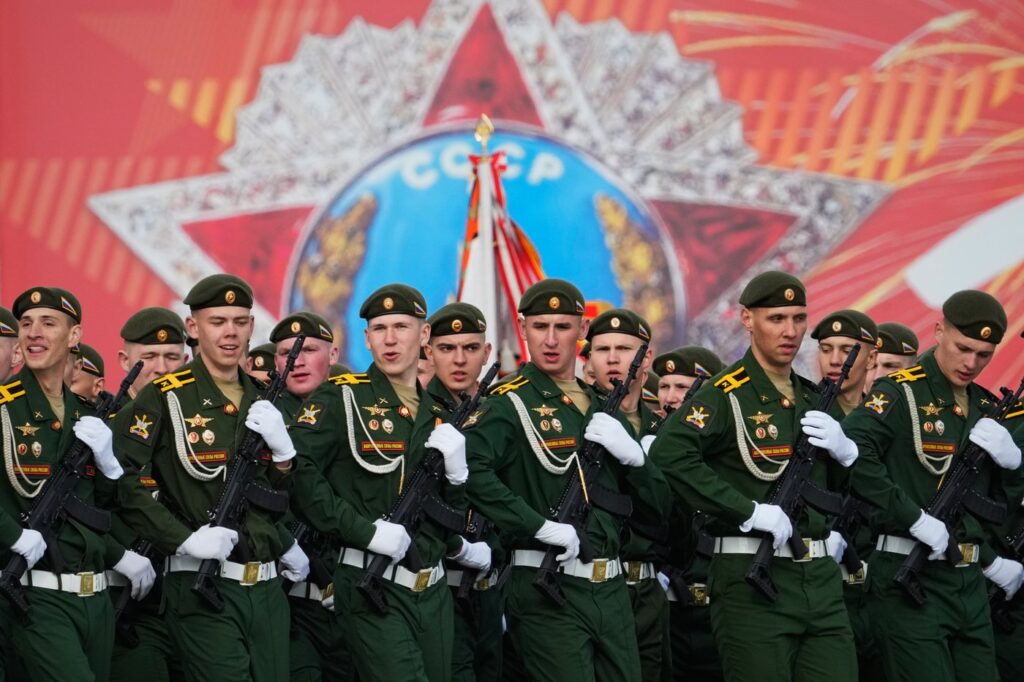
MOSCOW (AP) - Security was exceptionally tight in Moscow as President Vladimir Putin prepared to address the annual Red Square parade on Saturday, commemorating the defeat of Nazi Germany in World War II. This year’s event took on added significance amid heightened tensions due to a U.S.-brokered three-day ceasefire, which alleviated fears of possible Ukrainian disruptions during the celebrations.
Putin, who has maintained his grip on power for over 25 years, has traditionally used Victory Day to showcase Russia’s military prowess and rally public support for its ongoing military actions in Ukraine, which has now entered its fifth year. However, notably for the first time in nearly two decades, the parade lacked the usual display of tanks, missiles, and heavy weaponry, featuring only a traditional flyover of combat jets. Officials attributed this change in format to the "current operational situation" and the perceived threat of Ukrainian attacks, prompting Kremlin spokesman Dmitry Peskov to confirm that additional security measures were being implemented.
Earlier ceasefires prior to this event had failed, with Russia declaring a unilateral ceasefire for Friday and Saturday. In response, Ukrainian President Volodymyr Zelenskyy announced a truce slated to begin on May 6, yet both nations exchanged blame as skirmishes continued. U.S. President Donald Trump, who announced the ceasefire on Friday, expressed hopes that this reduction in hostilities could signal "the beginning of the end" for the conflict.
Zelenskyy, having remarked on the likelihood of Ukrainian drones potentially hovering over Red Square on May 9, responded by issuing a decree that mockingly allowed Russia to proceed with its Victory Day celebrations, declaring Red Square temporarily off-limits for Ukrainian strikes. Peskov dismissed Zelenskyy's decree as a "silly joke," asserting that Russia needed "no one's permission to be proud of our Victory Day."
Victory Day remains a critical point of unity within Russian society. Over recent months, the Russian military has made gradual gains along the extensive more than 1,000-kilometer front line, although Ukraine has retaliated with effective long-range strikes targeting Russian infrastructure, energy facilities, and military depots. Ukraine's advancements include the development of drones capable of striking targets over 1,000 kilometers deep into Russian territory, something that was virtually unimaginable before the conflict escalated in 2022.
In response to any potential disruptions of the festivities, Russian authorities have issued stark warnings: should Ukraine attack during the celebrations, Russia would conduct "massive missile strikes" on the center of Kyiv. The Russian Defense Ministry urged civilians and employees at foreign diplomatic missions to evacuate the city. However, the European Union indicated that its diplomats would remain in Kyiv despite the threats issued by Russia.
Victory Day celebrations have historically fueled national pride and reiterated Russia's stature as a global power. The Soviet Union endured staggering losses during World War II, with estimates of 27 million people dead between 1941 and 1945—an immense sacrifice that resonates in the collective memory of the Russian populace and represents a unifying theme in a country often divided by its Communist past.
Parades on Red Square since 2008 have featured a wide range of heavy weaponry, including armored vehicles and nuclear-tipped intercontinental ballistic missiles. This year, however, many planned festivities across Russia were reduced or canceled for security reasons. In anticipation of the march on Saturday, authorities imposed restrictions on mobile internet access and text messaging services in the capital, a reflection of a broader trend of increasing internet censorship and control over public discourse in Russia, which has sparked rare expressions of discontent among the populace.
Prominent international figures expected to attend the ceremonies include Malaysia's King Sultan Ibrahim Iskandar, Laos President Thongloun Sisoulith, Kazakhstan's President Kassym-Jomart Tokayev, Uzbekistan's President Shavkat Mirziyoyev, and Belarusian leader Alexander Lukashenko. Notably, Slovakia's Prime Minister Robert Fico, while meeting with Putin to lay flowers at the Tomb of the Unknown Soldier, planned to avoid participation in the Red Square parade itself.








