

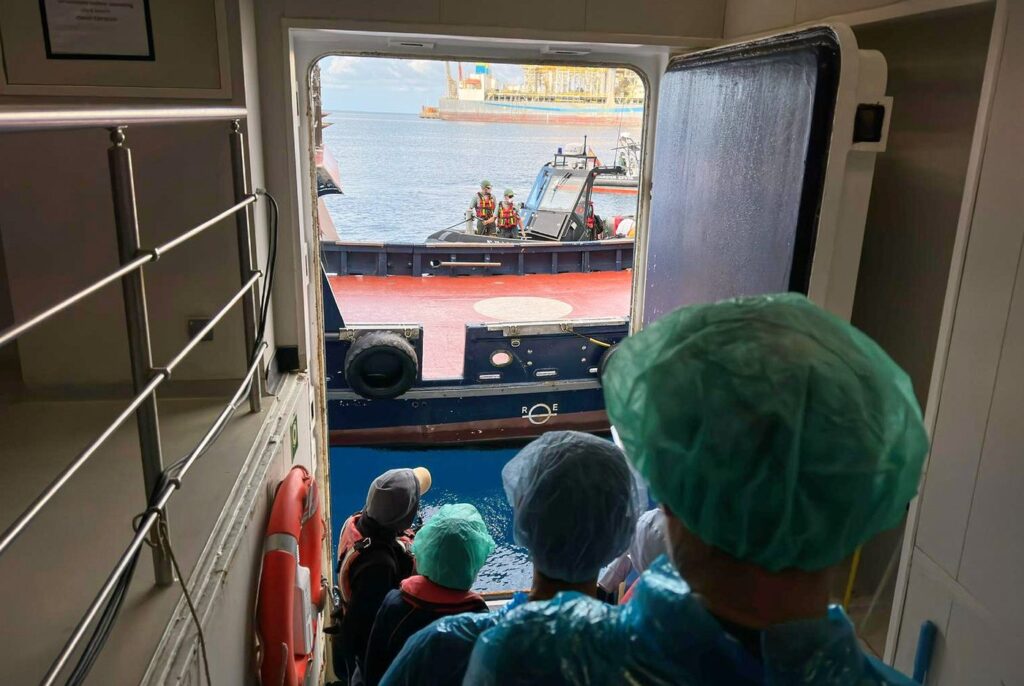
The MV Hondius, a cruise ship affected by hantavirus, had over 140 passengers and crew members aboard as it reached the port of Granadilla in Tenerife, Canary Islands, Spain. The ship's arrival on May 10, 2026, marked a critical moment in an ongoing public health concern, as passengers were being disembarked one by one under careful observation from health authorities.
Upon arrival, the disembarkation process was closely monitored by Spanish government officials and emergency services. Passengers, eager to return to shore after an unsettling experience, were assisted by the Guardia Civil officers on the scene. They were screened for health concerns, with temperature checks becoming part of the standard protocol to ensure safety during the ongoing hantavirus outbreak. The photo gallery provided by Associated Press editors captured the tense but orderly scenes as passengers began to leave the ship.
Each image in the gallery illustrated the various aspects of the disembarkation process. In one photograph, passengers could be seen waving to the waiting Guardia Civil officers, a gesture that highlighted both relief and the lingering fear associated with their recent health crisis. Other images showed individuals being sprayed with disinfectant as an additional measure taken by health officials to mitigate any potential spread of the virus.
Media personnel gathered near the ship, documenting each moment as news of the outbreak spread rapidly across the globe. Photos depicted the efforts of emergency personnel working alongside journalists, creating a tableau of coordinated response to an unexpected crisis at sea. As passengers waited for transport, they were often seen gazing at the activities around them with a mix of curiosity and anxiety.
Passengers were eventually transported to Tenerife airport to board planes aimed at returning them to their home countries. As they moved away from the cruise ship MV Hondius, scenes of passengers boarding government planes reflected the urgency of the situation. Some were set to return to Canada, while others boarded French government flights, further underscoring the international ramifications of the hantavirus outbreak linked with the cruise.
Health officials continued their efforts to ensure public safety by screening disembarking passengers. This included administering a thorough temperature check before boarding flights, reflecting the serious nature of the health risks posed by the virus. The protocols established focused on containment and prevention, prioritizing the health of both returning travelers and the broader community.
As passengers departed the ship, many were filled with mixed emotions, waving from buses that would take them to their next destination. The assistance from local authorities was evident, as officials worked diligently to manage the situation with precision. The atmosphere was charged with a blend of relief, concern, and hope for a swift resolution to the health scare that had abruptly interrupted their cruise experience.
The events surrounding the hantavirus-affected MV Hondius illustrate the evolving challenges of public health management in the context of travel and tourism. As the world continues to grapple with outbreaks, the situations that arise from them highlight the importance of vigilance and quick response in safeguarding public health during emergencies.








