

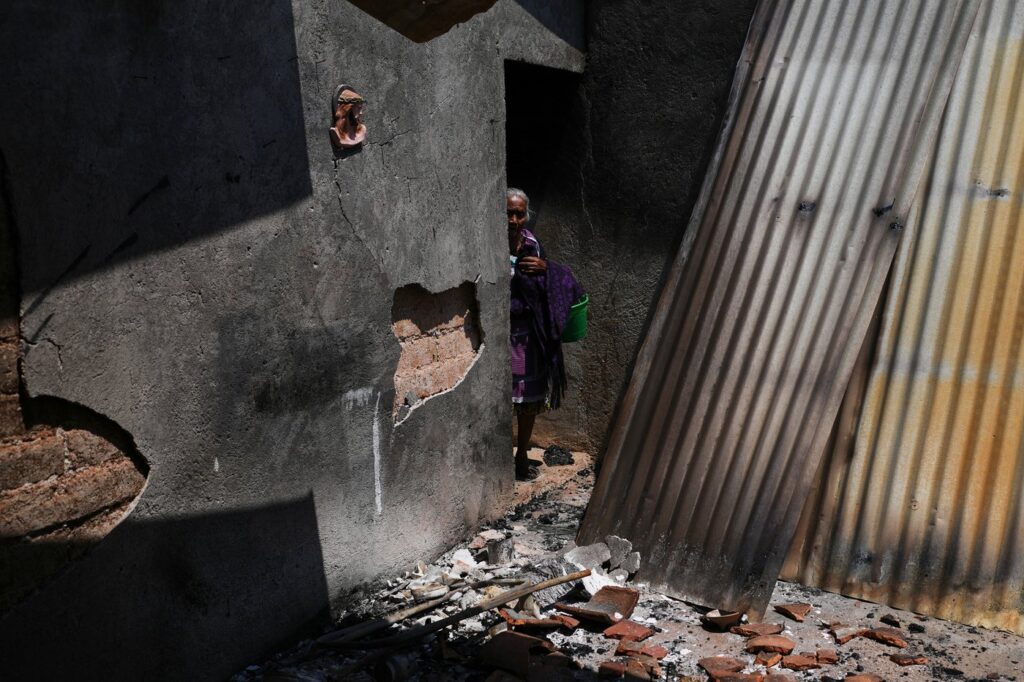
TULA, Mexico (AP) - As bombs fell and gunfire erupted, 74-year-old María Cabrera and her family fled into the mountainous terrain of central Mexico, leaving behind everything but the clothes on their backs. A week later, Cabrera returned to her home of 60 years, sifting through the charred remnants of her life, including pots, woven cloths, and a small wooden cross. Heartbroken, she wandered past the ashes of her mattress in a small room with a collapsed roof, lamenting, "Oh God, why have you abandoned me? How are we going to rebuild? We don’t have money, we don’t have anything."
Cabrera's forced departure reflects a growing trend of displacement in conflict-ridden regions of Mexico, where violence from organized crime has become an "invisible crisis" with severe humanitarian implications. There are scant official reports detailing the number of displaced individuals, leaving many without resources after being uprooted by violence.
Last Friday, Cabrera and her family evacuated Tula, a small town inhabited by around 200 native Náhuatl people, which has faced escalating cartel violence for years. This violence has intensified as rival criminal groups, such as Los Ardillos, battle for territorial dominance. Just the previous week, the group launched drone attacks on her town, executed violent assaults on local community police, slaughtered livestock, and razed homes including Cabrera's.
While Cabrera attempted to salvage what she could from her home, armed men in camouflage loaded her belongings into a truck, leaving her to say goodbye to her garden, dogs, and chickens. "We don’t want to abandon them," she expressed, reflecting the sorrow of leaving behind beloved pets while recognizing the impossibility of staying in a place that has become too dangerous. "But we suffered through everything. We can’t live here anymore."
A local human rights organization, the Indigenous and People’s Council of Guerrero-Emiliano Zapata (CIPOG-EZ), reported that at least 800 people were displaced along with Cabrera, with three community police officers who attempted to confront the criminal activity reportedly killed. In stark contrast, the Mexican government recorded only 120 displaced individuals and denied any deaths. However, community leaders estimate around 280 people were forced to flee from their town alone.
In the face of escalating violence and threats from criminal groups, families have scattered throughout Mexico, with some seeking refuge under local basketball courts while others, wounded and terrified, sought transport to safer areas. Videos circulating on social media showed emotionally distraught women and children pleading for assistance, prompting the government to deploy 1,200 military and police officers to the region to provide aid and attempt to contain the violence.
Despite these government actions, critics argue that the situation highlights a broader pattern of negligence towards the displacement crisis in Mexico. Unlike Colombia, which has a more comprehensive registry for displaced persons, Mexico lacks adequate tracking and acknowledgment of the issue, leading to underreported figures. The government’s National Survey of Victimization and Public Security Perception estimated that nearly 250,000 households fled their homes in 2024 due to crime.
In a report by Ibero-American University, at least 44,695 individuals were documented fleeing throughout the country during the same period. Displacement has sharply increased even as the government claims to have made strides in improving security, raising questions about the true state of public safety and community resilience.
Both Cabrera and her husband, 75-year-old Alejandro Venancio Bruno, are now confronted with the daunting task of rebuilding their lives. While their children have urged them to relocate to Mexico City or Queretaro for a fresh start, Venancio struggles with the thought of abandoning the land he has worked all his life. Faced with the loss of their home and possessions, he remarked, "It’s like starting from zero."








