

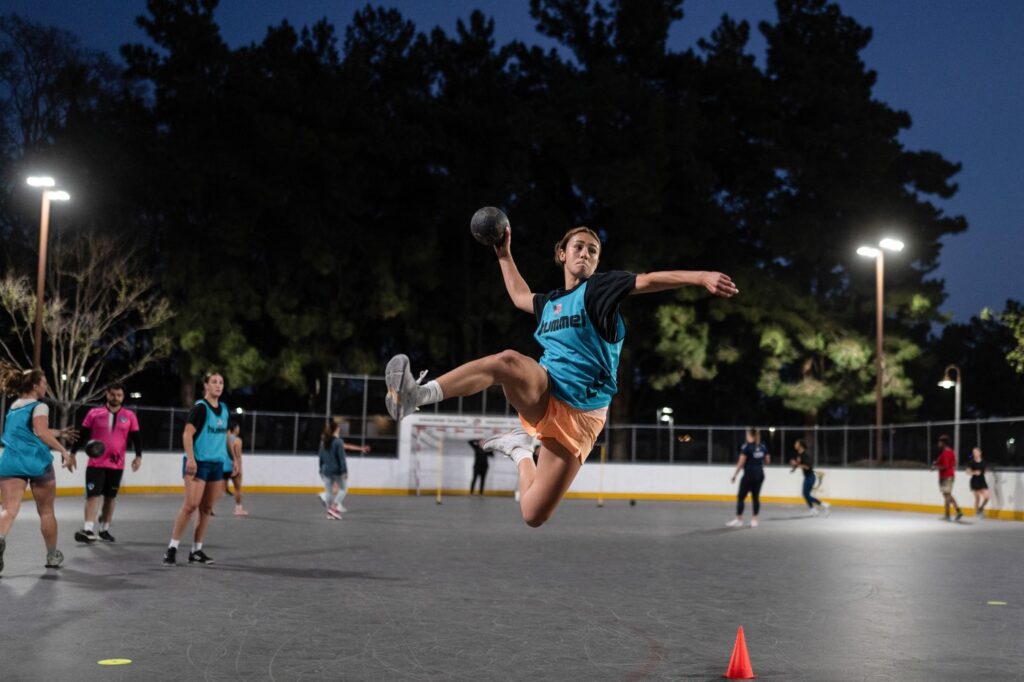
LOS ANGELES (AP) - Rylee White discovered the fast-paced sport of handball after her roommate mentioned a TikTok video about tryouts for the U.S. Olympic women's team in Los Angeles, which required no prior experience. Intrigued, White—a 27-year-old screenwriter—decided to attend the tryouts held in January, part of a surge that attracted over 150 women, a five-fold increase from previous events.
Five months after the tryouts, White is among a select group of women who have relocated to Florida to join USA Handball’s national residency program, aiming to earn a spot on the squad representing the United States at the 2028 Summer Olympics in Los Angeles. While handball enjoys popularity in Europe, it remains relatively unknown in the U.S. As the host nation, the U.S. automatically qualifies for every sport in the Olympics.
The last time the United States had a women's handball team at the Olympics was in 1996. The challenge of securing the necessary funding and resources to cultivate a competitive team persists, as many athletes are often dual citizens from Europe with professional playing experience overseas. Countries like Germany, France, Norway, and Denmark—along with various Balkan nations—consistently dominate the Olympic handball competitions.
Men’s handball made its Olympic debut in 1936, while women's handball was first included at the 1976 Games. Typically, Olympic athletes begin training as children, but in the U.S., many handball players transition into the sport later in life. The game features two teams of six players who pass a resin-covered ball to score in the opposing team's goal, defended by a goalkeeper. It’s a high-paced, full-contact sport that attracts thousands of spectators in countries where it is popular.
Many female handball players were previously Division One college athletes or have backgrounds in sports like basketball. Most players range from their 20s to 30s, with a few extending their playing careers into their 40s. White, who had ambitions of playing college sports in basketball and lacrosse, turned to handball due to injuries and surgeries that hindered her previous athletic pursuits. She saw the opportunity in handball as a chance to compete again, driven by her highly competitive nature.
After tryouts, White informed the coach of her commitment: “I’m ready to go do this and I will work as hard as you want me to work.” The goal of the residency program is to enhance player skills to the point where they can secure positions on professional teams abroad. Many of these dedicated athletes, including White, have left significant others behind to pursue their Olympic aspirations.
Sarah Gascon, a former national team player turned head coach, is focused on rebuilding the U.S. women's handball team after years of decline. Gascon emphasized the importance of athletic background, noting that multisport athletes typically excel in handball due to transferable skills learned in other sports, such as dribbling from basketball and blocking techniques from volleyball.
Despite the enthusiasm and talent among the Florida-based players, a lack of financial resources remains the most significant obstacle. USA Handball is unique among Olympic sports in that it does not receive funding from the U.S. Olympic & Paralympic Committee. The women’s team operates without financial support or access to elite athlete health insurance. As a result, many of the players work full-time jobs while balancing their training regimens.
Devyn Holbrook, another athlete who discovered handball through the same tryouts, shares a diverse athletic background, having participated in ballet, soccer, basketball, softball, and track and field. Inspired by her early experiences, Holbrook quickly fell in love with handball and dove into watching Olympic highlights, validating her decision to pursue this unexpected pathway. “There will never be a chance again that I could go to the Olympics in this capacity,” Holbrook reflected. “So why not give it everything that I have?”








