

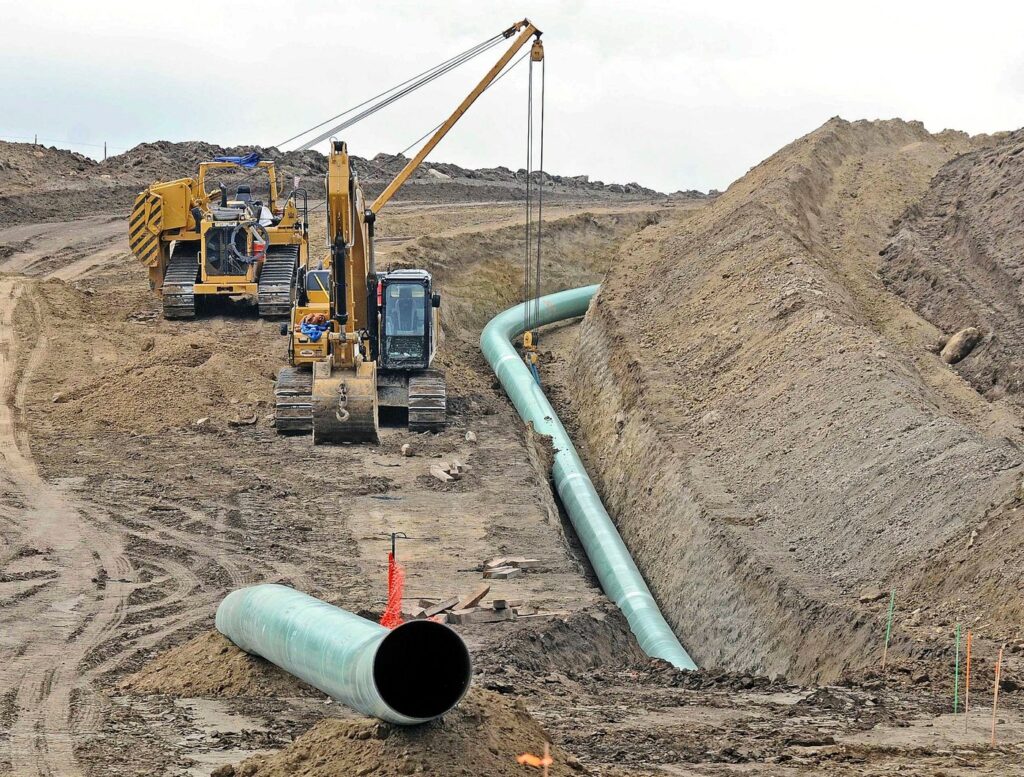
BISMARCK, N.D. (AP) – Federal officials have granted final approval for the Dakota Access oil pipeline to continue its operation across the Missouri River. This decision comes nearly a decade after widespread protests against the pipeline in North Dakota, particularly during 2016 and 2017 when the Standing Rock Sioux Tribe and thousands of activists expressed concerns over the environmental impact of the project.
The U.S. Army Corps of Engineers' approval allows the pipeline to keep operating but imposes additional conditions. These include enhanced systems for leak detection and groundwater monitoring, addressing concerns raised during the prolonged legal and regulatory battles stemming from the protests.
Since its initiation in June 2017, the $3.8 billion pipeline transports oil from North Dakota’s Bakken oil field to a terminal in Illinois. The pipeline has become a significant component of the U.S. energy infrastructure, carrying approximately 4% of the nation's daily oil production, equivalent to about 540,000 barrels per day.
Assistant Secretary of the Army for Civil Works Adam Telle stated that the Corps is "decisively putting years of delays to rest" and aims to ensure safe execution of the pipeline crossing beneath Lake Oahe. The river crossing is situated upstream from the Standing Rock Sioux Tribe's reservation, which has long opposed the project due to fears of potential spills contaminating their water supply.
The protests that occurred during 2016 and 2017 saw thousands camp near the river crossing, resulting in numerous arrests and ongoing legal actions. Notably, some litigation threatens the future of the environmental organization Greenpeace, demonstrating the lingering impact of the protests. In December, the Corps released its final environmental impact statement after a federal judge mandated a comprehensive review of the pipeline’s Missouri River crossing.
Upon reviewing several alternatives, including possible removal or rerouting of the river crossing, the Corps concluded that the easement to continue operating the pipeline with modifications represents the optimal balance between public safety, environmental protection, and effective leak detection. The approved measures will include continuous monitoring systems for leaks, assessments of surface and groundwater, and the involvement of third-party experts for evaluation.
Energy Transfer, the pipeline developer, praised the Corps' decision, highlighting that the pipeline has been in safe operation for nearly a decade and remains critical to the nation's energy framework. Vicki Granado, a spokesperson for Energy Transfer, expressed gratitude to the Corps for their extensive efforts in reaching this decision.
The response from the Standing Rock Sioux Tribe was not immediately available as the Associated Press reached out to representatives; however, the community has historically opposed the pipeline’s construction and operations. North Dakota Governor Kelly Armstrong, along with U.S. Senators John Hoeven and Kevin Cramer, expressed their support for the Corps' decision, which ensures the continuation of the pipeline's operations.
Simultaneously, officials and oil industry leaders congregated for a trade conference in Bismarck, where discussions about future energy projects were expected. Energy Transfer and Enbridge, another key player in the oil sector, are actively planning to move an additional 250,000 daily barrels of light Canadian crude oil through the Dakota Access Pipeline, contingent upon feasibility assessments expected by mid-2026.








