

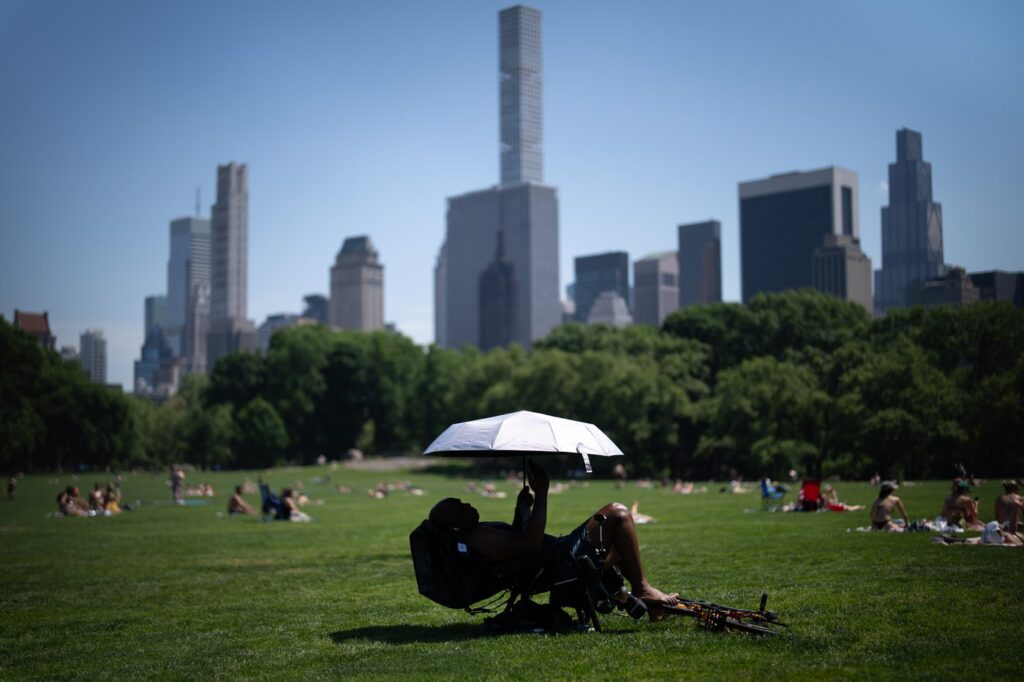
PHILADELPHIA (AP) — A heatwave has gripped the eastern United States, lasting into a second day on Wednesday. The extreme temperatures have prompted some school districts to send children home while others have struggled to keep students comfortable in their classrooms.
The Philadelphia school district enacted remote learning for approximately 57 schools due to insufficient air conditioning, despite some improvements over the years. This decision reflects ongoing challenges faced by many public institutions in managing heat during summer months. The National Weather Service has issued warnings that record highs are expected from the mid-Atlantic region stretching to New England before a cold front is forecasted to bring rain later in the week.
Record-breaking temperatures were reported on Tuesday, with Portland, Maine reaching 92 degrees Fahrenheit (33 degrees Celsius) and Boston hitting 96 degrees (35.5 degrees Celsius). These highs have raised concerns about public health and safety, especially among vulnerable populations such as children in schools without air conditioning.
In Dorchester, a neighborhood in Boston, high school officials took additional measures to ensure student comfort. They set up fans, distributed bottled water, and temporarily relaxed the school's uniform policy to allow students to wear shorts and T-shirts. One student, Ariolainy Baez, shared their experience, stating that while the heat outside felt manageable due to the wind, the conditions inside the school were oppressive, especially with ongoing quizzes and exams. "There is no excuse," Baez told CBS News, highlighting the pressure students face even amidst extreme weather conditions.
A heat advisory has been issued for several states, including New York, New Jersey, Pennsylvania, Connecticut, Massachusetts, and Rhode Island, effective through Wednesday evening. In New York City, officials have opened cooling centers to provide residents with a refuge from the heat. Mayor Zohran Mamdani emphasized the importance of community support during such challenging weather conditions, drawing parallels to how New Yorkers rely on one another during the harshest winter days.
The ongoing heatwave has drawn attention to the need for improved infrastructure, particularly in public schools, where air conditioning systems may be inadequate to handle such soaring temperatures. As schools and municipalities make adjustments to cope with the heat, the community's well-being and the health of its citizens remain paramount amidst rising concerns about climate and public health.








