

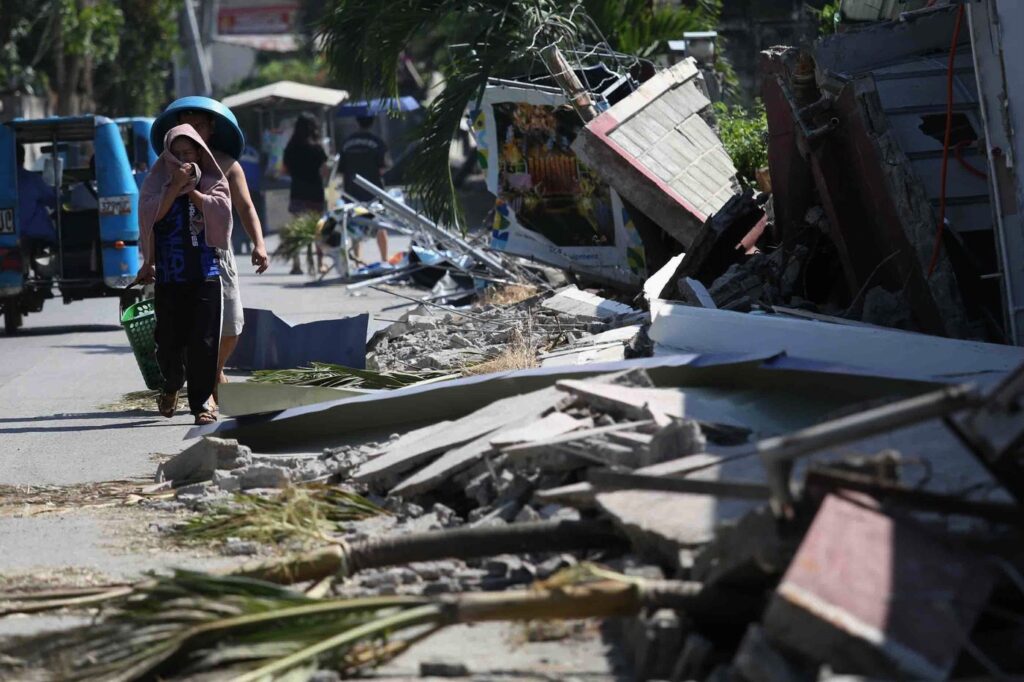
GENERAL SANTOS, Philippines (AP) - In the aftermath of a devastating 7.8 magnitude earthquake that struck the southern Philippine province of Sarangani on Monday, the mayor of the affected town of Glan has urgently requested helicopters to deliver food supplies to isolated villages. The quake, one of the strongest to hit the country in 50 years, has resulted in at least 47 fatalities, with over 688 injuries and 31 individuals still missing.
As a direct consequence of the earthquake, more than 45,000 residents have been displaced, with approximately half currently residing in emergency shelters. Officials report that the quake has damaged over 12,600 houses in various farming towns and cities, with many survivors still too traumatized to return home due to ongoing aftershocks.
According to the government's Office of Civil Defense, Glan has recorded the highest death toll in Sarangani, with 20 casualties primarily attributed to landslides that buried homes in the coastal region. Mayor Victor James Yap has highlighted the difficulties in accessing 10 out of the town's 31 villages, where aid is urgently needed but transportation is hindered by landslides.
"We need food and water, but it's difficult to transport them to some of our villages which remain isolated," Yap expressed during an interview with DZMM radio network. He emphasized the necessity for air force helicopters to expedite food delivery, warning that the residents are already experiencing hunger.
While a key access road has been reopened to facilitate fuel deliveries, Glan remains without power and cellphone services are still unreliable. Most fatalities from the quake have resulted from falling debris and landslides in Sarangani, along with the coastal city of General Santos and neighboring provinces of South Cotabato and Davao Occidental.
In a related incident, two swimmers drowned, and one is still missing off the coast of General Santos after being swept out to sea shortly after the earthquake struck. Waves measuring up to 1.4 meters (approximately 4.6 feet) above the tide level were recorded in southern parts of the Philippines, with smaller waves making landfall as far away as Indonesia, Palau, and Japan.
The recent quake is noted as one of the most significant seismic events since the catastrophic 8.1 magnitude quake and tsunami of August 17, 1976, which resulted in approximately 8,000 deaths. The Philippines is known to be prone to both earthquakes and volcanic eruptions due to its geographic location on the Pacific "Ring of Fire," which comprises an arc of seismic faults surrounding the ocean.








