

MIAMI (AP) – In late March, a Florida Fish and Wildlife officer approached a Guatemalan couple walking their dog in a Bonita Springs park. From his vehicle, he requested the husband’s identification and ordered them to exit the park. The officer subsequently arrested the husband on an alleged dubious charge, according to his wife, who requested anonymity to protect their pending asylum applications.
The wife claimed the officer issued a ticket alleging that the dog had bitten him, despite the fact that he had not exited his vehicle during the incident. Following the arrest, the officer reportedly waited 40 minutes for federal Immigration and Customs Enforcement (ICE) agents to arrive to take her husband into custody.
The nationwide immigration crackdown initiated during former President Donald Trump’s administration has received notable resistance in Democratic-led sanctuary cities, where local law enforcement is prohibited from collaboration. However, Florida, under Republican leadership, has embraced this crackdown, leading to a significant increase in immigration arrests, involving 347 state and local agencies including police, sheriff’s departments, and even the Florida National Guard.
Data reveals that immigration arrests in Florida surged dramatically following Trump’s second term commencement on January 20, 2025. In the 416 days that followed, approximately 39,000 immigrants were arrested, a stark increase from 11,088 arrests during the previous 416 days of the Biden administration. On average, Florida saw 93 daily arrests during the Trump era, making it only second to Texas for immigration arrests.
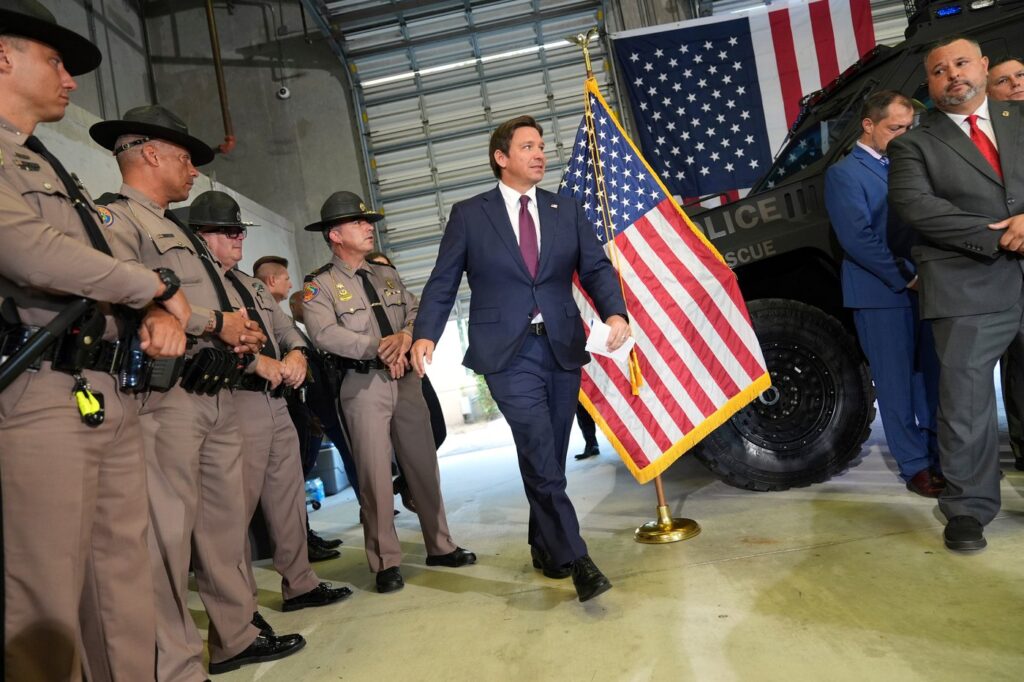
Governor Ron DeSantis has actively supported Florida’s enforcement collaboration with ICE through 287(g) agreements, allowing local agencies to take on immigration enforcement duties. Experts have observed that officers with these deputizations often seek out individuals with the intent to demonstrate arrest numbers to both state and federal entities. Arrests often stem from minor traffic violations, leading to individuals being taken into ICE custody.
An illustrative case involved the detention of a Guatemalan man and his adult son on February 15, 2026, by Lee County sheriff’s deputies. The deputies approached them under the pretense of an expired license plate, despite the vehicle’s tags being valid until March 25. Both men had pending immigration court cases but were detained and deported one week later, complicating their family dynamics as their wife and mother remained in Florida with their younger children.
In the case of the husband walking his dog, the Department of Homeland Security (DHS) asserted that he was apprehended due to two final removal orders. Both cases exemplify the lack of transparency experienced by many families within the immigration system, as state agencies like the Florida Fish and Wildlife Commission and local sheriff’s offices have refused to provide arrest reports or body camera footage, citing ICE directives that assert control over such documents.
The ICE guidelines state that information gathered through 287(g) agreements remains under federal jurisdiction, presenting potential conflicts with Florida's Sunshine Law, which mandates public access to government records. Critics argue that this oversight violates the Florida Sunshine Law, which has been consistently undermined by legislative exclusions in recent years.
Florida leads the nation in these immigration enforcement partnerships, having opened new detention facilities in the last year. Nationwide, participation in the 287(g) program increased from 135 agreements in 20 states before Trump’s second term to over 1,700 agreements across 41 states and territories, driven by financial incentives from DHS for local law enforcement agencies.








