

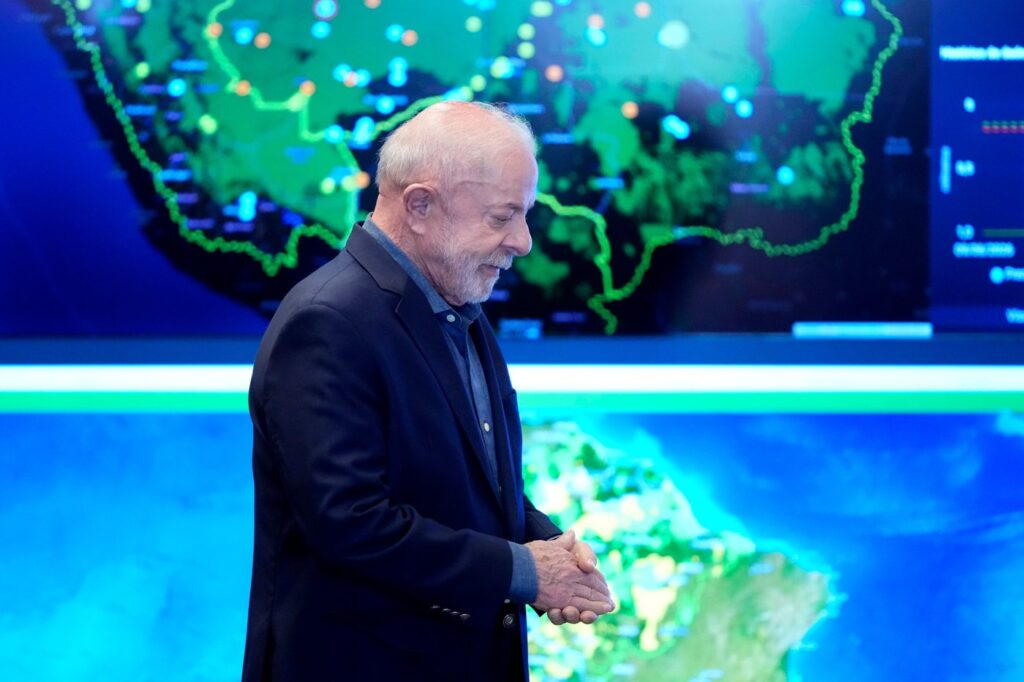
SAO PAULO (AP) — Brazilian officials reported a significant drop in deforestation rates on Thursday, countering one of the arguments the Trump administration used to justify imposing additional tariffs on Brazil. According to the National Institute for Space Research (INPE) and the Ministry of Environment, May 2026 saw a remarkable 61.4% decrease in Amazon deforestation compared to the same month in 2025.
Despite this positive trend, approximately 370 square kilometers (nearly 143 square miles) of the rainforest were still cleared. Additionally, deforestation in the Cerrado, a savanna region in central Brazil under pressure from the agribusiness sector, decreased by 12% over the same period. Environment Minister João Paulo Capobianco announced that these figures represent the lowest level of deforestation ever recorded for May and indicated that Brazil is poised to achieve its lowest annual deforestation rates once data is fully consolidated in the coming months.
Capobianco mentioned that May typically experiences higher deforestation rates as it marks the beginning of the Amazon’s dry season. In the 10 months spanning from August 2025 to May 2026, overall Amazon deforestation had already dropped by 37.5% compared to the same previous period.
On June 2, 2026, the Trump administration proposed imposing 25% tariffs on imports from Brazil, citing that the nation’s trade practices were “unreasonable” and that they “burden or restrict U.S. commerce.” This announcement followed an investigation by the Office of the U.S. Trade Representative, which accused Brazil of engaging in illegal deforestation and implementing unfair tariffs among other issues.
In response, Capobianco asserted that the recent deforestation figures disprove the “unfair and unfounded accusations by the United States,” which had used deforestation claims as a rationale for imposing tariffs. President Luiz Inácio Lula da Silva supported Capobianco’s remarks, stating that the Trump administration had misrepresented Brazil’s trade and environmental efforts, particularly during the previous year when tariffs were first imposed due to alleged trade deficits.
Lula emphasized that concerns about deforestation misunderstand Brazil's commitment to reducing it to zero by 2030. He stressed that this objective is not dictated by international agreements but is a government decision, emphasizing the importance of protecting the environment for Brazil, the Amazon, and the global community.
Deforestation remains the primary driver of Brazil’s greenhouse gas emissions, which contribute significantly to global warming. The Amazon Rainforest, the largest in the world, plays a crucial role in regulating climate beyond South America. Experts warn that continued forest loss could accelerate global warming and jeopardize agricultural productivity in regions as distant as the U.S. Midwest and parts of Europe.
Deforestation levels, which had peaked in the 1990s and 2000s, were on a downward trajectory until the presidency of Jair Bolsonaro (2019-2022), whose government faced widespread criticism for undermining environmental protections. Under Lula's leadership, deforestation rates have once again declined, registering their lowest level in a decade during the previous year.
Despite recent improvements, various threats remain, including climate change and potential legislative changes that could pose risks to the Amazon. Forest degradation from wildfires, logging, and drought impacts around 40% of the rainforest and has recently surpassed clear-cutting efforts. Concerns are heightened this year due to a strong El Niño phenomenon, which leads to increased temperatures and drier conditions in the rainforest, exacerbating the likelihood of wildfires.








