

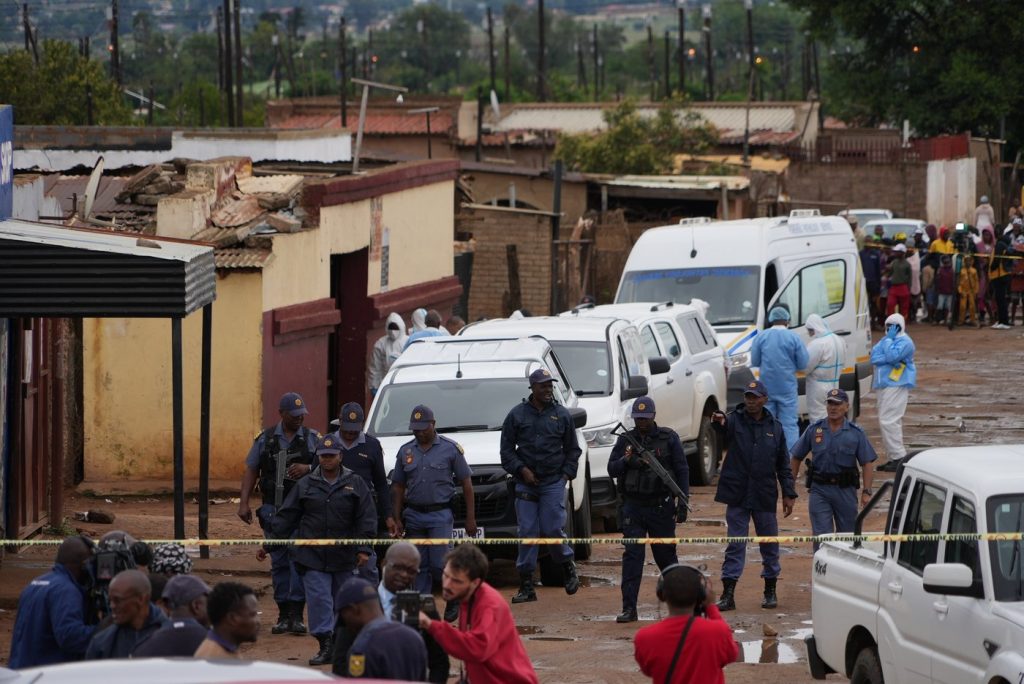
JOHANNESBURG (AP) — A recent mass shooting in Johannesburg, South Africa, highlights ongoing violence tied to organized crime in impoverished areas of the country. The shooting occurred in an informal settlement, resulting in 12 fatalities and at least 15 injuries, with authorities reporting no arrests to date.
In response to rising violence, South Africa's president has previously deployed the military to several crime hotspots, a move seen by critics as an acknowledgment of the police's inability to manage the surging crime rates. Allegations of police corruption and collusion with criminal gangs have further complicated the situation, leading to the arrest of senior police officials, including the national police commissioner and the police minister.
Experts note that recent mass shootings often occur in areas with poor security, inadequate lighting, and slow police response times. Criminal organizations exploit these vulnerabilities to operate in the shadows, thereby exacerbating the violence. Jacob Mofokeng, a criminology professor at the University of South Africa, emphasized that these syndicates utilize the chaotic environments to engage in violent acts, including targeted killings.
South Africa experiences alarmingly high levels of violent crime, with statistics indicating an average of over 60 homicides daily. The majority of these killings take place in underprivileged townships and informal settlements, where the disparity between wealthy and poor neighborhoods is stark. This inequality significantly affects crime rates, with affluent areas exhibiting much lower violent crime statistics.
Illegal mining gangs, known as zama zamas, have established strongholds in and around Johannesburg, which harbors some of the world's largest gold reserves. These gangs often include undocumented immigrants from neighboring countries, complicating police efforts to apprehend suspects as they lack proper identification or ties to the community.
Estimates suggest that between 2 million and 3 million illegal firearms are circulating in South Africa, despite stringent laws regarding legal gun ownership. Gun violence remains the leading cause of homicides. Willem Els from the Institute for Security Studies noted that the unchecked flow of illegal firearms, coupled with police failures, has created a conducive environment for organized crime to flourish.
The public's trust in law enforcement has been severely undermined due to rampant corruption within the police force. These issues have made citizens hesitant to cooperate or provide information to authorities. As a result, investigators face significant challenges in resolving cases and maintaining public safety.
In light of these ongoing challenges, the South African government has recognized the staggering losses to the economy caused by illicit mining operations, estimated at over $3 billion annually. The proliferation of illegal mining gangs among Johannesburg's impoverished neighborhoods poses a persistent threat to stability and safety.
Residents in the area where the recent mass shooting occurred indicated that illegal mining gangs had been known to operate there, which brings the investigation focus back to these organizations. Despite the challenges faced by law enforcement, efforts are underway to confront the rising tide of violence and restore safety to South Africa's most vulnerable communities.








