

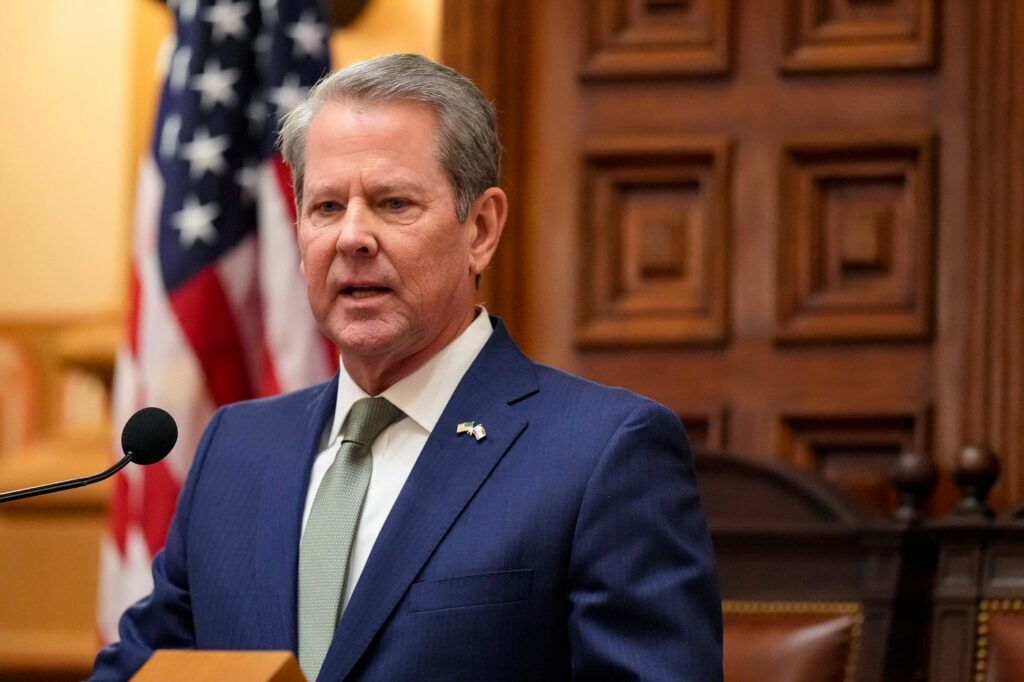
In Georgia, Republicans are set to convene for a special session aimed at redrawing voting districts, a move that critics argue could undermine the political power of Black and nonwhite voters. This session, called by outgoing Governor Brian Kemp, follows the U.S. Supreme Court's controversial ruling in the Louisiana v. Callais case, which targeted Louisiana's congressional map for being an illegal racial gerrymander. The state's General Assembly will convene on Wednesday, with an emphasis on creating new district maps for the 2028 elections, diverging from other Southern states that prioritized immediate changes for the November midterms.
Kemp's decision to seek the redistricting changes ahead of other Southern governors highlights the potential implications of the Callais ruling across states with significant Black populations and representation. Georgia is particularly symbolic in this context, as it hosts a statue of Rev. Martin Luther King Jr. within proximity to historic sites linked to the civil rights movements that led to the Voting Rights Act of 1965.
As of late Tuesday, both Kemp and Republican legislative leaders had not disclosed specific proposals for the redistricting, raising concerns among Democrats and activists who are planning daily protests during the special session. State Representative Tanya Miller expressed frustrations over the lack of transparency, emphasizing that the process of redistricting voters should be open and not conducted in secrecy.
Despite assurances from Governor Kemp to discuss redistricting on Wednesday, details on the drawing of new districts remain vague. House Speaker Pro Tem Jan Jones indicated that while she is in a leadership position regarding the committee overseeing the creation of new maps, she has not been privy to the map-making process. The situation underscores a broader uncertainty about who is actually responsible for the new district designs.
The Supreme Court's Callais ruling shifted the legal interpretation surrounding redistricting, suggesting that maps drawn with racial demographics in mind are discriminatory under the U.S. Constitution's equal protection clause. This decision has significant ramifications, particularly in Southern states where the intertwined nature of race and party affiliation has historically influenced legislative representation.
Georgia’s current political landscape reflects a complex demographic reality, with approximately one-third of state representatives being Black and nearly 40% identifying as nonwhite, mirroring the state's overall population trends. While the Callais ruling advocates for "race-neutral" districting, it raises questions regarding the feasibility of achieving genuinely neutral maps in a socio-political environment where race often correlates with party loyalty.
As Republicans aim to redraw these districts, they face the dual challenge of catering to their base while navigating demographic shifts among white suburban voters, many of whom are moving away from conservative ideologies. This may complicate their efforts, particularly in the competitive metro Atlanta region, where the potential for emerging battleground districts could put previously secure Republican seats at risk.
The ongoing redistricting effort in Georgia is a crucial part of a national narrative, where former President Donald Trump's calls for partisan redistricting in 2022 led various Republican-controlled states, including Texas, to act quickly in shaping congressional boundaries prior to the midterm elections. Democrats too have engaged in redistricting efforts, leading to a highly polarized political landscape in the lead-up to potential gains for one party or another.
Overall, the unfolding situation in Georgia highlights the complexities and contentiousness of redistricting, especially in a state marked by a deep legacy of racial and political struggle. The decisions made during this session could significantly influence Georgia's electoral future and serve as a bellwether for how redistricting battles will play out across the nation in the years to come.








