

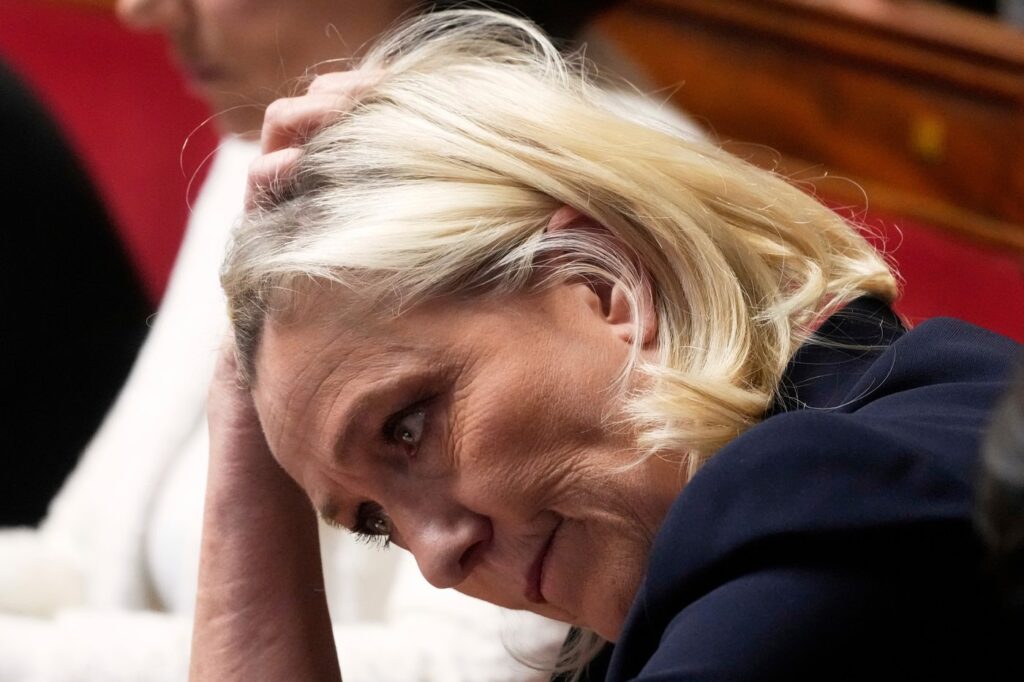
The Paris appeals court is poised to deliver a significant ruling on Marine Le Pen's embezzlement case, with the decision expected to impact her prospects in the upcoming presidential election. Le Pen, aged 57, is contesting a March 2025 conviction against her and other members of her National Rally party for misusing European Parliament funds intended for parliamentary assistants between 2004 and 2016.
The lower court suspended her prison sentence pending appeal and imposed a five-year ban on holding elected office. Le Pen, who continues to assert her innocence, aims to launch her fourth bid for the presidency. The outcome of the appeals court ruling could see her options dramatically shrink or reshape the political landscape in France's 2027 presidential election.
In a favorable scenario for Le Pen, the appeals court might acquit her of all charges. During the five-week appeal trial, she acknowledged that there had been "a mistake," asserting that some employees paid as EU parliamentary aides had performed work for her party, then known as the National Front. Le Pen maintained her belief that such practices were permissible and claimed she had never attempted to hide them, even criticizing European Parliament officials for not providing guidance on the legality of her party's hiring practices at the time.
Her lawyer, Rodolphe Bosselut, emphasized the gravity of the matter, stating that Le Pen has entrusted her entire future to the court's decision, posing the crucial question of whether her political career could continue or come to an end.
Another potential outcome involves the court finding Le Pen guilty but reducing the ban on holding elected office to two years or less, or possibly imposing no ban at all. Since the lower court's ruling took immediate effect, Le Pen has already been serving the ban since March 31 last year. A reduction in the ban to two years or less would allow her to participate in the first round of the French presidential election scheduled for April 2027. However, any prison sentence, electronic monitoring, or other judicial restrictions could significantly hinder her ability to conduct a nationwide campaign, leading her to express doubts about embarking on a presidential bid under such circumstances.
Le Pen conveyed her concerns in an interview, stating that if elected but restricted in her campaign activities, it would render a candidacy impractical, emphasizing her desire not to be dependent on judicial consent for holding campaign rallies or engaging with voters.
Conversely, prosecutors are seeking a heavy sentence for Le Pen, advocating for four years in prison, including three years suspended, along with a five-year ban on holding elected office. They alleged that she orchestrated a "system" to siphon off EU public funds to benefit her party. The appeals court has the authority to impose an immediate ban, similar to the lower court's ruling, irrespective of the prosecutors' requests. While Le Pen could appeal a stringent decision to the Court of Cassation, it remains uncertain whether the higher court would suspend her sentence during a final ruling. However, the Court of Cassation has indicated it would strive to issue a ruling before the 2027 presidential election.
Le Pen has stated she won't delay her decision-making regarding a presidential campaign. She articulated that waiting for resolution from the Court of Cassation takes away precious time needed for a substantial campaign, as France's presidential race is likely to ramp up in September and accelerate as early as next year. Candidates are also required to obtain endorsements from 500 elected officials to qualify for the ballot, complicating the substitution of a presidential nominee late in the race.
In light of these developments, Le Pen expressed concerns that if she were barred from running yet later cleared by the Court of Cassation, it could be too late for her to mount an effective campaign.








