

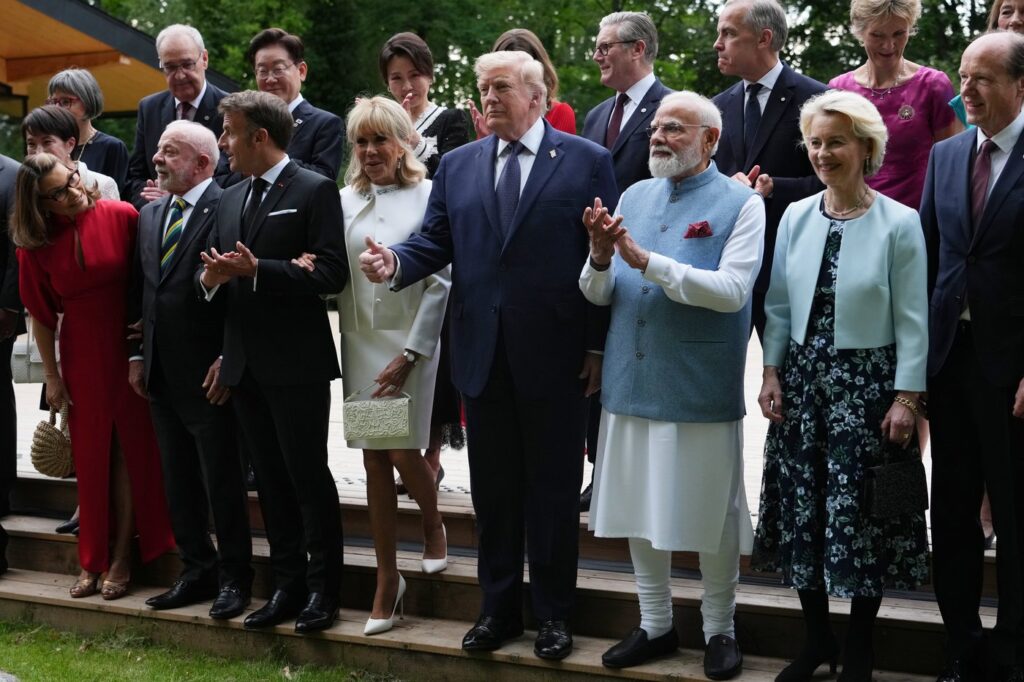
In Evian-les-Bains, France, U.S. President Donald Trump is concluding discussions with global leaders at the Group of Seven summit. During this summit, Trump has been promoting a tentative agreement with Iran, which he claims will prevent the Islamic Republic from developing nuclear weapons, despite lacking detailed specifics on its implementation.
On Wednesday, the formal talks among the leading industrial nations wrap up at a scenic lakeside resort in the French Alps. Sessions include discussions on the future of artificial intelligence and strategies to stimulate economic growth. Following these discussions, Trump is set to attend a lavish dinner at the Palace of Versailles near Paris before returning to Washington.
However, Trump faces considerable skepticism regarding the Iran agreement, complicated by the fact that neither the White House nor Iran has shared the text of the deal. He is under pressure from key ally Israel regarding the situation, particularly as Israel expresses concern over the implications of the agreement.
Trump praised the memorandum, which remains undisclosed, referring to it as a "great document." He emphasized that it guarantees Iran will never possess a nuclear weapon, stating, "It won’t have one to buy, to develop—it will not have a nuclear weapon. And I would say that’s about 99.9% of what I wanted." Despite this assurance, he continues to face doubt from members within his own party, who question whether the deal adequately curtails Iran's nuclear ambitions.
Confusion persists regarding the agreement's provisions as both U.S. and Iranian officials have presented different interpretations. Iranian Foreign Minister Abbas Araghchi remarked that Israel's ongoing occupation of southern Lebanon would breach the deal's conditions. He stated, "Without the withdrawal of Israeli forces from the territories they occupied during this war, the war has not fully come to an end." In contrast, Trump indicated that he does not believe Israeli actions against Hezbollah would necessarily jeopardize the agreement.
Trump's relationship with Indian Prime Minister Narendra Modi is also being tested amid the conflict in Iran. The two leaders are scheduled to meet during the summit, following a recent incident where three Indian sailors were killed in a U.S. military strike on a tanker in the Gulf of Oman. The Indian Foreign Ministry has officially protested this action, indicating the diplomatic strain caused by the ongoing Iran war.
Previously, Trump and Modi had a favorable rapport, but the dynamics have shifted, particularly due to the U.S. imposing tariffs on India over its reliance on inexpensive Russian oil. Additionally, the unfolding war has disrupted energy supplies vital to India, causing further concern in New Delhi about Trump's recent outreach to China for trade compromises, potentially undermining India’s competitiveness as a manufacturing partner.
Furthermore, Trump is expected to have one-on-one discussions with Egyptian President Abdel-Fattah el-Sissi during the summit, as three Middle Eastern leaders were invited by French President Emmanuel Macron to participate. Earlier discussions among the G7 leaders included el-Sissi, Qatar’s ruling emir, and the President of the United Arab Emirates, focusing on developing energy supply routes out of the Gulf, with Egypt potentially playing a key role.
Before the escalation of conflict in Iran, approximately one-fifth of the world's oil and natural gas transited through the strategically critical Strait of Hormuz, a route effectively closed off since hostilities began. French Foreign Ministry spokesperson Pascal Confavreux discussed ongoing discussions aimed at exploring alternative infrastructure and routes to bypass the Strait of Hormuz.
Macron has planned a special dinner for Trump at Versailles, celebrating America’s 250th anniversary next month. Trump expressed excitement over the invitation, noting the aesthetic appeal of the historic venue and its significance. He referred to Versailles as “the real deal,” appreciating the opportunity to extend his visit post-summit.








