

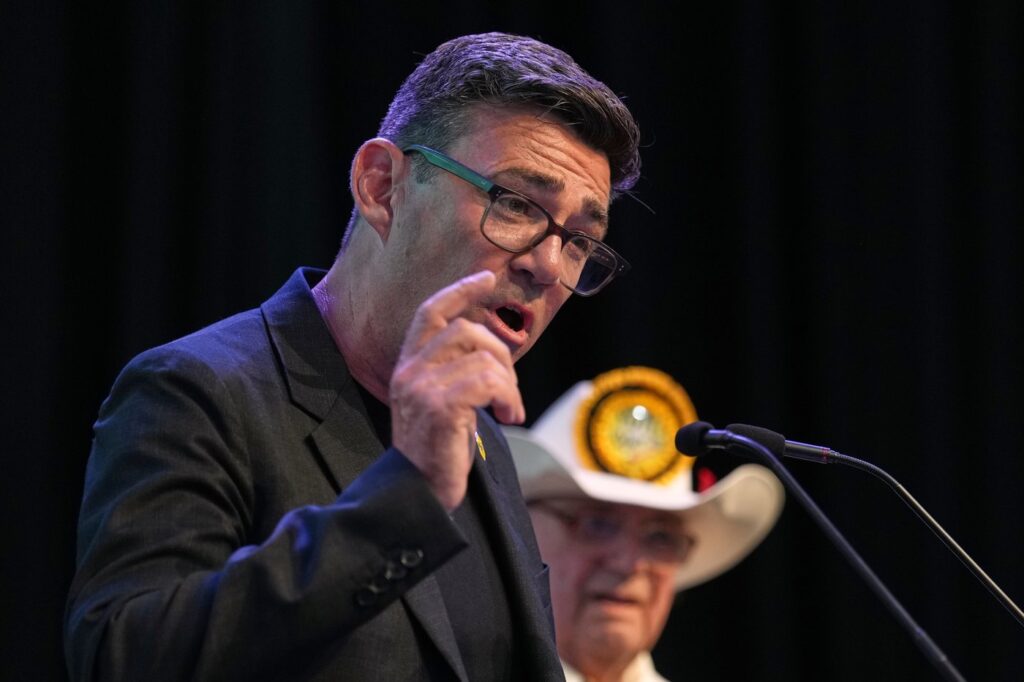
LONDON (AP) — Andy Burnham, a seasoned political figure with roots in the Labour Party, aspires to succeed as Britain's next prime minister. At 56 years old, Burnham crafts an image of a relatable northern figure, often opting for casual attire like T-shirts over traditional suits, and engaging in leisure activities such as playing soccer and participating in DJ battles with 1990s music.
Burnham's political journey has seen him transition from high-profile government roles to becoming the mayor of Greater Manchester, from where he now stands on the brink of pursuing the prime minister's office. His recent success in winning a seat in Parliament during a special election is perceived as a pivotal moment for U.K. politics amidst anticipated challenges to Prime Minister Keir Starmer.
Born and raised in northwest England, between Liverpool and Manchester, Burnham is the son of a British Telecom engineer and a receptionist. He joined the Labour Party at a young age, furthering his education at Cambridge University, and was first elected to Parliament in 2001. His political career spans over 15 years, during which he rose through the ranks alongside Prime Ministers Tony Blair and Gordon Brown, serving in Brown’s Cabinet from 2007 to 2010.
Despite two unsuccessful attempts at securing the leadership of the Labour Party in 2010 and 2015, Burnham pivoted to local politics, winning the mayoralty of Greater Manchester. His leadership earned him the nickname "King of the North," a title inspired by the popular series "Game of Thrones," reflecting both his advocacy for his region and his broader political aspirations. During the COVID-19 pandemic, he openly criticized Conservative Prime Minister Boris Johnson for what he perceived as a “London-centric” approach to crises impacting Northern England.
Since taking on the mayoral role in 2017, Burnham has overseen significant renewal in Greater Manchester, an area known as the birthplace of the Industrial Revolution. The city center has undergone rapid transformation, with many residents applauding his efforts to revitalize the area. His leadership has extended to taking control of the disparate public transport system, which he branded as the "Bee Network," significantly enhancing service delivery.
Burnham’s political stance places him to the left of Starmer, a fact that resonates positively with Labour Party members. His transformation from a somewhat stiff public speaker during his earlier leadership bids to a more relaxed figure in casual clothes has also garnered attention. His victories in three mayoral elections, coupled with a commanding win in the recent Makerfield by-election, where he decisively defeated a candidate from the anti-immigration party Reform UK, have solidified his reputation as an effective electoral campaigner.
He promotes a vision of "Manchesterism," advocating for a governance approach that prioritizes local communities and areas often overlooked by the central government in London. “What we’ve built in Greater Manchester needs to go national,” he stated during his campaign, expressing his belief in his capability to enact meaningful change on a larger scale.
However, political analysts remain skeptical about Burnham’s broader appeal, particularly outside northern England. Tim Bale, a professor of politics at Queen Mary, University of London, pointed out the challenge of transitioning from being “King of the North” to a figure widely accepted across the entire nation. Nonetheless, Bale acknowledges Burnham's potential to bridge the ideological divides that characterize the current political landscape in the U.K.
Critics of Burnham assert that his political proposals are often vague, particularly in addressing pressing questions, such as funding for his initiatives. They emphasize that governing a country with 70 million residents presents challenges that differ significantly from managing a city region of 3 million.
Despite these criticisms, Burnham’s ongoing momentum positions him as a plausible contender for 10 Downing Street. Bale remarks, “Andy Burnham is probably one of the most popular politicians in the country,” though he notes the relative lack of strong contenders in contemporary British politics.








